

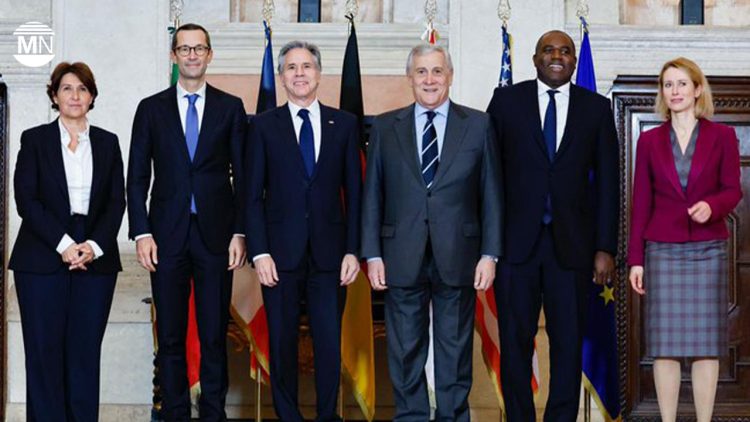
US Secretary of State Antony Blinken, continuing his diplomatic tour through South Korea, Japan, and France, arrived in Rome on 9 January for talks on Syria’s political future. The meeting comes at a critical juncture, with Turkey’s escalating threats of military action against Kurds in Syria intensifying regional tensions. Blinken and his European counterparts are steadfast in their commitment to ensuring long-term stability in Syria, particularly following the recent removal of Bashar al-Assad by Islamist-led forces.
“In Rome, I met with my counterparts from France, Italy, the UK, and Germany on helping the Syrian people seize this opportunity to build a better future,” Blinken said on his X account.
Ahead of the meeting with Blinken and their European counterparts, Italian Foreign Minister Antonio Tajani emphasised the importance of ensuring equal rights for all Syrians. His remarks highlighted concerns about the rights of religious minorities and women under Syria’s new de facto authorities, Hay’at Tahrir al-Sham (HTS), a group previously linked to al-Qaeda. He underscored the collective diplomatic effort, saying, “the Syrian people must be able to hope for a future of peace, stability and prosperity. Coordination and cohesion between our diplomacies are strategic elements to achieve this shared goal.”
Additionally, the international community remains focused on Syria’s human rights situation, particularly given the jihadist-terrorist ties of the new ruling faction. US State Department Spokesperson Matthew Miller urged all Syrian factions to uphold human rights, adhere to international law, and prevent Syria from becoming a threat to its neighbours or a haven for terrorism.
Syria’s diplomatic outreach
Since the end of Bashar al-Assad’s administration, a transitional government has been established with Mohammed al-Bashir as interim Prime Minister and Ahmed al-Sharaa (also known as Abu Mohammad al-Julani) as the de facto head of state until 1 March 2025. The transitional government claims it aims to maintain state functionality, stabilise the country by providing basic services to civilians, and prevent power struggles between armed groups over state resources and ministries.
Nevertheless, concerns persist regarding the transitional government, the future of the Kurds within Syria’s framework, and the looming fear of a hardline Islamist government replacing Assad’s regime. Recently, the Ministry of Education, rooted in Islamic Radical stances, announced potential changes to the school curriculum, including the removal of poems on women and love. The group has made it clear that it intends to impose Islamic law, though whether it will demonstrate flexibility and progress toward democracy remains uncertain.
On 20 December 2024, senior US diplomats met with Syria’s leader al-Sharaa in Damascus, marking the first official meeting between Washington and Syria’s new leadership. This diplomatic milestone led to the US dropping the $10 million reward for al-Sharaa’s arrest and easing certain restrictions for humanitarian transactions. The US Treasury has issued a six-month general license permitting specific transactions, including limited energy sales, while broader sanctions remain in place. This engagement signals a cautious yet significant shift in US-Syria relations as the future of Syria hangs in the balance.
The diplomatic engagement of German and French foreign ministers in Syria, including their meeting with Ahmad al-Sharaa, a former jihadist, reflects a new approach to the region’s complexities. As Donald Trump prepares for a second term in the White House, the Biden administration, and its foreign affairs ministry, is working closely with European partners to establish a stable Syrian framework. This effort aims to foster strategic cooperation with Kurdish forces, manage Turkey’s ongoing military operations in northeastern Syria (Rojava), and address the pressing challenge of Syrian refugee integration in Europe.
Kurdish issue in the new Syria
Concerns for the international community include Turkey’s threat to northeastern Syria and its ties to jihadist groups, including the ruling faction. The Syrian Democratic Forces (SDF), led by Kurds, have cooperated with the US in combating ISIS, but Turkey links them to the Kurdistan Workers’ Party (PKK). In Paris, Blinken acknowledged Turkey’s “legitimate concerns”, calling for the SDF’s gradual integration into a reformed national army, with foreign fighters removed. In this context, he stressed, “And in the meantime, what is profoundly not in the interest of everything positive we see happening in Syria would be a conflict. We’ll work very hard to make sure that that doesn’t happen.”
However, French President Emmanuel Macron said earlier this week that Paris would not abandon the SDF, which was one of a myriad of opposition forces during Syria’s 13-year-long civil war.
Addressing a news conference in Paris alongside outgoing US Secretary of State Antony Blinken, French Foreign Minister Jean-Noel Barrot, stated: “The Syrian Kurds must find their place in this political transition. We owe it to them because they were our brothers in arms against the Islamic State.” He added, “We will continue our efforts … to ensure that Turkey’s legitimate security concerns can be guaranteed, but also the security interests of (Syria’s) Kurds and their full rights to take part in the construction in the future of their country.”
Nevertheless, in a complex diplomatic standoff involving the United States, European nations, and Turkey, Turkish Foreign Minister Hakan Fidan has taken a firm stance against the Kurdish-led SDF. Fidan emphatically stated that there is no place for the SDF in Syria’s future political landscape.
Status of Syrian refugees in EU
The divergence in the approaches of European countries and the United States towards Syria likely stems, in part, from the issue of Syrian refugees in European nations. Since 8 December 2024, the UNHCR has reported that over 115,000 Syrians, primarily from Turkey, Jordan, and Lebanon, have returned to Syria. While EU host countries continue to offer protection, challenges are emerging. On 5 January 2025, Germany signalled a policy shift, suggesting that some Syrians may need to return if the protection they sought is no longer warranted, following the changing situation in Syria after the fall of Bashar al-Assad’s regime.
Germany’s Interior Minister Nancy Faeser has unveiled a four-point plan to reassess their status, which includes reviewing and potentially revoking protection for individuals no longer in need, while allowing well-integrated Syrians to remain. This policy shift is occurring as Germany approaches its national election, with migration emerging as a key issue.
On the other hand, Italy’s far-right government has launched an aggressive campaign to curb immigration, implementing stringent measures that reflect a broader shift in European politics. Since 2019, Italy has consistently allocated over 40 million Euro annually to support the Syrian population and refugees in neighbouring countries.
The financial strain on European countries, along with the challenges of integration, has driven them to focus on resolving Syria’s political issues and securing a better future for the region.
Syria’s path ahead
Italian Foreign Minister Tajani’s visit to Damascus, including discussions with his Syrian counterpart Al-Shibani, underscores the West’s strategy to bolster European security, ease financial strains, and maintain a balance of power in Syria to avert the crisis from reaching Europe.
Accordingly, the international community is likely to concentrate on guiding the HTS-led government in Damascus toward greater inclusivity in the coming months. Through diplomacy, humanitarian assistance, economic support, and conditional recognition based on concrete actions, the global community seeks to encourage HTS to establish a responsible and representative government.
At the heart of these efforts is the implementation of Resolution 2254, which outlines a framework for a Syrian-led government that represents all societal segments. Nonetheless, the international community remains cautious, given the ruling group’s jihadist roots and its close ties with NATO member Turkey, which could temper these efforts with measured scepticism.


