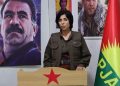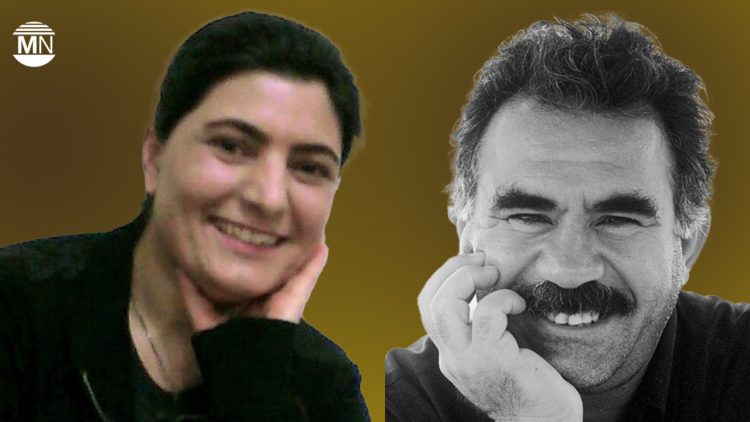
From inside Yazd Prison, Zeynab Jalalian, Iran’s longest-serving female political prisoner, has declared her unwavering support for the global campaign to free Kurdish leader Abdullah Öcalan, announcing her commitment in a letter on 4 January in support of Öcalan’s liberation.
Jalalian introduces herself as a political freedom-seeking woman who has been imprisoned for her ideas. “My thoughts are inspired by the intellectual paradigm of my leader, Abdullah Öcalan, who has been in inhumane captivity for 26 years because of his thoughts. I consider it my prime and moral duty to participate in the campaign launched for the physical freedom of my leader. I want freedom for this thinker,” she said.
"At a time when the Middle East and particularly Kurdistan faced relentless oppression — when the forces of resistance appeared to falter and the existence of the Kurdish people was denied — Abdullah Öcalan emerged as a beacon of hope. In northern Kurdistan, where the Turkish state pursued a policy of denial, assimilation and brutal violence against the Kurds, his ideas became the guiding light for those seeking freedom. His leadership transformed despair into a collective determination to resist tyranny, not only for the Kurdish people but for all the oppressed peoples of the region."
“Abdullah Öcalan’s lifelong struggle for justice reflects profound sacrifices—he gave up his personal freedom, family and conventional attachments to champion the rights of the oppressed,” Jalalian continued, referring to Öcalan’s theories. “Despite his imprisonment on Imrali Island in strict isolation, his ideas have transcended physical boundaries, inspiring movements worldwide. His philosophy of Democratic Confederalism offers a visionary framework for coexistence, justice and peace in a region plagued by division and authoritarianism.”
Jalalian highlights Öcalan’s efforts to develop a new political theory, advocating not only for Kurdish rights but also for the peaceful coexistence of all peoples in the Middle East, and refers to the “international conspiracy of 1999” that led to Öcalan’s abduction. “Through this democratic system, the people of the region will be able to achieve their rights and achieve a peaceful coexistence. Through this system, the interests of the governments would be endangered, and this is why the fascist government of Turkey, on behalf of all nation-states, has increased its pressure against the free-thinking leader Abdullah Öcalan.”
Enduring 17 years of imprisonment under harsh conditions, Jalalian has been persecuted for her advocacy for her own rights and the rights of her people. Despite her ordeal, she continues to champion the cause of justice and freedom, expressing solidarity with the campaign for Öcalan’s liberation and an end to the prison isolation system. “If we break the isolation imposed on our leader in Imrali, all the prisons will be destroyed as well,” she said. “We will break it. In this way, we women will be the scouts in breaking the prison system.”
"I call upon women and youth, intellectuals, academics, artists, legal professionals, environmentalists, feminists, and all freedom-loving people in Iran and beyond to join the campaign for Abdullah Öcalan’s freedom. His release is essential not only for the Kurdish people but for the advancement of justice, equality, and democracy across the region. Supporting his liberation is an act of defiance against patriarchy and authoritarianism, a vital step toward building a society where freedom and dignity are universal rights."
Jalalian also highlights the state’s attempts to silence the essence of the slogan ‘Jin, Jiyan, Azadi’ (Woman, Life, Freedom) in Iran, emphasising its connection to Öcalan’s ideas. She explains that the philosophy behind the slogan, rooted in the liberation of women, transcends geographic and cultural boundaries. “It resonates deeply with the struggles of women and marginalised peoples worldwide,” she states, adding that in Iran, the slogan has become a rallying cry for a transformative movement advocating fundamental change.
In conclusion, Jalalian urges collective action, stating, “Let us fulfill our shared human responsibility by standing in solidarity with this campaign. Abdullah Öcalan’s freedom is not merely his own; it symbolises the freedom of all who aspire to a just and equitable world.”
Who is Zaynab Jalalian?
Jalalian, a Kurdish women’s activist from Maku city in Iranian Kurdistan (Rojhilat), joined the Kurdistan Workers’ Party (PKK) in 1999 and became a member of the women’s wing of the Kurdistan Free Life Party (PJAK) in 2005. In March 2008, she was arrested near Kermanshah in Iranian Kurdistan, and was subjected to severe physical and psychological torture during her detention.
Jalalian’s initial death sentence for “enmity against God” (moharebeh) was later commuted to life imprisonment. She is the longest-serving female political prisoner in Iran, currently in her 17th year of incarceration.
Throughout her imprisonment, Jalalian has been denied medical care and proper treatment for various health issues, including eye disease, kidney problems and gastrointestinal ailments. She has been transferred multiple times between different prisons, including Khoi, Qarchak, Varamin and Evin prisons in Tehran, Kerman, Kermanshah, and currently Yazd, and has never been allowed leave.
Human rights organisations, including Amnesty International and the UN Working Group on Arbitrary Detention, have repeatedly called for her immediate release, citing her detention as arbitrary and the result of an unfair trial. Despite these appeals, Jalalian continues to face harsh conditions and medical neglect in Yazd prison.