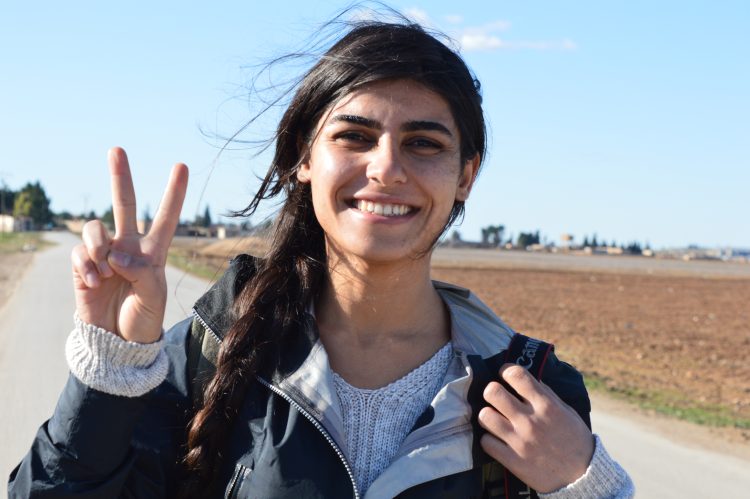
Kurdish journalist Cîhan Bilgin, known for her tenacity and courage, was killed in a Turkish drone strike on 19 December, alongside her colleague Nazım Daştan. The two were travelling through the Sirrin district, near Kobani (Kobanê) in northeast Syria, when the attack occurred. The strike targeted the journalists as they documented critical developments in the region, where tensions between Kurdish forces and Turkish operations have been escalating.
Bilgin’s final reflections, published in full below, were recorded shortly before she was killed, offering a poignant insight into her dedication to journalism and the pursuit of truth. “The fighters here warned us, saying, ‘They will specifically target you.’ But can my friend Nazım and I stay in one place and turn a blind eye to the distortion of the truth? I don’t think so!” she wrote.
Her last words, composed just 20 minutes before the strike, encapsulate a life driven by conscience and an unwavering belief in the power of journalism. “I am here because my conscience could not accept what I saw with my own eyes,” she declared.
Bilgin had a deep connection to the region, having reported from liberated areas such as Qara Quzaq (Qere Qozaq), Tishreen, and Ayn Issa (Bozanê). She described how she shared in the joy of women freed from the Islamic State (ISIS) oppression, drinking tea with strangers and weaving their stories into her work. “I should be there if it was just for an old memory of a cup of coffee,” she wrote, illustrating the personal ties that informed her reporting.
Despite warnings from colleagues about the risks, Bilgin refused to stay away from the frontlines. “I am a war correspondent, and I have to follow developments on the spot,” she insisted. Her commitment was rooted in a desire to counter misinformation and bring clarity to a region plagued by conflicting narratives.
Bilgin’s account highlighted her empathy for the fighters and families caught in the conflict. “I see the eagerness to win in the young resistance fighters here… maybe in an hour they will be gone. But their determination is reflected in their eyes,” she observed.
Her reflections also touched on personal struggles, including the targeting of her family by Turkish authorities. “They took my father to a place he didn’t know. He protested, saying, ‘You know where Cîhan is, she is reporting, why are you putting pressure on us?’” Despite these challenges, Bilgin remained steadfast: “No matter what they do, I will not turn back from my path.”
In her final hours, Bilgin expressed hope for a brighter future for the Kurdish people, citing ongoing discussions involving Kurdish leader Abdullah Öcalan. “Somehow the leader will find a way to overcome all the obstacles,” she wrote, conveying her belief in the power of political solutions.
Bilgin’s last words underscore her unrelenting optimism and belief in her mission. “When you choose the path, you have to walk it at your own risk. The way is us, and we are the way,” she concluded, moments before embarking on the journey that would claim her life.
The deaths of Bilgin and Daştan have drawn widespread condemnation from press freedom advocates and Kurdish organisations. Local sources accuse Turkey of deliberately targeting journalists to suppress coverage of military operations in the region. Ankara has not commented on the strike.
Bilgin’s life and work leave behind a legacy of courage and an unwavering commitment to truth. Her story has galvanised calls for greater protection of journalists in conflict zones and brought renewed attention to the dangers faced by reporters in northeast Syria.
Below we share our translation of Cîhan Bilgin’s notes, written in the hours and minutes before she was killed:
Today, the Turkish state is again attempting psychological warfare by sharing fake news and spreading word that the Tishreen Dam is in their hands. Nazim and I are in Qara Quzaq [Qere Qozaq] now. There is a lot of drone movement at the moment. The fighters here are saying that when there is drone movement, it’s not safe for us to move a lot. They warned us, saying: “It’s true, you’re journalists, but at the end of the day, the reports that you write unmask them. They will specifically target you, if only for this. So don’t move about. Just three days ago, 12 women and children were killed in Ayn Issa [Bozanê], why should they not shoot at you?” But can my friend Nazim and I stay in one place and turn a blind eye to the distortion of the truth? I don’t think so!
Yes, Nazim said to the fighters, ‘You’re right, we have to be careful’, but it was clear from that modest and shy a smile that revealed his beautiful dimples that he thought, ‘we can’t stay in one place’. As for me, it is already clear how I approach the situation! I am here working as a journalist because my conscience could not accept what I saw with my own eyes. Otherwise, I could have completed the course I started at Dicle University and become a lawyer. I could have built my life on the opportunities that brought, and accepted an ordinary and mediocre life. But I did not accept this. I am here because I was willing to pay whatever the price for myself and for the enlightenment of society. So I have to go and write my reports even if there are drones and even if they shoot at me. In a way, this was like the meaning of my life.
IF A PRICE MUST BE PAID FOR FREEDOM…
My friends at the agency did not want me to go to Manbij [Minbic] because they thought it was risky. But I am a war correspondent and I have to follow the developments at the time and on the spot. Or how would I be different from those who sit at their desks and produce fake news, or false reporters who write fiction to make news reports with the security of a convoy of dozens of vehicles? And I know the land and the peoples of Manbij, Qara Quzaq, Tishreen and Ayn İssa. When these places were liberated, I shared the joy of the women there, I felt deeply the excitement of attaining freedom in their eyes. I was filled with the memories of women who saw me as their sister and told me about the cruelty inflicted on them by ISIS fighters. I drank the tea and coffee of people I did not know, I became a part of their stories and added their great tales to my own story. Even leaving all this aside, I said I should be there if it was just for an old memory of a cup of coffee, and I came here.
And I see the eagerness to win in the young resistance fighters here. All of them have a sparkle in their eyes. Maybe in an hour they will be gone, maybe nothing will happen to them. I cannot know… But reflected in their eyes at that moment were the excited, enthusiastic and determined actions of heroes willing to die for the sake of the life they want to build. Did the stance of these people not make me write ‘freedom can’t be achieved without a price’, just last night! If a price must be paid for freedom, I to should continue my work by taking this risk. So, I said, I should go to Tishreen, and I set off.
I am in Tishreen. Everyone is focussing on Tishreen now. They are making so much fake news they will almost persuade everyone to believe them! I will broadcast live from here now and the scales will fall from their eyes. I will breach the barrier to sprinkle cool water on the hearts of the mothers. Right there on that barrier where Turkey and its gangs are writing their fake stories of heroism, I will reveal the truth bit by bit in a live broadcast. I am sure the sparkle in the eyes of the fighters will increase still more when they see me speaking from here. And the mothers of those fighters will feel the pride of having fed their children with halal milk. I have make this happen.
I WILL NOT TURN BACK
I wonder if my mother will watch me when I broadcast? For some reason, I keep thinking of my mother today. The last time we spoke she was very unhappy. The MIT [Turkish Intelligence Agency] went and threatened them again. What do they want from these poor people? They took my father to a place he didn’t know. He protested, saying, ‘You know where Cîhan is, she is reporting, why are you putting pressure on us?’, but he still suffered his share of the oppressor’s cruelty. They then showered him with threats and terrorised him before letting him go. I just said, ‘No matter what they do, I will not turn back from my path’.
For a woman, her hair is her everything. I have not been able to wash and comb my hair due to the lack of facilities. There have not been many opportunities since I came here. My mother used to comb my hair so well. She used to comb my hair with the scent of roses, saying, ‘My Cîhan [My world], the light of my two eyes, my daughter, piece of my heart, my life’. She would say, ‘Today I will make my beautiful daughter her favourite dish, stuffed meatballs. Indeed, how well my mother used to make kutilk. I haven’t eaten my mother’s beautiful, steaming hot meals that she cooked with such care since 2017. On my way back from school, I used to know which meal she was cooking even out on the street. How I miss her and her meals! I didn’t get the chance to eat at noon because of work, so that’s probably why I’m thinking about these things.
We have already broadcast from Tishreen and finished our work here. I have also promised to go on a live broadcast on the television this evening. Friends here are insistent and say ‘we won’t let you go’, because there is a lot of drone movement, but we have to go. We are journalists! We will do our job despite all the dangers. We don’t need to take a long way round to get there. It might be riskier, but we will reach Qara Quzaq quicker by taking a shortcut.
So what if something happens! There was one thing I always knew and believed in, and it always made me happy. I really am a good person at heart. And I have shown this goodness in every moment of my life. I have never withheld goodness and beauty from anyone. Because I am like this, I have always been able to give lots of love to everyone with a smiling face. Because I loved being good, doing good, and of course, smiling!
There is something else that has been making me happy these days. The fact that there are talks with the leader [Abdullah Öcalan]! It is said that these talks will continue. Somehow the leader will find a way to overcome all the obstacles and improve the situation of the Kurdish people. So when my friends asked me on my arrival what is going to happen, I said, ‘I feel that very good things will happen for the Kurdish people.’ I have come to believe this in the deepest depths of my heart. Yes, there are attacks at the moment, but the leader has the power to solve all problems with his political and intellectual knowledge.
It is three o’clock in the afternoon… If we stay here any longer we will be late. Nazim has finished his work too. We must find a way to go despite the obstacles. When you choose the path, you have to walk it at your own risk. The way is us, and we are the way! We will go, and there will always be those coming after us. Maybe there will be obstacles before us that we cannot overcome, but when there is a way, there are those who walk and reach their destinations. As our poet said, there will be beautiful and bright tomorrows with or without us!
Cîhan Bilgin (1996 – 2024)