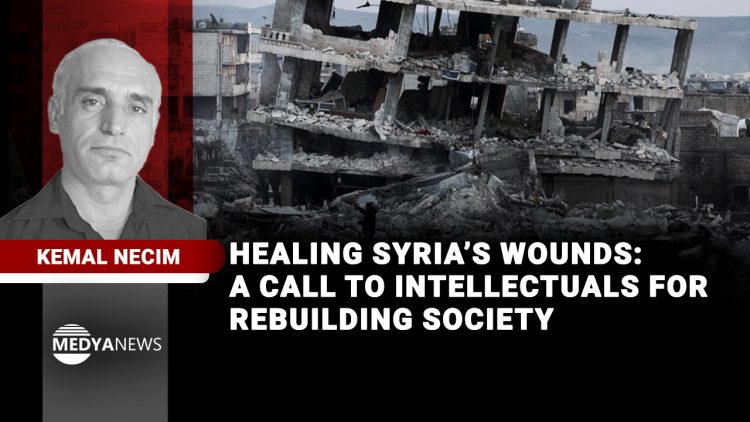
Kemal Necim
In internal wars, not only are villages and cities destroyed, not only are the infrastructures of countries demolished, and not only are people killed, but also memory, faith, meaning, and emotions are shattered. For this reason, the processes that follow the end of wars are often more challenging than the war itself.
The lingering devastation of war
Currently, in Syria, a situation like this is unfolding. After a brutal war that lasted over 10 years, leaving most of the country in ruins, hundreds of thousands killed, imprisoned, and displaced, the war appears to have halted. Yet, it has left behind immense devastation in the minds, memories, and consciousness of the people. This devastation is so profound that it will impact the lives of the people in this land for years to come.
It is known that this movement initially began as a revolution for freedom but later transformed into a difficult internal war due to external interventions. As the war turned inward, every individual in the country became an enemy to someone else, and everyone was left with a blood feud. If this fire of war does not extinguish itself in the minds and memories of the people, and if efforts are not made to put it out, the country will head towards a much larger catastrophe.
In this context and this critical historical phase, the responsibility now falls on the shoulders of the wise, intellectuals, scholars, and thinkers of the country who can tend to these wounds and prevent further animosity, hatred, opposition, and revenge. Instead, they must foster forgiveness, coexistence, and unity for a shared life.
The Ba’ath regime ruled this country for years with repression, dictatorship, and centralisation. Due to this situation, which completely blocked the path to freedom, values such as citizenship and equality among the country’s communities were systematically eroded. This repression affected all segments of society, including intellectuals and thinkers.
Intellectuals’ role in rebuilding society
However, now, following the collapse of the regime, many intellectuals and artists are emerging and declaring that they represent a new era, standing in opposition to the old regime. In this process, if an intellectual may rise and say, “I too stood against the regime; I too was an advocate for equality and justice,” it sounds like nonsense, yet these efforts alone bring no benefit to the wounded Syrian society.
What must now be done is for the country’s intellectuals to reconnect with their essence, acknowledge the responsibility that falls on their shoulders, and take up the task of reconstructing the values of citizenship, forgiveness, and coexistence. They must become a force for rebuilding the social fabric that has been deeply scarred.
A significant attack is underway against the Syrian people. Certain sides aim to sow seeds of hatred, animosity, and opposition among the people, fragmenting communities, groups, institutions, and beliefs to escalate conflict. In response to these attempts, the intellectuals, thinkers, and bright minds of the country must recognise the threat posed by these forces and fulfil their responsibilities accordingly. The role of intellectuals is twofold: one aspect is to guide the political leadership of this country to prevent the return of memories and doctrines of centralisation and the suppression of basic citizen rights, which could drag the nation back into an era of repression and tyranny.
Another aspect is to turn towards society, addressing the pain, suffering, and illnesses that have arisen as a result of the war, tending to these issues, and promoting values of citizenship, coexistence, forgiveness, and solidarity.
Kemal Necim is a Kurdish writer and poet. He was born in 1969 in the city of Derik in northeast Syria. He has published six books of poetry and prose.