

Selahattin Erdem
The capitalist modernity system—namely the US, UK, and Israel, or NATO—continues to use Turkish President Recep Tayyip Erdoğan as a tool. Following the elections of 24–28 May 2023, he was utilised first during the initiation of the Gaza War on 7 October 2023, then to encourage Hezbollah’s attacks on Israel, and most recently in efforts to bring down the Baath regime in Syria.
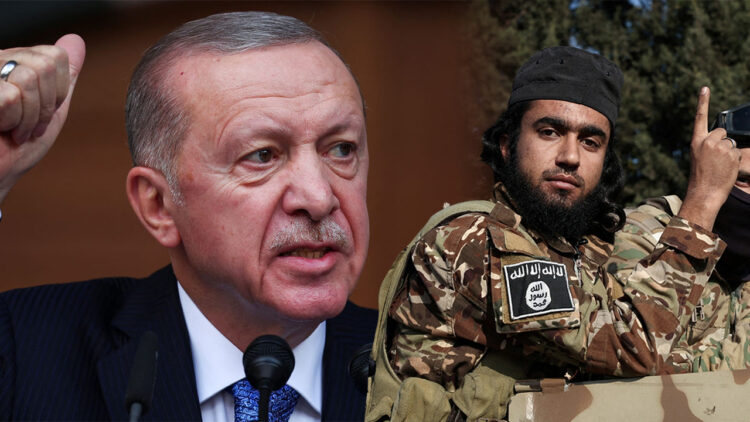
Over the past year, few could have imagined that after the supposed verbal sparring between Erdoğan and Israel during the Gaza War, a joint operation in Syria involving Erdoğan’s administration and Israel would take place. Initially, when the Hay’at Tahrir al-Sham (HTS) and the Syrian National Army (SNA) forces launched an offensive from Idlib towards Aleppo (Heleb), it was unclear who was behind the attack. Some could not discern this at all, attributing it solely to Erdoğan’s administration and reporting only what they observed.
Indeed, it was Erdoğan’s administration that mobilised forces in Syria, just as it did in Gaza and Lebanon. HTS and SNA’s coordinated assaults were reportedly orchestrated by Erdoğan’s administration and Turkish generals. At least, this was the visible picture perceived by those without deep political insight. Ultimately, the operations that toppled the Baath regime and led to the slaughter of communities in North and East Syria were managed by Erdoğan’s administration and Turkey’s special warfare apparatus, achieving a military success in Syria. Now, they seek to celebrate this so-called victory and use it to prevent the collapse of the Justice and Development Party (AKP) and Nationalist Movement Party (MHP) regime.
Earlier reflections and insights by Selahattin Erdem
Aleppo war and Syria’s future: A battle of geopolitical realignments and a hope for democratic confederalismErdem: A new era of political debate on the Kurdish question
However, as time passed, it became increasingly clear that the Syrian plan was, in fact, a NATO initiative developed and implemented by the US, UK, and Israel, with Erdoğan’s administration as a pawn. It has emerged that HTS was bolstered primarily by the UK and Saudi Arabia. The process initiated in Gaza on 7 October 2023 has continued in Syria, revealing that the larger conflict, referred to as the Third World War, which began with Iraq and Kuwait on 2 August 1990, has now centred on Syria.
It is evident that the US-UK-Israel partnership is executing its “New World Order” strategy from the 1990s and progressing its new energy corridor project spanning India, Israel, Cyprus, and Greece. Overcoming obstacles, whether through massacres or deceitful methods, they aim to open the region to greater capital mobility and profit, using figures like Erdoğan as provocateurs.

Now, it is clear that the focus has shifted to Syria, with sixty years of Baath rule in the country brought to an end. The fifty-year Assad regime has been overthrown. Following the downfall of Iraq’s Baath regime, Syria has become the next target in dismantling single-party nation-state systems in the Middle East. Statues of the unitary state have been symbolically toppled. US policies under Trump, implemented after his election on 6 November, played a pivotal role here. The US brokered an agreement with Russia to withdraw its support for Assad in Syria, and Iran’s influence, already weakened in Lebanon and Syria, further diminished. The rapid fall of Damascus by HTS and SNA forces under Erdoğan’s command was a result of this dynamic.
Attention now turns to Iraq, with speculation that anti-US-UK-Israel forces in the region will also be suppressed. The US has been repositioning its military presence in the region to prepare for such an eventuality. Similar adjustments and arrangements in Iraq seem likely under this broader plan.
Who will be the next target? For some time, many have speculated that Iran is the next focus. While not entirely incorrect, this perspective is narrow and insufficient. The US-UK-Israel alliance’s pressure on Iran began with the assassination of Qâsem Soleymâni/Qassem Soleimani and has since escalated through attacks stretching from Hezbollah and Syria to Iraq. These efforts aim to isolate and weaken Iran, ultimately subjugating its regime.
These developments indicate that global monopolistic capitalist systems seek to dismantle the entrenched nation-state structures in the Middle East, facilitating the free flow of capital and boosting profits. The unitary nation-state models established after World War I are being reconfigured, and Iran, as a key regional state, is at a crossroads: either adopt a democratic modernity revolution and become an alternative system, or fully capitulate to capitalist modernity. There appears to be no third option for Iran.

Is Iran the only country in this precarious position? Are these attacks solely aimed at Iran? Clearly not. Alongside Iran, Turkey stands as a major target. Turkey played a pioneering role in establishing the single-party nation-state frameworks in the Middle East following World War I. Arab nationalism, exemplified by Nasserism and Baathism, was derivative of Kemalist Turkish nationalism. Over the last century, Turkey has left its mark on the region’s rigid nation-state structures, making it the primary representative of this status quo. As such, transnational capitalist attacks are as much aimed at Turkey as at Syria, Iraq, or Iran.
Moreover, wars in Gaza, Lebanon, Syria, and Iraq may dismantle the old system, but they are insufficient to establish a new one. Even Iran lacks the capacity to create a comprehensive regional system. If a new order is to be built, it must begin with Turkey. As long as Turkey’s ethnonationalist, fascist unitary state persists, a new system in the Middle East cannot emerge. Consequently, Turkey is becoming an increasingly central target. As noted before, the ultimate clash may well erupt in Cyprus.
Given all this, is Erdoğan’s success in Syria truly a victory or a defeat? This question is critical, and many have begun asking it. As these discussions grow, the broader implications of Syria’s developments for Turkey will become clearer. While Erdoğan has achieved a military victory in Syria and may use it to mask the failure of his policies and stall his regime’s collapse, this is not a victory for Turkey. Erdoğan’s triumph is a Pyrrhic* one—an illusion of success that conceals inevitable failure.

The unitary nation-state system has left Turkey at an impasse. Neither Kurds nor other communities in Turkey accept this structure, nor do international systems. The century-old Turkish state must change, and this change is inevitable. Let us hope that this transformation favours freedom and democracy, empowering Kurds, peoples, and women, rather than allowing capital to deepen oppression and exploitation.
*A Pyrrhic victory refers to a win that comes at such a great cost that it is tantamount to a defeat, originating from King Pyrrhus of Epirus, who suffered devastating losses despite defeating the Romans in 280 BC.


