

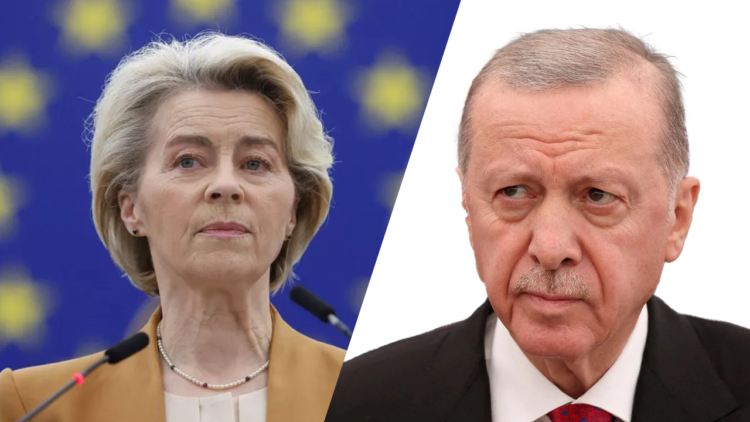
European Commission President Ursula von der Leyen and Turkish President Recep Tayyip Erdoğan convened in Ankara on Tuesday, with Syria’s fragile security and EU-Turkey relations dominating the agenda. The talks come amid growing international concern that Turkey is preparing a large-scale military incursion in North and East Syria, the Kurdish-administered region known as Rojava, with reports of troops amassing on the border.
Erdoğan, in his remarks, doubled down on Turkey’s position regarding Kurdish forces. “Turkey will not allow the Kurdistan Workers’ Party (PKK) and its affiliates to thrive,” he stated, referring to Kurdish-led groups in northern Syria. “We are the only NATO ally to defeat both the Islamic State (ISIS) and PKK on the ground. The region’s future holds no place for terrorist organisations.” Erdoğan’s language mirrors past rhetoric that preceded military incursions into Kurdish regions, fuelling fears of a new occupation.
Von der Leyen, while avoiding direct mention of Turkey’s military ambitions, underscored Europe’s commitment to stability in Syria. “Syria’s territorial integrity and national unity must be respected,” she said. “Minorities must be protected, and all Syrians, regardless of their background, must feel safe.” She added that Europe would increase its humanitarian aid to the region, focusing on essential recovery efforts such as infrastructure and basic services.
The EU’s stance on Kurdish groups remains cautious, as Turkey classifies key actors in Rojava, particularly the Syrian Democratic Forces (SDF) and its Kurdish backbone, the People’s Defence Units (YPG), as terrorist organisations. However, these groups have been pivotal allies of the international coalition against the ISIS.
Erdoğan criticised what he called international “double standards” on terrorism. “We expect our partners to support our fight against all terrorist groups equally,” he said, signalling frustration at EU sympathy for Kurdish-led forces. His remarks come amid reports of increased Turkish military activity along the Syrian border and intensified drone strikes targeting Kurdish leadership in Rojava.
Beyond Syria, Erdoğan and von der Leyen discussed broader EU-Turkey relations. While Erdoğan pushed for updates to the Customs Union and progress on visa liberalisation, von der Leyen announced an additional €1 billion in EU support for refugees in Turkey in 2024. “We stand by Turkey in its efforts to host millions of Syrian refugees,” she said, adding that humanitarian conditions for refugees must ensure “safe, voluntary, and dignified” returns.
The talks come at a precarious moment for the region. Turkey has launched multiple cross-border operations into Syria since 2016, claiming security concerns, while displacing thousands of civilians in Kurdish regions. International observers warn that a new military offensive could destabilise the area further and exacerbate the humanitarian crisis.
Von der Leyen reaffirmed Europe’s focus on diplomacy and recovery: “The fall of the Assad regime offers hope to the Syrian people. But all efforts must prioritise peace and stability.” Her words reflect the EU’s delicate balancing act as it seeks to maintain cooperation with Turkey while addressing its concerns over Kurdish autonomy and human rights.
The meeting sets the stage for further discussions at the upcoming EU summit, where Turkey’s policies in Syria and its relations with the EU are expected to take centre stage. Kurdish officials in Rojava have already called on the international community to prevent further Turkish incursions, warning of renewed displacement and conflict.
‘We can see Turkish forces amassing, stop the invasion’: Kurdish official warns Trump


