The 29th UN Climate Change Conference finally ended on Sunday after over 13 days. The outcome was paltry, with funding for climate vulnerable countries reaching less than a quarter of what is believed to be needed. Many protests took place, highlighting the injustice of insufficient funding, the greenwashing of fossil fuel companies and Azerbaijan’s human rights abuses in the Artsakh (Nagorno-Karabakh) region.
Azerbaijan hosted this year’s Conference of Parties (COP) of the UN Framework Convention on Climate Change (UNFCCC). The conference, held in the country’s capital Baku, brought together the 198 Parties of the UNFCCC. At last year’s COP28, held in the United Arab Emirates (UAE), the UAE Just Transition Programme was agreed, defining financial commitments. The commitment to fossil fuel divestment was also renewed, despite opposition from some developing countries.
A conference out of step with the times
This year’s COP29 in Azerbaijan was marked by the obstructed discussion on the mitigation [fossil fuel divestment] commitment and the paltry final financing of $300 billion for climate action to help mitigate and adapt to the effects of climate change in the world’s poorest countries. Indeed, the effects of climate change are already visible in most parts of the world, with most regions, such as the Middle East, affected by rising temperatures and changes in weather and regional ecosystems.
UN Secretary-General António Guterres, speaking at the conference, called for the need for international cooperation centred on the Paris Agreement, which was signed at COP21 in Paris, committing signatory countries to act to limit climate change. “Do not forget what is at stake,” he said, referring to the devastating effects of climate change.
Other UN delegates explained that it is difficult to find financing because of questions such as who will bear the costs of the transition, who will reap the benefits, and what steps are needed to implement the measures.
In fact, COP29 faced several difficulties, not the least of which was the obstacles posed by the richest countries’ delegates, who refused until the last days to say exactly how much money they would put into financing the climate fund.
“We are so frustrated to see that developed countries have offered a figure of $250 billion a year, when they know very well that the needs are in the trillions of dollars, and the demands of developing countries are $1.3 trillion a year,” said Harjeet Singh, director at the Fossil Fuel Treaty Initiative on Saturday, before the figure was raised to the still woefully inadequate $300bn.
Lack of will and deliberate stalling
But the economist Amar Bhattacharya, Co-Chair member of the Independent High-Level Expert Group on Climate Finance at the London School of Economics and Political Science, said that in fact the money could be raised if the political will were there. “Is it feasible? The answer is absolutely yes. Is it politically challenging? The answer is also yes. But I do believe it can be done,” argues Bhattacharya, a senior fellow at the Brookings Institution. In his view, a mix of public, private and other financial sources could easily raise the $1 trillion needed.
Activists from international NGOs and political groups made their voices heard at COP29. Joseph Sikulu of the NGO 350.org made it clear that rich countries must stop exploiting and stealing from the poorest countries while stalling climate negotiations.
“This is a shameful failure of leadership. The top-down, take-it-or-leave-it approach of the COP29 Presidency has sidelined progressive voices,” said UNFCCC observer Safa’ Al Jayoussi.
Azerbaijan’s human rights abuses and greenwashing
Armenian activists strongly protested against the COP29 host Azerbaijan, accusing it of greenwashing its attacks on indigenous Armenians in the region of Artsakh (Nagorno-Karabakh). “How is it possible to talk about climate finance while looting the property of indigenous people and destroying their homes?” asks Armenian activist Arshak Makichyan, talking to Medya News. “The most important question is not only how much money the colonial powers will give back to the Global South, but where this money comes from,” he said.
Armenian activists also tweeted that the Zangezur trade corridor, from Azerbaijan to Nakhitchevan and then Turkey, will only be reopened when Ankara and Baku agree to it, despite it passing through the Armenian region of Syunik.
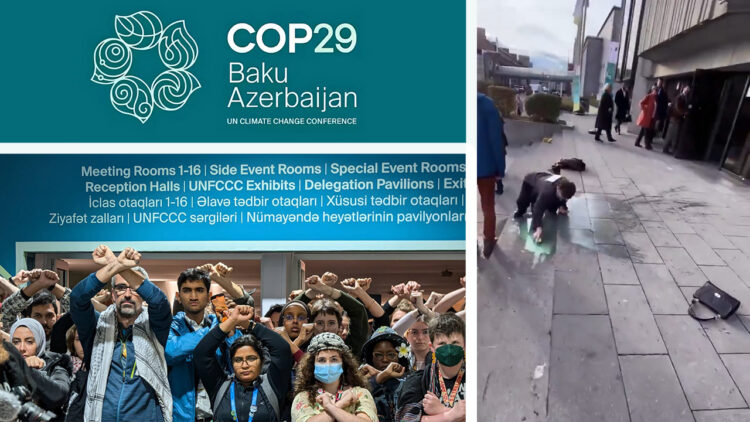
An artistic protest action took place outside the COP29 buildings, in which activists accused fossil fuel companies such as SNAM, Total, RWE and Siemens of greenwashing by engaging in investments that fuel colonial policies under the guise of green investments.
COP29 host Azerbaijan ‘greenwashes genocidal acts against Armenians’