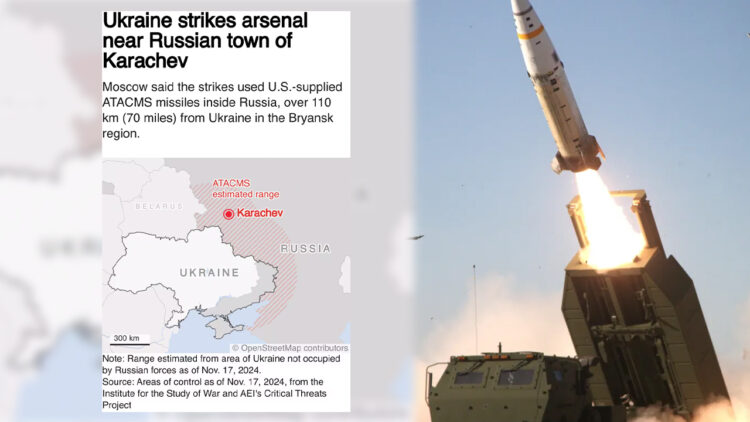
European military officials are rushing to prepare for potential conflict escalation after Ukraine’s first US-approved ATACMS strike on Russian territory prompted Moscow to deploy a new intermediate-range ballistic missile, marking a significant escalation in military capabilities.
“Russia has begun preparing its war,” warned Lieutenant Colonel Jörn Plischke of Germany’s Hamburg state command, citing Russia’s superior military production: “Russia currently produces 25 battle tanks per month, Germany three per year.” This statement came as Putin expanded Russia’s nuclear doctrine following Ukraine’s unprecedented missile strike.
Nordic countries have intensified civil defence measures, with Sweden distributing war preparation pamphlets while Finland and Denmark advise citizens on essential supplies. Germany’s classified ‘Operation Plan Germany‘ focuses on infrastructure protection, preparing to potentially host hundreds of thousands of NATO troops.
The Pentagon confirmed Russia’s new missile deployment was based on the RS-26 Rubezh design, with spokesperson Sabrina Singh noting: “It could be refitted to certainly carry different types of conventional or nuclear warheads.” Putin characterized the launch as a direct response to Ukraine’s recent long-range strikes using Western weapons.
Hamburg’s Mayor Tschentscher acknowledged growing vulnerabilities: “In case of military use of our infrastructure, the risk of cyberattacks and sabotage will increase significantly.” The city has created over 40 new positions for crisis management, while Swedish officials urge citizens to “mentally prepare for war”.
European nations are conducting military exercises, with Germany’s ‘Red Storm Alpha’ focusing on port protection. However, critics highlight the stark disparity between Russian and European military production capabilities as Washington and Moscow exchange warnings over missile deployments.
Emergency legislation across European countries could allow governments to implement wartime measures, including food rationing and mandatory work assignments in essential sectors, reflecting growing concerns about the conflict’s potential spread beyond Ukraine’s borders.
The escalation comes amid complex US political dynamics, with President Biden’s authorisation for Ukraine to use ATACMS inside Russia potentially complicating his successor’s stated plans for peace negotiations. “If Russia escalates, we escalate,” explained Michael O’Hanlon from the Brookings Institution, characterising the move as consistent with Biden’s approach. However, Trump allies have condemned the decision, with Donald Trump Jr claiming it aims to trigger “World War 3 before my father has a chance to create peace”.
The situation places the incoming administration in a diplomatic bind: immediately rolling back the authorisation could draw criticism from pro-Ukraine Republicans, while maintaining it could preserve leverage in future negotiations.