

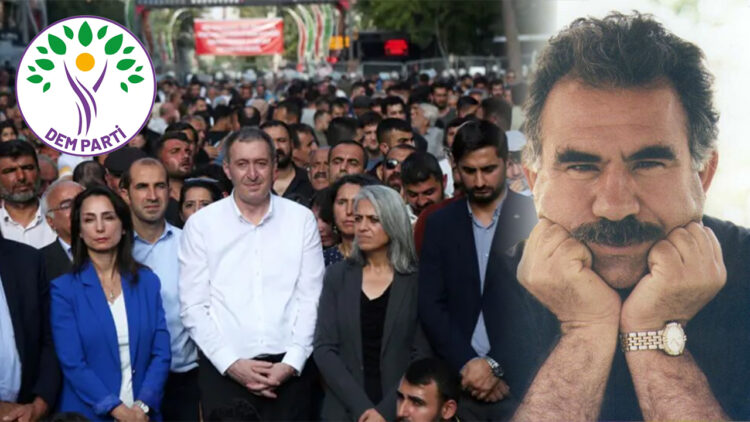
The Peoples’ Equality and Democracy (DEM) Party in Turkey has called for Abdullah Öcalan’s involvement in peace negotiations, underscoring that his physical freedom, safety, and fair working conditions are essential to meaningful progress. In a statement released on Sunday, DEM Party stressed, “Ensuring Öcalan’s conditions to carry out this mission is essential for a true option for peace.”
DEM co-chair Tuncer Bakırhan described Öcalan as the “chief negotiator” needed to end Turkey’s crisis through democratic dialogue. Bakırhan insisted that Öcalan’s involvement in a peace process would provide a democratic path forward, adding, “The conditions necessary for Öcalan’s role as chief negotiator must be provided to bring an end to Turkey’s ongoing crises.”
Turkey’s Human Rights Foundation (TİHV) and the Human Rights Association (İHD), alongside other legal groups such as the Association of Lawyers for Freedom (ÖHD), advocate for the “right to hope” for Abdullah Öcalan and others serving aggravated life sentences. This stance aligns with a 2014 European Court of Human Rights (ECtHR) ruling, which determined that denying Öcalan any possibility of release constitutes a violation of his “right to hope”. Despite this judgement, Turkey has not enacted legislative reforms to allow conditional release for those with life sentences.
Turkey’s human rights bodies demand closure of notorious ‘well-type’ prisons
Turkey’s rights leaders support bill allowing conditional release for life-sentenced prisoners
Human rights advocates argue that lifting Öcalan’s isolation would not only respect his “right to hope” but also pave the way for broader democratic reforms critical for peace in Turkey.
The call for Öcalan’s involvement extends to influential international and regional Kurdish organisations. The Kurdistan National Congress (KNK), an umbrella organisation representing Kurdish interests and advocacy on an international level, has long supported Öcalan as a foundational figure in Kurdish political advocacy and peace efforts, especially within Turkey. The Kurdistan Communities Union (KCK), which is an umbrella organisation for various Kurdish political, social, and cultural groups operating within and outside Turkey and aligns with Öcalan’s vision of democratic confederalism, stresses that Öcalan’s philosophy is central to resolving the Kurdish issue and stabilising the region.
In Europe, the Freedom for Öcalan Campaign receives support from notable political representatives, including Germany’s Left Party, the European Free Alliance (EFA), Catalonia’s CUP, and Norway’s Red Party, all of whom see Öcalan’s involvement as essential to peace in Turkey and beyond. Maria Lorena Lopez de Lacalle, EFA president, expressed, “Only with Öcalan’s freedom can a true peace process arise,” while Senator Josu Estarrona Elizondo of Spain’s Basque Country also affirmed Öcalan’s importance to a sustainable solution.
Within Turkey, civil society groups, including the Kurdish Peace Mothers, persist in advocating for Öcalan’s participation as essential to achieving a peaceful and democratic solution to the Kurdish issue. As Turkey faces mounting pressure from Kurdish, Turkish, and international advocates, DEM and its allies argue that Öcalan’s active role in negotiations is crucial for a meaningful peace framework that addresses both local and regional stability.
Abdullah Öcalan has been serving a life sentence since 1999, following his capture and subsequent trial in Turkey. Initially sentenced to death, his sentence was commuted to life imprisonment in 2002 after Turkey abolished the death penalty as part of its EU accession reforms. Over the years, Öcalan has been held under highly restrictive conditions on İmralı Island, where he is the only prisoner and has faced long periods of isolation.
In recent years, Öcalan has been held in total isolation for extended periods, with the latest such period lasting 43 months without any contact with family or legal representation. Despite occasional brief contacts and visits, these incommunicado periods have raised significant human rights concerns, prompting calls from both domestic and international organisations for an end to his isolation in line with the “right to hope” principle.
Speculation around a potential peace process between Turkey and its Kurdish population reignited following remarks by Devlet Bahçeli, leader of the far-right Nationalist Movement Party (MHP) and a key ally of President Erdoğan. Bahçeli’s comments, seen as a shift from his typically hardline stance, prompted discussions on the possibility of renewed talks.
A chink of light in İmralı prison, as lights go out in Syria – a weekly news review
Öcalan talks: Is there a path to peace?
Shortly afterward, Ömer Öcalan, a member of Turkey’s pro-Kurdish DEM Party and Abdullah Öcalan’s nephew, visited his uncle, temporarily breaking his 43-month incommunicado status. This visit, although brief, spurred further hope among Kurdish politicians and rights advocates that Öcalan’s complete isolation might end, which they see as essential for any genuine peace dialogue. Many believe that Öcalan’s active role could be crucial to achieving a democratic resolution to Turkey’s longstanding Kurdish issue.
The “right to hope” is a legal principle established by the European Court of Human Rights (ECtHR) and the United Nations, which holds that even those serving life sentences should have a realistic chance of release, provided they show evidence of rehabilitation. This principle asserts that life imprisonment without the possibility of release violates human dignity, as it denies any opportunity for personal transformation or societal reintegration.
‘Right to hope’ for Kurdish leader Abdullah Öcalan: debate grows in Turkey
The Council of Europe, ECtHR decisions, and Turkey’s compliance
The ECtHR ruled in 2014 that denying Abdullah Öcalan, a key figure in the Kurdish peace process, and other inmates at İmralı Prison the possibility of release violated their “right to hope”. The ECtHR judgement mandates that Turkey implement legislative changes to allow for sentence reviews for those serving life sentences, aligning with the Council of Europe’s human rights standards. However, Turkey has resisted this requirement, leading the Council of Europe’s Committee of Ministers to periodically review Turkey’s compliance and pressure it to enact the necessary reforms.
UN’s Mandela Rules
The United Nations Standard Minimum Rules for the Treatment of Prisoners (known as the Mandela Rules) reinforce humane treatment and uphold the right to hope by advocating conditions that protect the dignity of all prisoners, including those serving life terms. Rule 10, in particular, emphasises the need for sentence reviews for inmates, aligning with the ECtHR’s stance on rehabilitation and hope for release. The Mandela Rules call on states to avoid extreme isolation and inhumane treatment, directly relevant to Öcalan’s situation, as his prolonged isolation at İmralı Prison has been seen by advocates as violating both international human rights standards and Turkey’s own obligations.
For Öcalan, ‘Nelson Mandela rules’ are a distant dream
Meral Danış Beştaş, a prominent DEM Party lawmaker, spearheaded the legislative initiative to end Turkey’s no-parole policy for those serving aggravated life sentences. Her proposed bill, introduced in the Turkish parliament on 30 September, specifically seeks to allow conditional release after 25 years, aligning with ECtHR guidelines. Beştaş emphasised that this reform is critical for addressing the country’s human rights obligations, as the current policy not only violates prisoners’ dignity but also ignores international standards on humane treatment. By advocating for these changes, Beştaş and her supporters aim to enable democratic dialogue and establish fairer sentencing laws for prisoners currently denied parole opportunities.
Abdullah Öcalan’s “right to hope” and conditions of confinement are central to discussions of peace in Turkey, with the leader viewed by Kurdish organisations and international advocates as crucial for peace negotiations with the Turkish government. They argue that his isolation limits dialogue channels, obstructing peace efforts with Turkey’s Kurdish population.


