

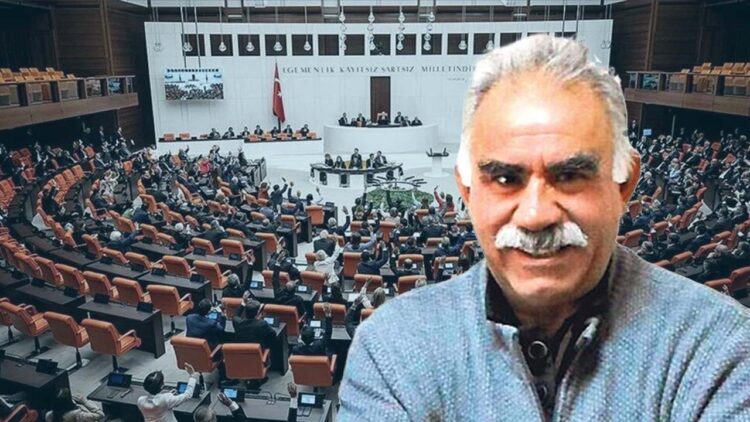
Recent remarks by Devlet Bahçeli, leader of Turkey’s far-right Nationalist Movement Party (MHP) and a key partner in the country’s ruling coalition, have reignited discussions about the imprisonment of Kurdish leader Abdullah Öcalan and the possibility of his benefiting from the ‘right to hope’, and brought the issue of his conditional release firmly back into the spotlight, with political actors and media outlets engaging in a renewed debate.
Bahçeli’s comments on Tuesday, particularly his suggestion that Öcalan would be able to address the Turkish parliament if the Kurdistan Workers’ Party (PKK) were to lay down their arms, have heightened discussion of Öcalan’s imprisonment. The mainstream ANKA news agency, which usually steers clear of such matters, was among news sites giving extensive coverage to a legislative proposal of 30 September by Meral Danış Beştaş of the pro-Kurdish People’s Equality and Democracy (DEM) Party, which advocates changing the law to allow Öcalan the right to hope.
Beştaş’s proposal called for amendments to the Turkish Penal Code to bring it into line with European human rights standards. The proposal suggests that Öcalan, who is serving an aggravated life sentence, should be eligible for conditional release after 25 years. The current system denies him any hope of release, which the European Court of Human Rights (ECHR) has ruled constitutes inhuman treatment. Although Turkey abolished the death penalty in 2004, it has yet to reform its penal code to comply with ECHR rulings on the right to hope.
Following Bahçeli’s speech, which he made on 22 October, the MHP’s deputy leader for legal affairs and elections Feti Yıldız explained the concept of the Right to Hope on his X account. Yıldız, who is also an MP for Istanbul and a member of the Constitutional Commission, said: “Over time, new concepts have emerged in modern criminal law. One of them is the ‘right to hope’, or the convicted person’s right to hope for release. This concept refers to the right of those sentenced to life imprisonment to expect to be released some day.” Shortly before this, Yıldız had tweeted, “22 October will be a turning point in Turkish politics. From now on, political assessments will be made in terms of ‘before 22 October’ and ‘after 22 October’.”
Bahçeli’s comments brought the DEM party’s legislative proposal back into the spotlight and broadened discussion on Öcalan’s case and the wider implications of Turkey’s stance on life imprisonment without conditional release.
DEM party co-chair Tülay Hatimoğulları reiterated the need to end the isolation imposed on Öcalan, noting: “The solution to the Kurdish question must take place in parliament, with Öcalan as part of the process.” İbrahim Bilmez, a lawyer acting for Öcalan, echoed this sentiment, pointing out that this continued isolation violates a European Court of Human Rights ruling of 2014 on Öcalan’s right to hope, and calling on the Turkish government to comply with international legal standards.
Cengiz Yürekli, a lawyer from the Asrın Law Office also acting for Öcalan, described Bahçeli’s use of the word “isolation” in his recent speech as an “admission of total isolation” regarding Öcalan’s situation. Yürekli stressed that the next immediate step should be allowing Öcalan to meet with his family and lawyers, a right that has been unlawfully denied for nearly 44 months. He further emphasised that the right to hope is a universal human right, as outlined by the European Court of Human Rights (ECHR), and should not be a matter of political negotiation. Yürekli reiterated the need for Turkey to comply with ECHR rulings and to end the unlawful isolation by ensuring that Öcalan’s legal rights are fully upheld.
Akın Birdal, honorary president of the Human Rights Association (İHD) and a prominent figure in Turkey’s peace movement, has weighed in on the ongoing debate about Abdullah Öcalan’s right to hope. Birdal, a long-time human rights activist, stressed that Öcalan must be recognised as the main interlocutor in dealing with the Kurdish question. He urged the government to approach the issue with sincerity and pointed out the importance of a roadmap for peace, noting that lifting Öcalan’s isolation would be the first step towards meaningful dialogue.
These recent discussions follow an earlier call by the Committee of Ministers of the Council of Europe (CoE) in September, where the Committee urged Turkey to introduce a review mechanism for aggravated life sentences in line with the standards of the European Court of Human Rights (ECHR). The Committee had expressed deep concern at Turkey’s lack of progress and set a deadline of 2025 for Turkey to take the necessary legislative steps, warning of further scrutiny if the country failed to comply.
As the debate continues, Bahçeli’s remarks have led to a wider conversation about Öcalan’s condition and Turkey’s need to bring its legal practices into line with European human rights standards, particularly in relation to the resolution of the Kurdish question.


