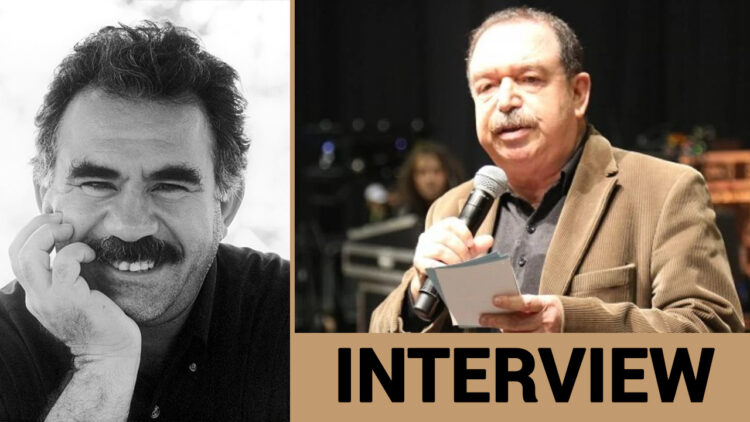
On 10 October 2023, a global campaign advocating for the freedom of Kurdish leader Abdullah Öcalan and a political solution to the Kurdish question was launched. Hatip Dicle, in a recent interview, reflected on the campaign’s current progress and its future trajectory.
What were the consequences of the process known as the ‘international conspiracy’—which involved the forced expulsion of Abdullah Öcalan from Damascus by the Syrian government on 9 October 1998 and his subsequent abduction from Kenya to Turkey by Turkish intelligence on 15 February 1999—for Kurdish politics and international politics?
We are marking another anniversary of the 9 October conspiracy. On 9 October, 26 years will have passed, and we will enter the 27th year. In this context, I can say the following: Öcalan is a distinguished thinker and philosopher of our time. To take such a person and imprison them in an isolated cell on an island is, first and foremost, a crime against humanity. Therefore, those behind this conspiracy are condemned by history’s unerring judgement and stand guilty.
What did this conspiracy mean for the Kurdish people? It inflicted great harm. Öcalan had left for Europe in search of peace, but the path to a peaceful solution was blocked by over 20 countries, including the US and several European states, all of which played a role in this conspiracy. By doing so, they committed a grave crime, not only against the Kurdish people but against all people, because this ensured the continuation of the war, in which the Kurdish people sacrificed nearly 50,000 of their children.
Similarly, the children of Turkey’s people, sent off as soldiers, also suffered tens of thousands of casualties. Therefore, this conspiracy against Öcalan resulted in the deaths of tens of thousands of people.
Another important aspect is that the conspiracy emboldened the Turkish Republic to persist in its policy of avoiding a solution. The countries involved in this conspiracy gave Turkey the confidence to continue down this path.
The long duration of the war has also had a tremendous financial cost for our peoples. It is estimated that $4.3 trillion has been spent on this war—this is a figure confirmed by scientists, not something I’m saying offhand. Therefore, this conspiracy has been a disaster not only for Öcalan and the Kurdish people but also for the Turkish and Middle Eastern peoples. The conspirators are guilty in the eyes of history. Even if they are not held accountable in a court of law, they will be condemned by the conscience of the people—this is certain.
‘The campaign ‘Freedom for Abdullah Öcalan: A Political Solution to the Kurdish Question’ was launched globally on 10 October 2023. How do you evaluate the course of this campaign?
As you know, the international and global campaign for ‘Freedom for Abdullah Öcalan and a Political Solution to the Kurdish Question’ was launched on 10 October 2023. We can liken this to the movement for the freedom of Nelson Mandela in the 1970s and 1980s. Like Mandela, who spent 27 years in an island prison, Öcalan has been imprisoned on an island since 1999. However, his rights are severely violated—he has had no contact with the outside world for over 42 months. His status is more akin to that of a hostage than a normal prisoner, and his rights are severely violated. Family visits are extremely limited, and he has had no contact with the outside world for over 42 months (3.5 years in fact).
This campaign was launched to address these injustices. As part of the campaign, intellectuals, writers, civil society leaders, and activists from 75 countries and more than 120 cities organised press conferences and seminars calling for Öcalan’s freedom and a solution to the Kurdish issue. They have organised events to read Öcalan’s books and sent him hundreds of thousands of cards, but it is unclear whether they have reached him.
There were discussions on how Öcalan’s ideas, in particular the paradigm of a democratic and peaceful world, could offer solutions to current problems. Letters were also sent to the Council of Europe and the Committee for the Prevention of Torture (CPT) calling for action. Recently, 69 Nobel laureates, led by Jody Williams, called for Öcalan’s release, and various international organisations, including the Council of Europe and the European Court of Human Rights, responded.
Did the 10 October initiative have the desired impact on both national and international public opinion?
The ultimate goal is Öcalan’s freedom. However, for satisfactory progress, at least his communication rights must be restored. According to the European Convention on Human Rights, to which Turkey is a party, the ‘right to hope’ is a fundamental right of every prisoner sentenced to life imprisonment. Legally, Öcalan has the right to freedom.
None of these goals have yet been realised, but there is significant awareness, especially among left, socialist, democratic, and green groups. The global community increasingly recognises that the decline in Turkey’s democratic values is directly linked to the unresolved Kurdish question. Since the collapse of the peace process with Öcalan, Turkey has moved further and further away from democracy.
As more people read Öcalan’s work, his ideas are gaining sympathy. His vision of a democratic Middle East resonates globally.
How have European institutions such as the Council of Europe and the CPT responded to this international campaign?
As I mentioned earlier, the CPT is authorised to inspect prisons, especially in Council of Europe member states such as Turkey. Although the CPT visited İmralı in September 2022, the report was not published due to Turkish obstructions. The legal term for Öcalan’s situation is ‘incommunicado’, meaning absolute isolation. We do not know how much communication Öcalan has with the other three prisoners in İmralı or how he is treated. The lack of information even from his family is worrying and cannot be normalised.
The CPT has responded to letters from writers, activists, and members of the public, expressing thanks for the interest and stating that they will continue to monitor the situation. However, a concrete response from the Council of Europe will require a delegation to İmralı from the Committee of Ministers, composed of the foreign ministers of the member states.
What are the next steps in this campaign for Abdullah Öcalan’s freedom?
The campaign is entitled ‘Freedom for Abdullah Öcalan, Political Solution to the Kurdish Question’. In order to achieve these goals, we plan to intensify our efforts on many fronts: political, diplomatic, artistic, and cultural. We will continue to mobilise global networks against racism, authoritarianism, and all forms of reaction. The various stages of the campaign will be announced in the media.
It is critical to emphasise that Abdullah Öcalan is currently the most isolated prisoner in the world. The conditions in İmralı are, in my opinion, even worse than those in Guantanamo Bay. İmralı symbolises the Kurdish people’s struggle for freedom. In Turkey, for example, even Kurdish road signs are being removed as part of the state’s anti-Kurdish policies, which are leading the country towards a dangerous division.
This campaign must be supported by all democratic forces. The international human rights community has begun to make its voice heard more strongly, and this must continue. On 1 September, an important intellectual meeting took place in Berlin, where important calls were made. This campaign needs to be embraced by everyone, especially to strengthen the democratic opposition in Turkey.
How long will this campaign continue?
The campaign will continue until Abdullah Öcalan is free. His freedom is linked to the political solution of the Kurdish question and the democratisation of Turkey. As I mentioned before, Öcalan’s situation can be compared to that of Nelson Mandela in South Africa. Just as Mandela’s freedom depended on the end of apartheid, Öcalan’s freedom depends on the solution of the Kurdish question and the democratisation of the Middle East. This campaign will continue until his release.
Do you have a message for the Kurdish people and their allies?
First of all, I would like to express my gratitude to the activists, socialists, democrats, and Nobel laureates who have supported this campaign. Their opposition to the injustices against the Kurdish people and their support for Öcalan’s freedom are very valuable. It shows us that we are not alone in this struggle and that we are on the right path.
The Kurdish people, both in Turkey and in the diaspora, have continued to support Öcalan, and their understanding of his paradigm has deepened. I call on them to strengthen their struggle, diversify their actions, and exert creative pressure on state mechanisms. Only by uniting and building an international solidarity campaign can we achieve results. The more far-reaching and persistent our efforts, the sooner we will see success.
***
Hatip Dicle has been an important figure in Kurdish politics for decades, championing the rights and freedoms of the Kurdish people in Turkey. His career was shaped during a period of intense political repression against Kurdish activists, and he became an ardent advocate for the peaceful resolution of the Kurdish question.
In 1991, Dicle was elected to the Turkish Grand National Assembly as a member of the People’s Labour Party (HEP). However, the Turkish state’s crackdown on Kurdish political movements led to his imprisonment along with other members of the Democracy Party (DEP) after their immunity was lifted in 1994. He spent ten years in prison, during which time he became a symbol of the Kurdish struggle for self-determination.
After his release, Hatip Dicle resumed his political activities and played a key role in the peace process between the Turkish government and the Kurdistan Workers’ Party (PKK), with PKK leader Abdullah Öcalan at the centre of negotiations. Dicle was re-elected to the Turkish Parliament in 2011 but was denied a seat due to a previous conviction.
Throughout his career, Dicle has been a strong supporter of Öcalan, whom he sees as essential for a lasting solution to the conflict between the Turkish state and the Kurdish population. Dicle’s views are also in line with the broader Kurdish movement in Turkey, which seeks democratic reforms as well as cultural and political autonomy.
Dicle has been living in Germany for eight years.