

Sarah Glynn
A year and a half ago, a delegation of three women visited the Council of Europe to meet with MPs. Each of them was inspired by the Kurdish struggle and the ideas of Abdullah Öcalan, and they talked with me about what motivated them. One of the three was Sawsan Shouman from Lebanon, who told me that she discussed Öcalan’s ideas with women from other Middle Eastern countries over Zoom and also held group discussions in her home. On Tuesday, that home was reduced to rubble by an Israeli bomb, which seriously injured members of her family. She has described what happened for Medya News.
I begin with this individual account because it demonstrates so clearly the brutal nihilism of today’s world politics, and the hollowness of the pretence that Israel’s attacks – which are being carried out with US and European weapons – are simply targeted at ‘terrorists’. Indeed, Shouman writes, “The occupying forces are deceitful in their claims. Thousands of martyrs are civilians — women and children — our neighbours, people we know well, whose identities and lives are familiar to us. Israel is a criminal and shameless entity, committing genocide against civilians under the false pretence of destroying Hezbollah’s power. Did they find Hezbollah’s forces in my home, among my five children playing innocently, unaware that a brutal enemy lurks, one that cannot distinguish between a child and a fighter?”
As I write this, more bombs are raining on Lebanon, and the danger of war spreading across the Middle East is palpable.
Turkish hypocrisy and the UN
All round the world, people are watching Israel’s attacks with horror, but anger at what is happening is matched by anger at the lack of effective response by world leaders. There have been some strong words spoken at the General Assembly of the United Nations this week – and delegates walked out when Benjamin Netanyahu began to speak – but this doesn’t translate into real action. America’s pretence that they are working for peace while they send billions of dollars of weaponry to Israel is staggering; but an equal prize for chutzpah must go to Turkey’s President Erdoğan, who portrays Turkey as a harbinger of peace and stability even as the Turkish military invades and destabilises neighbouring countries, displacing populations and introducing Islamist gangs that are sowing the seeds of future conflicts. Erdoğan’s criticisms of Western hypocrisy will resonate with all those watching in despair as western countries continue to arm the perpetrators of a genocide that has been live-streamed on our phones, but Erdoğan can match western hypocrisy with a hypocrisy of his own. Even with respect to helping Israel, and in spite of repeated criticism, Turkey has not stopped the flow of Azerbaijani oil through Turkish ports – oil that meets 40% of Israel’s needs.
Turkish authoritarianism at home
And, within Turkey itself, the march towards fascism continues. The growth of right-wing authoritarianism is an almost world-wide phenomenon, and every reactionary development in one country makes this easier in another, but Turkey is exceptionally far down the authoritarian road. Turkish authoritarianism serves an ethnic Turkish nationalism that was built into the foundations of the Turkish republic and particularly expresses itself through the oppression of the country’s large Kurdish minority.
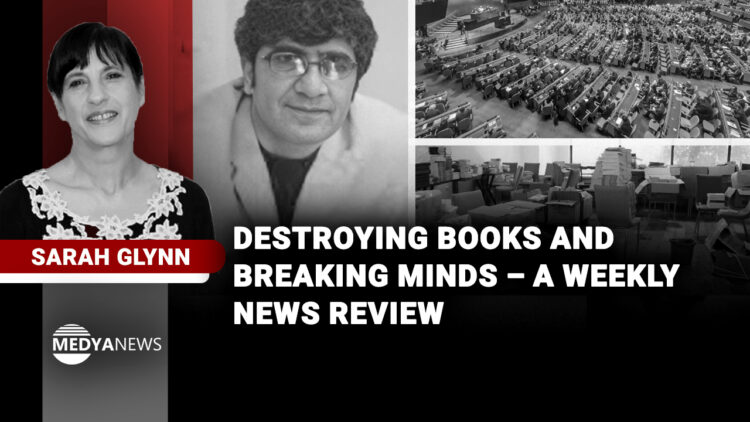
This week has seen a spate of attacks on Kurdish cultural organisations and their members. On Tuesday morning, police in Diyarbakır (Amed) raided the Mesopotamian Language and Culture Research Association (MED-DER), Payîz Pirtûk bookshop, and Anka Language and Art Education Cooperative, and also detained 30 people associated with Kurdish language and culture in house raids. Detainees were forbidden access to lawyers for 24 hours. Mezopotamya Agency records that the investigation into these organisations was initiated in 2022, reportedly through “the informant Ümit Akbıyık, who has made false statements about hundreds of people to date, and a secret witness.” Large numbers of books and magazines have been seized along with computer hard discs. The lock on the MED-DER office was changed and the key given to the local headman.
Sunday night, another set of Kurdish language road markings were painted out in Elaziğ, in an echo of similar vandalism carried out in July.
On a very different scale, Turkey has begun work on a further dam that will submerge more historical structures and landscapes in the Hasankeyf district of Batman. This follows the controversial Ilısu dam, completed in 2019.
There have also been numerous other detentions of political activists and journalists in Istanbul and Mardin and in İzmir.
A week ago, police raided the home of Jin News journalist Rabia Önver. That day she had published the third and final part of an investigation into a network that has been coercing young women into drugs and prostitution. The articles exposed links with officials of the ruling Justice and Development Party (AKP), and complicity by the authorities, who pressured families to withdraw complaints. Önver argued that this network was deliberately corrupting Kurdish youth. Rather than investigate the allegations, the authorities have again chosen to punish the journalist.
A prominent Kurdish activist from Australia has been arrested in Turkey as she was about to fly home – and her fellow Australian Kurds have been further unsettled by the statement from the Turkish authorities that they had had her under surveillance for her activism in Australia.
Every repression is met with resistance. There have been well-attended, defiant protests against the raids on the cultural organisations and the associated detentions. Speakers have included politicians, attendees have stressed their resolve to use Kurdish, and links have been made with the isolation of Abdullah Öcalan. A statement put out by seven bar associations stressed that this criminalisation of the Kurdish language is unlawful. In a statement published on Thursday, PEN International made clear that PEN “condemns the latest clampdown on Kurdish language and culture carried out by the authorities of Türkiye”.
Diyarbakır is hosting an academic conference on architectural conservation that will have papers in English, Turkish, and Kurdish; and Sur Municipality, which is one of the conference supporters, has also made a ‘sister’ agreement with Fındıklı Municipality in Rize, on the Black Sea Coast. The DEM Party administration in Sur and the Republican People’s Party administration in Fındıklı want to practise cultural exchange and political solidarity as a counter to the forces of racism and fascism.
The Kurdish diaspora is part of this resistance too. Last Saturday some 40,000 Kurds from across Europe came to Frankfurt for the annual festival of Kurdish culture.
To root out resistance from the PKK, the Turkish army carries out military operations that turn large sections of the countryside into no-go areas. This week temporary security zones were declared in Van Governorate.
Not all Turkish racism is directed at Kurds, and Syrian refugees have become an increasingly popular target for abuse. The fatal shooting of a 15-year-old Syrian refugee in Istanbul last Saturday is thought to be a racial attack, though investigations are still ongoing.
Racial hatreds and scapegoating are encouraged by politicians who want to deflect people’s anger away from serious economic woes, rather than address underlying inequalities. There is no shortage of economic woes in Erdoğan’s Turkey. Reports have described farmers leaving crops in the field because the cost of harvesting is more than they can recover in the market. Other reports describe farm workers on starvation wages. The pro-Kurdish leftist DEM Party has been talking to people on low incomes as part of their Bread and Justice Campaign. This week, party co-chair, Tülay Hatimoğulları listened to seasonal workers in Adana and promised to raise their issues in parliament. In Van the DEM Party municipality has opened a restaurant serving low-cost meals.
Iraq
Last Saturday viewers of Habertürk TV heard İsmail Hakkı Pekin, former chief of Turkey’s military intelligence, call for the assassination of Bafel Talabani, leader of the Patriotic Union of Kurdistan (PUK). The PUK is one of the two main parties in the Kurdistan Region of Iraq, and – unlike the rival Kurdistan Democratic Party (KDP) – refuses to fall into line behind Turkey and assist them in their fight against the PKK. When the moderator of the programme protested, Pekin elaborated, “You wouldn’t do it yourself; you would have someone else do it.” Erdoğan had already promised to do “whatever is necessary” with respect to the PUK, but Talibani has remained firm in his resistance to Turkish threats and his determination to work with the Autonomous Administration of North and East Syria, which Turkey portrays as terrorist.
This week, campaigning began for the Kurdistan Region of Iraq’s much delayed election, which will be held on 20 October; and the PUK is portraying the KDP, which has dominated the region’s politics, as having “sold the Kurdistan Region lands to the enemies of the Kurdish people and Kurdistan”. This betrayal, as well as lack of money or opportunity as a result of endemic corruption, is expected to eat into KDP votes. Both the KDP and the PUK are controlled by powerful families and accused of corruption and authoritarianism, but none of the other parties has managed to build much support.
The KDP delayed the election as long as they could because of a justified fear of losing their dominance. Hawre Karwan for Mezopotamya Agency comments that the PUK “seems to be ahead”, but also notes that those who have most reason to reject the KDP – the people who have had to flee their homes due to Turkey’s attacks that the KDP has been supporting – will not be able to get to the polls and vote.
In Syria
In Syria, tensions continue between the different mercenary groups that control the areas occupied by Turkey. The exploitation of local people by these groups has become so extreme that the Kurdistan National Council (KNC), which is backed by the KDP and by Turkey, has suspended their activities with the other Turkey-backed groups and is talking about reviving talks with the Democratic Union Party (PYD), although they oppose the PYD’s Öcalan-inspired politics. While some see reconciliation between the KNC and PYD as a step towards peace with Turkey, it is difficult to envisage an agreement that would not compromise the region’s unique democratic experiment.
The PYD and the Autonomous Administration of North and East Syria have to operate under extremely difficult circumstances. Besides Turkey’s attacks – actual and threatened – the region suffers severe shortages of resources. This is exemplified by the sad competition for school buildings in Hasakah. After Turkey’s last occupation, in 2019, many displaced families were housed in school buildings. There has not been the resources to build them alternative homes, and over 7,000 people are still occupying 38 schools, while local children have missed out on five years of schooling. Now the families are being moved out to camps to allow the schools to start up again, but there is a lot of worry and uncertainty.
Iran
In Iran, two years after the death of Jina Amini triggered the Women Life Freedom movement, the Guardian Council of the Islamic Republic has formally approved the “Hijab and Chastity Bill”. In the words of Hengaw Organisation for Human Rights, this “will increase the hardships faced by women and sexual and gender minorities in Iran under the Islamic Republic’s gender apartheid regime.” The new law spells out punishments for “inappropriate dressing” and for businesses that provide services to those who are “poorly veiled”. There are especial penalties for people with social influence, and new rules stipulate increased gender segregation in universities and other public spaces.
Free Öcalan Global Days
Looking forward, 10 October will be the anniversary of the international campaign Freedom for Abdullah Öcalan: a political solution for the Kurdish Question. To mark the occasion, organisers have called on supporters around the world to be part of 10 days of actions, starting next Tuesday. Öcalan’s freedom is an issue of huge political importance. He holds the key to any future peace negotiations between the Kurds and the Turkish state (if the latter ever opts to look for peace not war), and his political philosophy has provided the basis for a new way of organising society, which informs the practices of Kurdish politicians and organisations in Turkey and in Syria and has inspired organisations and individuals across the world.
But even before touching on the issue of freedom, the form of Öcalan’s incarceration breaches international – and national – law on human rights and has become a template for the gross mistreatment of thousands of other political prisoners in Turkey. Last week I talked about the Council of Europe’s unconscionable delay in following up Turkey’s refusal to allow Öcalan, and some 4,000 other political prisoners, the possibility of parole, which the European Court of Human Rights describes as the Right to Hope. He is also being denied his right to see, or even communicate with, his lawyers and his family, and he is being held in conditions of solitary confinement that themselves constitute torture.
Solitary confinement
Human Rights law is clear that the use of isolation must be strictly limited. The United Nations’ Mandela Rules stipulate that isolation must be a last resort and not exceed 15 days. But authoritarians increasingly enforce isolation as a deliberate tool to destroy prisoners from the inside and deprive them, not only of their liberty, but also of their humanity. I will end by quoting from a powerful testimony written by Zeki Bayhan, who has spent 27 years as a political prisoner in Turkey and has described his own experience of solitary confinement, but first I want to look at research on the impact of solitary confinement from the “Land of the Free”.
The United States not only has the biggest prison population in the world, but keeps an estimated 80,000 people, mostly men, under conditions of extreme isolation. (They may lecture their enemies about freedom but are not much perturbed when such practices are carried out by themselves or their friends.) In 2018, Scientific American reported on the impact of this isolation on prisoners’ mental health, including physical changes to the brain, as described to a meeting of the Society of Neuroscience by a panel that included wrongly imprisoned Black Panther, Robert King. King spent 29 years alone in a nine by six-foot prison cell 23 hours a day. The meeting heard that “Chronic stress damages the hippocampus, a brain area important for memory, spatial orientation and emotion regulation. As a result, socially isolated people experience memory loss, cognitive decline and depression… When sensory deprivation and an absence of natural light are thrown into the mix, people can experience psychosis and disruptions in the genes that control the body’s natural circadian rhythms.” Stephanie Cacioppo, an assistant professor at the University of Chicago told the meeting, “We see solitary confinement as nothing less than a death penalty by social deprivation.” Scientific American records that “King said he survived the ordeal because he recognized that his case was ‘politicized,’ and bigger than himself,” and that Cacioppo observed that “collective identity is protective against individual loneliness.” These observations are borne out by the Kurdish experience.
In Zeki Bayhan’s letter from prison, which Medya News published in full on Monday, he observes, “solitary confinement is not limited to locking someone between four walls. The real aim of solitary confinement is to imprison the mind within the body. This is the truly destructive part. Physical isolation, along with the control, surveillance technologies, and practices of the prison regime, all aim to achieve this. In solitary confinement, the prisoner’s entire focus, sensitivity, anxieties, and fears are directed towards themselves and their body. Once the prisoner falls into this trap, they begin to hollow themselves out, consuming themselves. Solitary confinement is the politics of pushing a person towards their own destruction by their own hand. Physical, ideological-political, psychological, but always destructive… From the most extreme to the relatively milder forms, the goal of solitary confinement is the same: to break a person psychologically, emotionally, and mentally.” Crucial to this process is the monotony of prison, which “replaces thought with habit”.
But Bayhan emphasises that the destruction that these practices seek can be avoided through resistance – by refusing to become a victim and instead remaining a political subject who continues their fight.
Sarah Glynn is a writer and activist – check her website and follow her on Twitter


