Sarah Glynn
Turkey’s war of attrition against the Kurds has been corroding Kurdish existence for a hundred years – sometimes more aggressively than others. When an attack is drawn out like that, it rarely makes international headlines, and the constant aggression can become normalised. The latest week in this 5,000 week-war has produced little news that will register outwith Kurdish circles, but even a relatively unremarkable seven days destroys lives and blocks hopes. It demonstrates, too, how this anti-Kurdish war is part of a wider authoritarianism that has become increasingly fascistic.
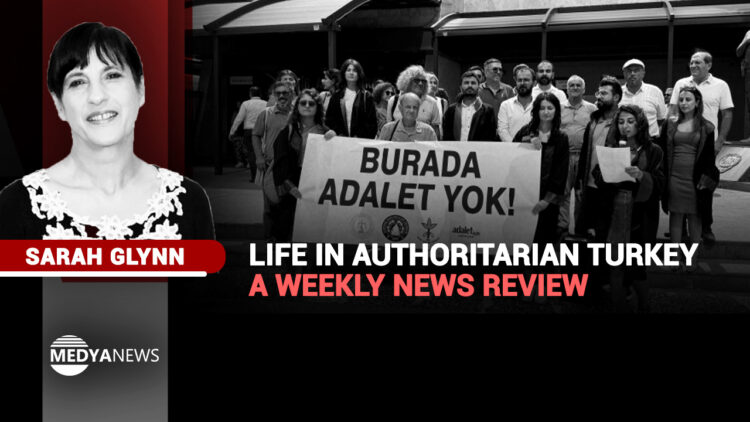
This week saw the beginning of Turkey’s judicial year, and in İzmir, human rights lawyers held a press conference outside the courthouse, with a banner that read “There is no justice here”. Leyla Bilgen, of the Association of Contemporary Lawyers, stated, “Nazi-era trials have now become the ‘normal situation’ of the country. Fascist oppression is in a rush to reproduce itself every day by means of the law. While this fascist machine is used in the most ruthless way on Kurds and socialists, the same practice is also applied in favour of supporters in an ordinary earthquake case.”
In Turkey’s prisons
It is frequently stated that “the degree of civilization in a society can be judged by entering its prisons.” In Turkey, every week brings accounts of sadistic cruelty from the country’s prisons, as well as miscarriages of justice from the judiciary. A trawl through last week’s reports from Mezopotamya Agency paints a devastating picture of the situation facing thousands of political prisoners, as the state tries to destroy their mental freedom as well as control them physically.
The president of the Human Rights Association in Van has spoken of finding an increase in violence every time he visits a prison. He described how prisoners are increasingly isolated from each other and from the outside world. New rules reminiscent of the 1980s and 90s prevent prisoners speaking Kurdish with their families. Use of a Kurdish word can result in phone calls being terminated and meetings banned.
In Samsun, the Human Rights Association reports that in the Bafra prison isolation is so extreme that prisoners can only exercise alone in their cells, and wards are built far apart to prevent communication. They note that, in Kavak, surveillance cameras even see into the toilets, and prisoners are forced to march in line and obey commands. The use of the word Kurdistan in his poems earned a Kavak prisoner eleven days solitary confinement.
The DEM Party Deputy for Mardin has applied to the Parliamentary Human Rights Investigative Committee over violations in Sincan, where the abuses listed include prisoners being kept in their cells for over 22 hours a day – 23 hours in the case of those serving aggravated life sentences. Prisoners’ writings and books are confiscated, and prisoners are prevented from sharing books and newspapers. Hospital appointments are postponed or cancelled. When taps failed to work, prisoners were expected to buy the parts needed for the repair or go without water.
Another application was made by the DEM Party Deputy for Hakkâri (Colemêrg), with respect to prisons in Tekirdağ and Kocaeli, where prisoners who refused strip searches were tortured, and hospital transfers were refused to those who wouldn’t accept full head searches; where writings and books were seized, and where social activities were restricted to ten hours in 45 days.
82-year-old Makbule Özer, who was released from prison last Saturday – and left at the prison gates without her family being informed – has described the especial difficulties facing the old and infirm. It was hard for her to get up to her bunk bed, and she fell out many times. Other prisoners had to help her with everything, even carrying her up and down stairs on their backs.
Prisoners in Giresun Espiye have told their families that the new prison director has deprived them of almost all rights. Complaints are torn up and objections are met with disciplinary investigations. A prisoner who underwent solitary confinement and beatings in Kirşehir, informed his brother that when he spoke to the chief warden he was told “We can do whatever we want whenever we want”. At the women’s prison in Manavgat, prisoners have reported violence and threats.
Practices are conceived so as to punish families and make family visits difficult. When the family members of two prisoners in Maltepe went to visit them, they found they had been transferred to another prison. It was two days before they were told where they had been taken.
Freedom delayed
A growing concern is the refusal to release prisoners who have come to the end of their sentences. This especially effects people given life sentences in the 1990s, who should be able to expect release after thirty years. Prison Administrative and Monitoring Boards, introduced in 2021, are adding arbitrary and repeated delays on the grounds that prisoners have not shown repentance for their actions and beliefs.
Nedime Yaklav, in Sincan women’s prison for “disrupting the unity of the state and the integrity of the country”, reached the end of her thirty years in April 2023, but has since seen her release delayed five times. Like many other prisoners, she also suffers from poor health. She explained through her lawyer, “Asking ‘do you regret?’ is not an ordinary question. Anyone who encounters this question knows that they are faced with denying their entire life up until now. Those who ask ‘do you regret’ do not stop there. They also bind the future with the question ‘What will you do from now on?’ The message is very clear; deny yourself, ignore yourself and become nothing.” She observes, “There is no such thing as ‘good conduct’ for political prisoners. It doesn’t matter if you escape, if you have hundreds of disciplinary punishments or if you haven’t done anything. If you are Kurdish and political, you are not of good conduct.”
In Bafra, the Human Rights Association found that prison times were being extended without even meeting the prisoners, who were all given the exact same reasoning.
Aydın Kudat and Abdurrahman Güner, in Karabük, have been in prison for 32 years and seen their release delayed four times. They have been told “As long as you refuse to say I regret, you will not be released.” Güner has suspected stomach cancer.
In Bolu, Ataş Göbe completed thirty years on 2 June, but has seen his release delayed twice. He told his family that 26 other prisoners were facing a similar fate.
In Antalya Döşemealtı, İdris Başaran, whose thirty years ended in July, has had his release delayed by six months. He has multiple severe health problems, including cancer, and has been taken to hospital many times without being given treatment.
In Ahlat, Naif İşçi, who was sentenced in 2010, aged 14, has also seen his conditional release delayed for refusal to repent. Despite serious health problems, he has gone on hunger strike in protest.
Sometimes legal processes are allowed to triumph eventually, though this cannot hide the deep problems in the judicial system. Ali Şen, also suffering poor health, was released by the court after five delays and 31 years in prison. Sinan Sütpak and Adnan Özbay were released after six delays and 31 years.
Ill prisoners
Poor health is a huge problem for prisoners, thanks to poor conditions and grossly inadequate healthcare. While Turkey gives compassionate release to seriously ill common criminals, they rarely release Kurds, unless they are on the very verge of death. Even medical reports stating that the prisoner should not remain in prison are ignored.
Abdulkadir Kuday in Metris has motor neuron disease, which results in progressive and severe disability. He is unable to sit or eat and now can hardly speak. He has just a short time left to live and wants to be able to spend this with his family.
He was arrested for involvement in a murder in 2014, despite witness statements proving he was in another place, and for six years was deprived of proper healthcare in prison and prevented from sending and receiving letters. Despite repeated medical statements that he is not fit enough to stay in prison, he was left with a cellmate whose ability to help was limited, as he himself had no hands. When taken to hospital 2 ½ weeks ago, Kuday was not given even the most basic personal care. His lawyer has applied to the Constitutional Court and the Minister of Justice for his release, and the DEM Party has highlighted his case and also made an application to the ministry. The DEM Party further point out that there are over 600 seriously ill prisoners in Turkey’s prisons.
The authorities claim that prisoners sentenced to life without parole can never be legally released, but the European Court of Human Rights, which overrules national courts, has ruled that such sentences are illegal as they deny the right to hope. There are estimated to be around 4000 people in Turkey illegally deprived of hope in this way.
Harassing the lawyers
Lawyers also face harassment, which ranges from petty mistreatment – insulting a lawyer and taking away his shoes when he visited his client in prison – to serious court cases. Burhan Arta has been accused of looking at files on behalf of “the organisation”, meaning the PKK. At Thursday’s hearing of his case, both prosecution “witnesses” denied knowing him.
Meanwhile, Dilek Ekmekçi, a criminal lawyer who filed a case against executives of the Nationalist Movement Party (MHP) and the Grey Wolves, implicating them in the murder of Sinan Ateş, has herself been arrested. The reason given, was a social media post that is alleged to have insulted a public official. The MHP is the alliance partner of President Erdoğan’s Justice and Development Party (AKP).
Politicised judiciary
Turkey’s politicised courts have become a mechanism for punishing opposition voices in an endless stream of miscarriages of justice – some well-known and widely protested, others little-known beyond those immediately affected.
147 people, including artists, journalists, human rights defenders, and intellectuals, have signed a call for overturning the double life sentence (without parole) awarded to Ayten Öztürk in 2018. Öztürk was kidnapped and brought to Turkey from Lebanon, and then subjected to six months of severe torture. Her conviction is based on accusations by a government “informant”, with the only concrete evidence against her being a false passport.
The Şenyaşar case is a notorious example of Turkey’s politicised “justice”. Emine Şenyaşar has been demanding justice since 2018, when her husband and two of her sons were killed in an attack by the bodyguards and relatives of former AKP Deputy, İbrahim Halil Yıldız, and another son was imprisoned. She has taken her vigil to the Turkish Parliament, where a fourth son is now a DEM Party MP, and, on Thursday, the leader of the main opposition Republican People’s Party (CHP) paid her a solidarity visit. However, the CHP is still a nationalist party and has historically been no friend of the Kurds. As Eren Keskin, the co-chair of Turkey’s Human Rights Association, points out when discussing racism, “The CHP is the party of the founding ideology anyway… The CHP is selective about victims. A few cases are on their agenda, but other than that, they are not conducting an active opposition. For example, in the process called the ‘Peace Process’, the CHP should ask the AKP the following: ‘Why couldn’t this process be concluded successfully?’ Instead of criticizing, they are asking ‘Why did you sit at the table with terrorists?’ In other words, the main opposition is criticising from a more backward point.”
Every week, activists are detained, and this week was no exception. On Monday, seven people were detained in dawn raids in Urfa (Riha). On Wednesday, three people who had each been sentenced to 8 years 9 months in what is known as the KCK Case, were detained in Yüksekova (Gever).
Twelve young people detained at a World Peace Day Rally in Kadıköy on Sunday, were arrested on Monday and charged with “propaganda for a terrorist organisation.” The young activists had danced halay to Kurdish songs, and opened a banner that spelt out their solution for a peaceful resolution of the Kurdish Question: “Interlocutor İmralı, solution democratic Turkey, Autonomous Kurdistan”. (İmralı is the name of Abdulla Öcalan’s prison, and his involvement is key.) A defiant press conference in support of the arrested activists was attended by representatives of civil society organisations and political parties.
Trade unionists
Turkish authoritarianism is not just used against the Kurds. It is a tool for elite dominance more generally, and is employed to restrict trade unionism and to crush resistance to developments that put private profit before ecological protection. Turkey continues to be classified by the International Trade Union Confederation as one of the ten worst countries for workers.
In Manisa’s Soma district, the site of a massive mining disaster ten years ago, a coal mine owned by an AKP Deputy, Ferhat Nasıroğlu, has become the centre of a dispute over safety and unionisation. The Independent Mine Workers’ Union has been exposing highly dangerous working conditions and ecological risks, and workers have been fired for joining the union. When workers tried to protest the dismissals at the mine, they were stopped by gendarmes, and the week before this one, over seventy protestors were detained, including the union chair and executives. Gendarmes continued to block the protestors this week too. As well as poor working conditions, the mine has exceptionally poor pay compared to others in the area, despite the fact that Nasıroğlu’s Fernas Group received 7 billion Turkish Lira (over $200 million) worth of public contracts between 2011 and 2022, plus tax exemptions and government grants.
Environmentalists
There have been numerous examples of the Turkish Government supporting development at the expense of the natural environment. In the Black Sea province of Artvin, villagers have been attempting to stop the destruction of the local forest and the construction of a tourist development. Protesters reported that they were being threatened by the developers, but got no response from the authorities. When they tried to stop machinery entering the forest, a man connected with the logging company opened fire, injuring three people, one of them fatally.
This took place in the same area in which a retired schoolmaster was killed by pepper spray when protesting against environmental destruction in 2011. The trial of the 13 police officers involved concluded only yesterday. They were accused of causing death by negligence, but after a heavily criticised trial, all were acquitted.
There are major fears over the impact of a gold mine in Kırşehir, planned by the same company who own the Soma mine; and, in Şırnak, relentless tree-felling is being carried out by the government. An application to the Ministry of Agriculture and Forestry pointing out that this contravenes constitutional requirements for the protection of forests has been rejected. It is now planned to take the Forestry Regional Directorate to court.
In addition
Also this week in Turkey: in Kars, where, in March, voters bussed in from elsewhere ensured MHP control of the municipality, more than 100 new municipal employees have been shown to be relatives of those now in charge; and the journalist who exposed this has been bombarded with threatening messages. Hakim Lokman, from Duhok, was fatally stabbed in Istanbul on Saturday, and his cousin, who was with him, reported that his attackers had abused him for speaking in Kurdish. A new investigation has been opened against a Mezopotamya Agency reporter on the basis of statements from a secret witness, who has also testified against other journalists. The government has frozen the assets of the Migrant Monitoring Association, which supports victims of rights violations. A new leftist party has been told to amend its statutes and remove references to “defending the rights of the Kurdish people” and “the right of nations to self-determination”, or face dissolution. An İzmir Court has again banned Gültan Kışanak’s collection of women’s prison writings, “The Purple Colour of Kurdish Politics”. And, as always, parts of the Kurdish areas have been closed off for military operations.
Military operations
In rural Nusaybin, an area including eight villages was declared a Temporary Special Security Zone for 15 days. Bagok Mountain came under ariel bombardment and helicopter gunfire, and the government announced the death of two PKK fighters. security zones were declared by Diyarbakir Governorship, and a military operation was launched in Yüksekova. The bodies of two PKK fighters killed in August were returned to their families for burial. Soldiers restricted entry to the cemeteries, but crowds came to the condolences, including DEM Party executives. Six more bodies were retained.
In trying to give a sense of the realities of Turkish authoritarianism, and especially of life in the prisons, I have left no space to talk about the many ways people are resisting, or to discuss news beyond Turkey’s borders – much of which is another aspect of that same authoritarianism. But I will end with the briefest of summaries of events elsewhere.
In Iraq
This week has demonstrated both the violent and illegal nature of Turkey’s attacks in Iraq, and the impunity Turkey is given to carry these out.
On Wednesday, a Turkish drone targeted a car near Sulaymaniyah, killing a father and his two sons, aged 18 and 14. On Thursday, another drone targeted another car, killing two men and a boy. Earlier, a civilian woman was killed in a Turkish airstrike.
While the Patriotic Union of Kurdistan condemned Turkey’s drone attacks, they observed that “The silence and lack of action by the Iraqi and Kurdistan Regional Governments legitimises Turkey’s attacks.” The Kurdistan Regional Government is dominated by the PUK’s rival, the Kurdistan Democratic Party (KDP), which works closely with Turkey.
In Syria
In the Autonomous Administration of North and East Syria, a Turkish drone targeted a vehicle in a criminal detention centre in Qamishli, killing an administrative member of the internal security forces.
Russia continues to work to reconcile Turkey and Syria – and to deliberately misrepresent the position of the Syrian Kurds.
Meanwhile, Turkey continues its geopolitical balancing act, applying for membership of BRICS, and completing a Free Trade Deal with Ukraine.
In Germany
And in Germany, another Kurdish political activist has been condemned to prison. Kenan Ayaz, who was sentenced to four years and three months after extradition from Cyprus, told the court that as a result of Turkish pressure, “democratic and peaceful protests in Germany to make the public aware of the attacks and brutality of the Turkish state against the Kurds are being prevented.”
Sarah Glynn is a writer and activist – check her website and follow her on Twitter