Fréderike Geerdink
A couple of years ago, a foreign colleague of mine who was a correspondent in Turkey too, like me, told me that her TV-channel had asked her not to propose stories about Kurds unless absolutely necessary because ‘we know that story by now’. Stories about Kurds were very 1990s. I think of that a lot these days, as Turkey is not only occupying ever expanding parts of (Kurdistan in) Iraq and Syria, but also Turkifying the lands it invades, and there is hardly any reporting about it in established media. It’s just not the story media want about Turkey now.
I could write this column at any moment in time, but I am writing it now because a new report was published about demographic change and Turkification in Turkey-occupied zones in Syria. Erdoğan’s speech on the occasion of Victory Day, 30 August, gave it jarring context.
Horizon
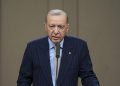
On 30 August 1922, Atatürk’s army won an important battle against the Greek army, paving the way for the establishment of the Turkish Republic in 1923. Erdoğan spoke in Ankara at the most important military academy. In his speech, he referred to lands where Atatürk had been, outside the current borders of Turkey, and said: “Whoever is trying to confine Turkey’s horizon to 782,000 square kilometres is a stranger to these lands. Even looking at the lands where Gazi Mustafa Kemal [Atatürk] left his footprint, is enough to understand the importance of the struggle we are waging today.”
As icing on the cake, Erdoğan said: “Our army is a source of hope for the oppressed all around the world with the crescent star flag it carries with honour as a badge of honour.”
Icing on the cake, as in: chilling. Can you imagine listening to such a speech as a Kurd who is denied his right to self-determination and is being oppressed by the militarist state that Atatürk created and Erdoğan leads? As a Kurd in Turkey, in Iraq, in Syria, whose lands are occupied by Turkey and where that flag is planted as a symbol of the violence that always comes with occupation, and of the forced assimilation into the Turkish identity?
Normalised
I have argued before that the Kurdish provinces of Turkey are in fact occupied by Turkey. For decades, the Turkish army didn’t engage much outside the sacred borders of the Republic, except for example in Korea in the 1950s and in Cyprus since the 1970s, but that has surely changed. Cross-border operations into Kurdistan in Iraq and Syria are fully normalised and so are the expanding occupations of those lands.
Under the pretext of fighting the PKK, Turkey is bombing the mountains in the Kurdistan Region in Iraq and wiping villages from the face of the earth and killing and displacing the inhabitants. While that gets some attention, the violence in Syria is basically not reported on at all. But the situation is terrible, as the report by Syrians for Truth and Justice (STJ) once again makes clear.
One of the regions STJ reports on, is Afrin, in northwest Syria. Kurdish-majority Afrin was one of the most stable parts of the country throughout the Syrian war, run by a Kurdish administration and militarily defended by the Kurdish YPG. But in early 2018, Turkey invaded and subsequently occupied it. STJ states that ever since, Afrin has been ‘subject to one of the largest demographic change operations witnessed in the Syrian conflict’, adding: ‘The vast majority of Afrin’s local Kurdish population was displaced, and hundreds of thousands of internally displaced people, from areas like Damascus and Homs countryside, were settled in their place.’
Kawa the Blacksmith
The report then continues to show how Turkification has completely altered the society and culture. Kurdish landmarks were destroyed and replaced by structures glorifying Turkey and its military. An example is the statue of Kawa the Blacksmith, an important figure in Kurdish mythology, that was standing at the centre of a roundabout in central Afrin, which was replaced by some weird structure depicting an ‘olive branch’, referring to the sinister name that Turkey gave its military operation.
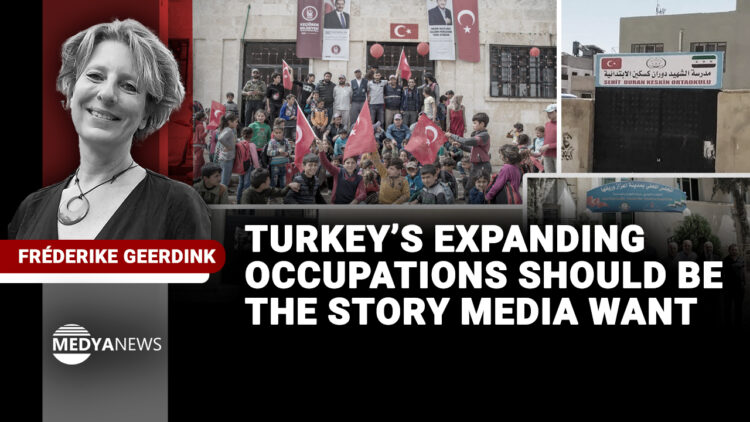
Schools in Afrin, but also in Arab-majority towns under Turkish occupation like Jarablus, Al-Bab and Azaz, teach a Turkish curriculum. The Turkish lira was introduced as everyday currency, portraits of Atatürk and Erdoğan appeared in schools but also in public buildings like post offices, Turkish flags are everywhere. Let’s echo Erdoğan’s words at Victory Day again: “Our army is a source of hope for the oppressed all around the world with the crescent star flag it carries with honour as a badge of honour.”
This is not the story media want to tell. It doesn’t fit their ‘framing’ of Turkey or Syria. Framing defined as the context in which media choose to report about, in this case, a country or region. Kurds are hardly ever the context. Why not? Because their struggle for freedom against their oppressors is, they think, not so relevant for Europe.
Dungeons
Currently relevant are, mainly, refugees. The extreme-right is becoming very strong in Europe. Most established media serve the extremist politicians’ fear-mongering and racist politics and rhetoric by making stories about, for example, the legality and technicalities of sending Syrian refugees, who have built lives in Europe, back to their home country. That Assad’s torture dungeons are still full of innocent citizens and that Turkey wants Syrian lands for keeps and rules the occupied lands with brutality, is hardly ever mentioned. Too complicated. Not fitting the frame.
Kurdish academic Loqman Radpey argued in a recently published piece, in which he makes a comparison between Turkey in Cyprus and Turkey in Kurdistan, that for decades, the US, the EU, NATO and the Arab League, have ‘made little to no effort to confront Turkey’s actions. They are effectively shielding Turkey from accountability for violating international law and humanitarian law, and for committing war crimes.’
The media’s silence is enabling this political cowardness. From political powers, we can hardly expect anything else than self-serving disrespect for the rules-based order they pay lip service to. From the media though, we must demand nothing less than a fierce and fearless commitment to the public interest, which is, ultimately, defending peoples’ lives and dignity, against the interests of power.
A new approach to journalistic framing is, in other words, desperately needed.
Fréderike Geerdink is an independent journalist. Follow her on Twitter or subscribe to her acclaimed weekly newsletter Expert Kurdistan.