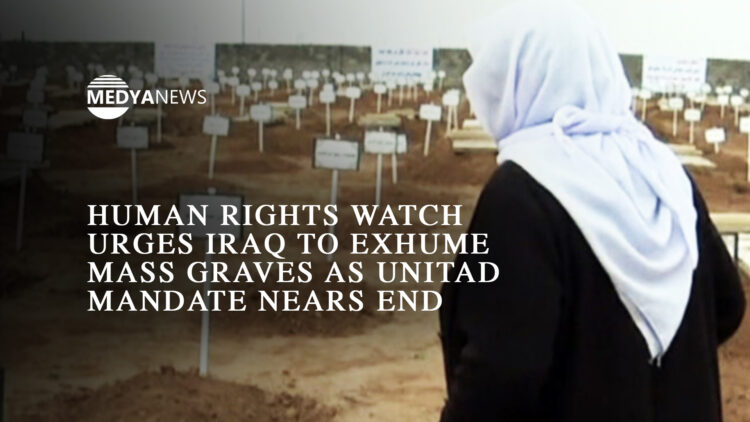
Human Rights Watch issued an urgent appeal on Tuesday calling on the Iraqi government to accelerate the exhumation of mass graves across the country. The graves, which contain the remains of hundreds of thousands of victims, serve as grim reminders of Iraq’s troubled history, including Saddam Hussein’s genocide of Kurds in 1988 and the mass killings carried out by ISIS between 2014 and 2017.
The United Nations Investigative Team to Promote Accountability for Crimes Committed by Da’esh/ISIL (UNITAD), established by the UN Security Council in 2017, has been instrumental in assisting the Iraqi authorities with this colossal task. With UNITAD’s support, Iraq’s Mass Graves Directorate and Medico-Legal Directorate have exhumed 67 mass graves linked to ISIS. However, concerns have risen following the UN Security Council’s decision in late 2023 to extend UNITAD’s mandate by just one year, with its operations now set to end in September.
Between 2017 and 2023, UNITAD played a crucial role in helping Iraqi authorities exhume 1,237 victims of the Camp Speicher massacre, in which ISIS executed 1,700 soldiers, cadets and volunteers who had fled the Tikrit Air Academy in June 2014. UNITAD’s June 2024 report found that these killings were carried out with genocidal intent, qualifying as crimes against humanity and war crimes.
Most recently, on 28 May, the Iraqi authorities and UNITAD began excavating the ‘Elo Enter’ pit, a mass grave located in the Tel Afar district, approximately 60 kilometres west of Mosul. Over 70 mass graves have been discovered in the region, believed to contain thousands of bodies executed and dumped by ISIS between 2014 and 2017.
The Strategic Centre for Human Rights in Iraq estimates that around 400,000 people are buried in mass graves across the country. Iraq has one of the highest numbers of missing persons in the world, with estimates ranging from 250,000 to one million, many of whom are believed to be buried in these graves.
Human Rights Watch called on the Iraqi government to take immediate steps to exhume these graves, identify the victims, and return their remains to their families for proper burial. They also urged the issuance of death certificates and compensation, as required by law.
Dhiaa Kareem Taama, head of Iraq’s Department of Mass Graves Affairs, reported that 288 mass graves had been uncovered since 2003, but noted that the lack of a unified national registry made it difficult to determine the total number of buried victims. Taama acknowledged the looming gap left by UNITAD’s departure and stressed the need for an alternative plan. However, he pointed out that the Iraqi government has already made its decision regarding UNITAD’s mandate, which poses a significant challenge for the future.
The enormity of the task, coupled with the limitations of the Iraqi government’s current capabilities, has resulted in a painfully slow process for victims’ families. Human Rights Watch has called for a more impartial approach to exhuming Iraq’s mass graves, regardless of the identity of the victims or the alleged perpetrators. They have also urged the Iraqi government to increase funding for the Mass Graves Directorate and the Medico-Legal Directorate to improve their capacity to collect evidence, use digital surveying, and reconstruct crime scenes. This would also include improving facilities for the storage of biological material and procedures for identifying victims.
“Exhuming all of Iraq’s mass graves will require a serious and sustained commitment by the Iraqi authorities, and it’s a commitment that must be made,” Belkis Wille, a senior crisis and conflict researcher at Human Rights Watch, said. “Healing the wounds of the past won’t be possible without it.”