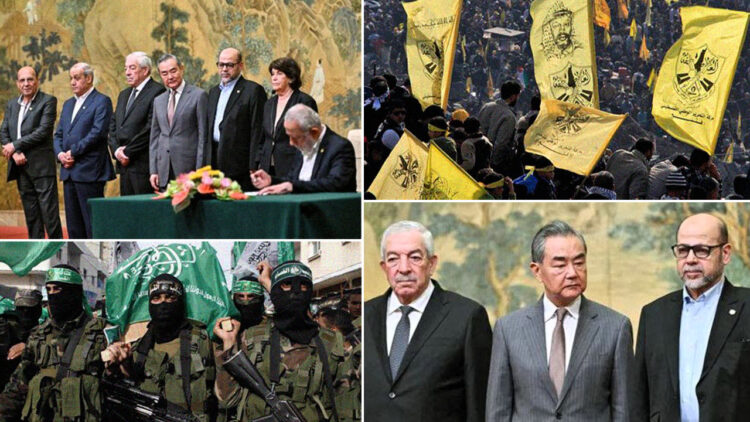
Fourteen Palestinian factions, including Fatah and Hamas, agree to end years of division and form a unity government. This landmark deal was signed in Beijing on 23 July, following three days of Chinese-brokered talks.
Hamas and Fatah, bitter rivals since their 2007 conflict for control over Gaza, have now committed to a unified leadership. Hamas has controlled Gaza since the conflict, while the Palestinian Authority, overseen by Fatah, retained partial administrative control in the Israeli-occupied West Bank.
China’s top diplomat, Wang Yi, emphasised the importance of Palestinian factions speaking with one voice. “Palestinian factions must be able to speak with one voice,” he stressed.
The agreement, dubbed the Beijing Declaration, is significant for its practical and detailed provisions. It outlines the creation of a unified leadership and an interim national reconciliation government for post-war Gaza. China has been a staunch advocate for Palestinian unity and a two-state solution, recognising the state of Palestine early on and hosting reconciliation talks between Hamas and Fatah in April.
Israel’s reaction has been fierce. Foreign Minister Israel Katz criticised Palestinian President Mahmoud Abbas, accusing him of embracing Hamas rather than rejecting ‘terrorism’. Katz asserted that Hamas’s rule would be crushed, and Israel’s security would remain under Israeli control.
Reports suggest that a secret meeting in Abu Dhabi included Israeli, US, and UAE officials discussing a post-war Gaza plan, involving UAE troops as part of an international peacekeeping force. This plan, pushed by the Biden administration, hinges on Israel agreeing to a two-state solution under the Palestinian Authority.
The agreement comes as Israeli Prime Minister Benjamin Netanyahu visits Washington, aiming to reassert his leadership amid domestic criticism over his handling of the war and the hostage situation in Gaza. His anticipated address to the US Congress is expected to be boycotted by several Democratic lawmakers.