

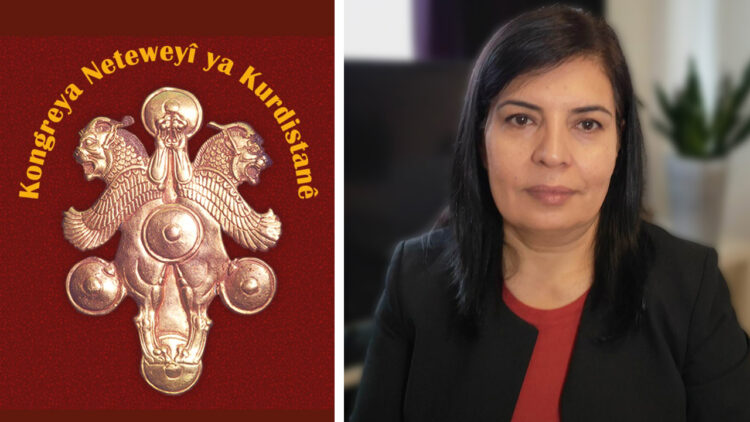
The Kurdish umbrella organisation Kurdistan National Congress (KNK) is mobilising against Turkey’s military expansion in the Kurdistan Region of Iraq (KRI), with Co-chair Zeyneb Murad has announced plans for an emergency meeting and action plan.
Turkey has been establishing new military bases and checkpoints and conducting identity checks in the KRI since 17 April 2022. Recent days have seen a significant military build-up in rural areas of Amêdiye district in Duhok.
‘We see hundreds of tanks and armoured vehicles and thousands of village guards being deployed to the region daily and stationed in evacuated villages. There is a resounding silence in the face of this,’ Murad said in an interview with the Mezopotamya news agency on 10 July.
She criticised the lack of response from both the Kurdistan Regional Government (KRG) controlled by the Kurdistan Democratic Party (KDP), and the central government of Iraq, warning, ‘Alarm bells are ringing for the status of South Kurdistan [KRI]. Turkey’s attacks were carried out in alliance with the central government and the South Kurdistan government.’
Murad highlighted concerns about a broader strategy targeting both Iraqi Kurdistan and North and East Syria. “The alliances that Turkey has formed with the central Iraqi government and the South Kurdistan government are significant,” she said.
The Co-chair also pointed to recent diplomatic moves, including the visit of KDP leader Masoud Barzani to Baghdad, as evidence of coordinated action. “This means that the expansion of Turkey’s attacks is taking place with the knowledge of the Baghdad and Hewlêr governments. This is a great danger for our people,” Murad warned.
Addressing recent developments in Turkish-Syrian relations, Murad said, “Turkey has recently entered into ways of allying with the Syrian leader Bashar al-Assad. They are prepared to compromise on everything to finish off the Kurds.”
Murad highlighted historical parallels to emphasise the gravity of the current situation. She referred to the Lausanne Treaty of 1923, which left the Kurds without a state, and the Algiers Agreement of 1975 between Iraq and Iran, which aimed to suppress Kurdish autonomy movements. Murad argued that these past events demonstrate a pattern of regional powers collaborating to undermine Kurdish interests. She stressed the importance of learning from this history in order to better understand and respond to present-day challenges facing the Kurdish people.
The KNK has established a Crisis Desk in response to the recent developments, Murad announced. “In the coming days, we will hold an urgent meeting with all artists, writers and politicians, as part of the emergency action plan. We need a political decision for our people,” she explained.
She concluded with a call for unity: “Let us all form a ring around Kurdistan to protect the gains of Kurds and Kurdistan. Let us oppose these occupation plans with a national stance.”


