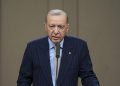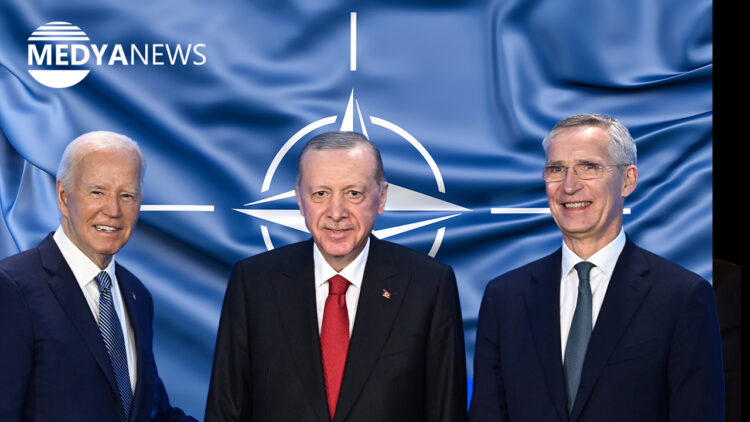
Heads of State, gathering in Washington for the 75th anniversary of the signing of the North Atlantic Treaty, welcomed Sweden as the newest member of NATO, reiterated their standing as a defence alliance, and outlined unprecedented global security threats. Meanwhile, Turkish President Recep Tayyip Erdoğan, leader of the second largest army in the military alliance after the United States’, signalled a split from its NATO allies in war policy on Ukraine, Gaza and Kurdish forces in the Middle East.
Modernised NATO faces “global and interconnected” security threats, the leaders declared, underlining the Russian threat and invasion of Ukraine and “terrorism, in all its forms”. Conflict and instability in Africa and the Middle East fuels broader forced displacement, human trafficking and irregular migration, they warned, while Iran’s “destabilising actions” and an emerging China-Russia strategic partnership “reshape the rules-based international order”. Rogue actors have launched malicious cyber and space attacks, the heads added.
Despite the NATO member states’ show of solidarity laid out in the Summit Declaration, Erdoğan told Newsweek that the Western powers were taking a “wrong and potentially dangerous” approach to the Ukraine and Gaza wars. A split between Turkey and its NATO allies, both geographically and in terms of domestic socio-democratic development indicators determines the rupture, with the Turkish president leveraging his power of veto and exasperating tensions.
Turkey does not belong in @NATO. pic.twitter.com/cdy0wK9kb1
— Diliman Abdulkader (@D_abdulkader) July 10, 2024
‘Data taken from Freedom in the World 2024, which analyses political rights and civil liberties on a 100-point scale, with 100 representing the highest level of freedom.’
The Turkish Armed Forces have launched a ramped-up incursion into Iraqi territory this month, bringing in hundreds more tanks and thousands of soldiers, expanding occupation of the Kurdistan Region, a longer-term plan to create a ‘security buffer’ along the Iraqi and Syrian borders with Turkey. Kurdistan Workers’ Party (PKK) forces with strongholds in the mountainous border region of Iraqi Kurdistan have launched a strong resistance.
Erdoğan has sought support from the US for its cross-border military incursions, and although the White House has given it a ‘de-facto green light’, blocks remain due to the US support for the Syrian Democratic Forces (SDF), Kurdish-led forces based in North and East Syria that partnered with the US in the Global Coalition Against ISIS, and to whom Turkey alleges links with the PKK.
Erdoğan’s cited anti-terror operations against Kurdish-forces are therefore fraught with complex loyalties for the US in terms of its SDF partners. Unable to garner full NATO backing, the Turkish president reached out to the federal Iraq government, in the first such attempt at rapprochement in over a decade.
Turkish Foreign Minister Hakan Fidan illustrated Turkey’s dilemma and subsequent lobbying agenda, as cited by Arab-American Al Monitor: “To be frank, there are two and a half NATO member countries with which we have problems on the issue of the YPG [SDF-allied forces]: the United States, United Kingdom and, a little bit, France.”
Turkey is expected to host the 2026 NATO summit, with Mark Rutte, the newly elected NATO chief set to take over from Jens Stoltenberg in October, signalling renewed support for Turkey’s foreign policy and thanking Turkish President Erdoğan for his support.
🔷Mark Rutte, newly elected NATO chief, thanks Erdoğan for his support, vowing to uphold NATO’s ‘collective security’. Read more:#NATO | #Turkey | #MarkRutte https://t.co/x8MRxOJyhP
— MedyaNews (@medyanews_) June 28, 2024
Last month Mark Rutte thanked Erdoğan for his support, vowing to uphold NATO’s ‘collective security’.