

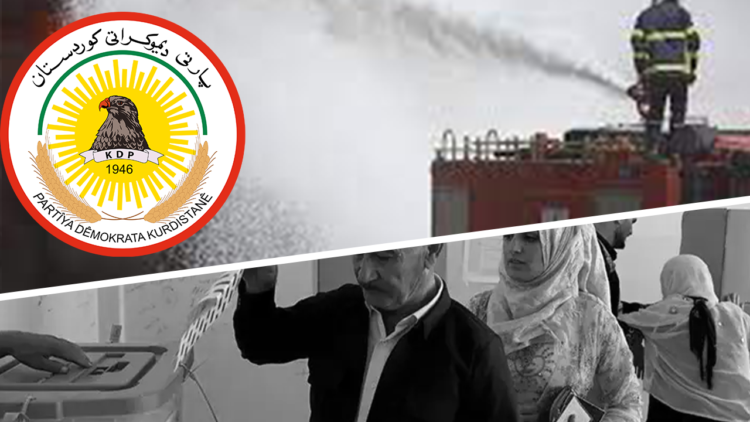
Following two years of parliamentary election delays in the Kurdistan Region of Iraq (KRI), the regions’ Kurdistan Democratic Party (KDP), the largest party in the regional government, is continuing actions to further stall the democratic process, analysts say. The KDP recently accused it’s main rival, the Patriotic Union of Kurdistan (PUK), and the Kurdistan Workers’ Party (PKK), an Kurdish movement with a significant presence in the Qandil mountains, of starting market fires, claims both deny as slander.
Furthermore, the KDP is alleged to have been cooperating with Turkish Armed Forces to occupy areas in Duhok, while KDP-affiliated media asserted Sulaymaniyah (Silêmanî), a PUK stronghold, has been turned into a PKK training ground.
Despite deploying a political strategy to defer the elections and achieving some success, the Kurdistan Democratic Party (KDP) was forced to set 20 October as the election date for the KRI due to domestic and international pressures and the Federal Court’s decision. Nonetheless, evidence of the party’s attempts to postpone the elections, citing the war and exceptional state, remain persistent.
By accusing the PUK and PKK of involvement in the recent fires in Erbil (Hewlêr), Zakho (Zaxo) and Kirkirk (Kerkûk), the KDP appears to be attempting to legitimise the Turkish government’s occupation attacks on the KRI (also known as Bashur or Southern Kurdistan). Additionally, the Erbil-based party may be setting the stage for an attack on Sulaymaniyah (Silêmanî) airport, which would give them the pretext to postpone the elections due to war conditions.
Even though Turkish National Covenant Organisation (TASHKILT-E EHDI MILLI TURK), an ultra-nationalist group, claimed responsibility for the fires in Erbil and Kirkirk on its official website, the KDP’s recent accusations against the other two Kurdish parties suggest the party is preparing blockages for a potential election delay.
To achieve such a goal, the media affiliated with the KDP are likely preparing the ground for the development of a state of war in the Sulaymaniyah region, by publishing claims about the presence of PKK fighters and training facilities in the Sulaymaniyah region, therefore legitimising Turkish drone attacks targeting Sulaymaniyah airport.
The transfer of 300 Turkish tanks and armoured personnel carriers to the Upper Barwari (Berwari Blal) region in recent days, the continuation of ground attacks in Dohuk province, the construction of military bases, the creation of checkpoints to control the identity of the residents of this region, and the presence of more than 300 ISIS-affiliated forces are considered by many commentators as signs of a joint operation by Turkey and the KDP to create a state of war in the Kurdistan Region and postpone the elections.
If the KDP can achieve partial success in its efforts to postpone or disrupt the elections, it may, with Turkey’s cooperation, maintain its hegemony over other opposition groups in the Kurdistan Region and potentially turn the current political situation into a de facto state.


