

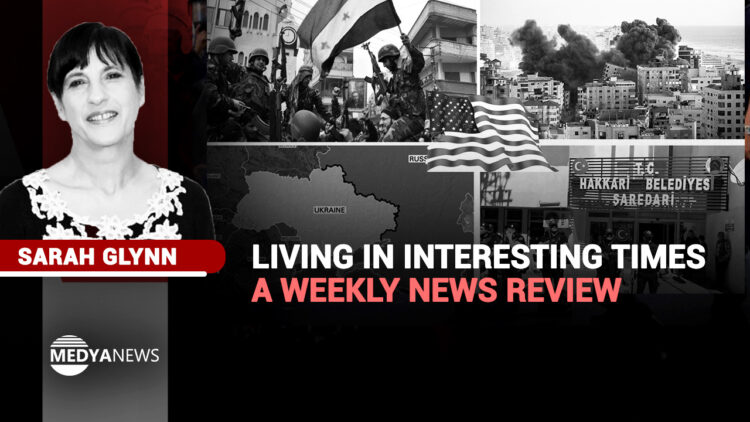
This has been a relatively quiet week for Kurdish politics, but that doesn’t mean that life has got any easier. Meanwhile international war continues to threaten our planet, and the Doomsday Clock, which is set by scientists each year as an “indicator of the world’s vulnerability to global catastrophe caused by man-made technologies”, still stands at an all-time most vulnerable 90 seconds to midnight.
In this hour of need, Western leaders are proving themselves as distant from reality as they are from most of their citizens. Anyone who hopes that “cometh the hour cometh the man” will look in vain among them for a leader that can turn the world back from disaster. Kurds will answer that there is a leader who has pointed a way out of this global destruction, but Abdullah Öcalan is held incommunicado within a Turkish prison, and international powers will not lift a finger to enable his voice to be heard.
Before looking at what a quiet week for Kurdish politics can actually mean on the ground, I want to step back and examine wider political changes that are affecting everyone, and not least those living in the contested regions of the Middle East.
The decline of US hegemony
Noone with any knowledge of American politics could expect the United States to face threats to their world political and economic dominance without a struggle, or that that struggle would not be carried out with a ruthlessness that would risk the lives of millions of people and even the future of the planet. A US empire in decline is an even more dangerous thing than in its time of expansion, and, as always, America drags Europe in its wake. They are incensed by the rising power of China, of course, and determined to contain their old rivals in Russia – even though Putin’s Russia is as opposed to Soviet communism as they are – and in their ruthless determination to hold onto power, they appear to be creating that which they most fear, a coming together of other countries who find shared interests in thwarting US and Western dominance.
For eight decades, the United States of America has used all means to ensure that a great part of the world is run in the interests of US capitalists and their military industrial complex; and for three of those decades, up to the recent rise of China, their dominance went largely unchallenged. America has used their power to crush and subvert all attempts at creating socialist alternatives or even social democratic mediation of capitalism, and they have succeeded in creating a world where capitalism has reached its worse ever crisis, with insupportable inequalities and unsustainable pressure on the planet itself.
The decline of such a negative force can only be welcomed, but no one can have any illusions in the regional and international powers that seek to take America’s place and take a share of world resources for their own capitalists. Today’s scramble for power and resources, and readiness to resort to military means, suggests that international relations have progressed little since the days before the First World War, even while weapons technology has attained terrifying heights.
Israel-Palestine
Western, and especially American, support for Israel, which is seen as a strategic foothold of Western power and civilisation, has revealed the hypocrisy of Western claims to morality. America, together with other Western nations, is supplying the weapons that Israel is using to carry out genocide in Gaza. They are publicly supporting Israel and relaying Israeli propaganda. For many in the West itself, this has been an eye opener with respect to the nature of US power and the culpability of their own elites. Internationally, public revulsion has turned against Western governments and their hollow talk of human rights.
Ukraine
With respect to the war in Ukraine, the danger of world-scale military catastrophe is even greater, and the impacts on international power balances and alliances are already huge; however, this war lacks the moral clarity of the genocide in Palestine, and analysis is often confused. America’s covert takeover of Ukraine’s politics in 2014, the years of bloody civil war, and incorporation of Ukraine in NATO plans to encircle Russia and limit Russian political and economic interests, have become obscured by Russia’s subsequent invasion. The natural sympathy that this invasion evoked for Ukraine – for Ukraine as a nation as well as for its people – has made it easier for NATO to pursue a proxy war against Russia in which real concerns for Ukrainian lives and freedoms have become subservient to American aims to wear down Russian military power. Instead of pushing for a peace agreement and the need for compromises from both sides, western nations continue to chase the illusion of total victory for Ukraine, to ignore Ukrainian authoritarianism and gloss over the rise of far-right Ukrainian ethnic nationalism, and to pour more weapons into the conflict.
In accounts from both sides, propaganda is given more importance than truth, but the Quincy Institute is interesting for its attempt to inject some sobering reality into US political discourse. Anatol Lieven writes for their journal, Responsible Statecraft, “For Ukraine to recover any significant portion of the land it has lost to Russia now looks highly unlikely given the balance of military and economic strength between the two sides, and the complete failure of last year’s Ukrainian offensive. To recover everything it has lost since 2014 looks impossible. It would require the total defeat of the Russian armed forces, which no serious military observer now expects. To bring this about would require NATO to launch a full-scale attack on the Russian army in Ukraine — something that has been ruled out by the Biden administration and the great majority of NATO governments, and that if it occurred, would make nuclear war not just likely, but highly probable.”
The American government must be aware of these realities, even as they continue to fuel the conflict. In May they agreed to give Ukraine $61 billion in military aid, and at the end of the month, they gave Ukraine permission to use US-supplied weapons to hit targets inside Russia. On 11 June they lifted their ban on arms shipments to the Azov Brigade, which is notorious for its neo-Nazi connections. A week ago, at their summit in Italy, the G7 group of rich nations agreed a $50 billion loan to Ukraine backed by the interest on Russia’s frozen assets held in the West: a move that President Putin has described as theft. Ukraine’s President Zelensky was a guest at the summit, where he and President Biden signed a 10-year bilateral security deal between the United States and Ukraine.
At the same time, the US has used fear of Russia to extend their control over Europe, notably with the NATO membership of Finland and Sweden. Last week, Sweden also finalised an agreement that gives the US military access to all Sweden’s military bases, and that has raised fears of facilitating the placing of nuclear weapons in Sweden.
China
While NATO is in a brutal proxy war with Russia, the United States is increasingly regarding China as their main enemy. John Pilger released his warning documentary “the Coming War on China” in 2016; America and China have been in a trade war since Donald Trump’s presidency; and, last year, China’s President Xi Jinping told European Commission president Ursula von der Leyen that “the US was trying to trick China into invading Taiwan, but that he would not take the bait,” as the Financial Times reported this week. This accusation was denied by the US State Department. The possibility of a Trump presidency has incentivised America to arrange support for Ukraine before the upcoming presidential election; however, while Trump has less appetite than Biden for war with Putin, he is obsessed with destroying Chinese competition.
New international alliances
Both Gaza and Ukraine have accelerated the development of new international alliances, and encouraged countries to make new links outside the American hegemony. They have given a powerful boost to the BRICS organisation and to the Shanghai Cooperation Organisation, and to the move away from the dominance of the US dollar in international trade.
BRICS describes itself as “an informal group of states” initiated by Russia in 2006. Founder members Brazil, Russia, India and China held their first summit in 2009, and were joined by South Africa a year later. The group now also includes Iran, Egypt, Ethiopia and the United Arab Emirates. It claims to incorporate nearly half the world’s population, and to be responsible for 36% of global GDP and 25% of world trade.
The Shanghai Cooperation Organisation (SCO) brings together Eurasian countries, and was established by China and Russia in 2001 on the back of an earlier organisation. It’s remit includes defence and economics, but member countries have sometimes conflicting outlooks, and there is no collective security agreement like NATO has. Their Regional Anti-Terrorist Structure focuses on the “three evils” of “terrorism, separatism, and extremism”.
While these organisations contribute to making a more multipolar world, they provide no challenge to the capitalist system, which is fuelling inequality and threatening our planet.
The political volatility is also reflected in new partnerships, such as the Comprehensive Strategic Partnership Agreement signed by Russia and North Korea this week. The US claims that North Korea was already providing arms to Ukraine. Now, the two isolated and sanctioned states have agreed to support each other to the extent of promising mutual assistance in the event of an attack. NATO is not happy, and South Korea has threatened to send arms to Ukraine in response. Russia has also agreed a new economic partnership with Vietnam, which attempts to maintain political neutrality.
Turkey
This geopolitical situation provides plenty of opportunities for regional powers, such as Turkey, to make beneficial alliances. Turkish foreign minister Hakan Fidan visited China and Russia this month. Turkey has long been sniffing around both BRICS and the SCO, where they have been a Dialogue Partner since 2013. Putin has promised to support a Turkish application to join BRICS, and Turkey is expected to attend the SCO summit in July. President Erdoğan was also a guest at the G7 summit.
Barın Kayaoğlu in Al-Monitor suggests that “Ankara’s main aim is to diversify its cooperation avenues”. Turkish trade with the European Union is roughly equal to their trade with Russia and China combined, and they are not alone in trying to keep a foot in both camps. Their approach can also be understood as part of Erdoğan’s long-running policy of playing Russia and NATO off against each other, and is facilitated by Turkey’s geostrategic importance.
Syria, Iran, and Iraq
Looking at the other states that control the Kurdish region, President Assad’s Syrian Government has been able to survive thanks to Russian backing, which is a legacy from Cold War days. Iran is an ally of the Russian-backed Syrian Government with both fighters and economic interests in Syria; and Iran has direct influence in Iraq through linked political parties and militias. Iran became a member of the SCO last year and of BRICS in January. They have also gained a new international importance through their support of Hamas. Despite the brutal treatment of their own people, their rejection of the West has brought them an element of international respect.
Sadly, standing up to Western dominance need not equate to any form of progressive radicalism, and in this new power struggle, stateless groups, such as the Kurds, that don’t conform to the agendas of the dominant players are left to fall through the gaps.
And what has this week brought for the Kurds themselves?
Kurds in Turkey
I will start with Turkey, where rallies and vigils continue in protest over the removal and imprisonment of the elected DEM Party mayor of Hakkâri. This week also saw the release of one of the co-mayors arrested after the first purge of Kurdish mayors in 2016. Mukaddes Kubilay spent nearly eight years in prison, and her release was delayed for so-called misbehaviour, including shaking hands with prisoners’ families.
Speculation continues around the meetings between Erdoğan and Özgür Özel, leader of the opposition Republican People’s Party (CHP). Özel made clear, in an interview with T24, that for the CHP “normalisation” of Turkish politics “will not exclude the Kurds”, and that “it must start with ending the policy of appointing trustees in Kurdish areas”. Erdoğan responded to talk of a rift between his Justice and Development Party (AKP) and the Nationalist Movement Party (MHP) with assurances of a continued alliance.
While Kurdish mayors can be removed simply for doing their job, the AKP mayor of Uğurludağ, Remzi Torun, has pulled a gun on members of the MHP at a police station after a fight broke out between the two parties.
The judge who was central to the attempt to disqualify the newly elected mayor of Van, by cancelling his own earlier decision to restore the mayor’s legal rights, has been rewarded with promotion.
Reports from Turkey’s prisons include many instances of release being postponed beyond the expected date, including for prisoners incarcerated for 30 years. Naif İşçi, who was only 14 when he was arrested and imprisoned for 14 years, had his release postponed for three months after the prison board demanded he give his opinion on Öcalan and the PKK. It is illegal to make someone express their opinion, and he refused to do so – but he was punished anyway. After an appeal against his punishment had been rejected in court, the case was raised in parliament.
A ward search in a Diyarbakir prison saw officers confiscate prisoners’ writings and address books.
Political prisoners are continuing their action for Öcalan’s freedom and a solution to the Kurdish Question. They are highlighting his conditions of prison isolation by copying them – refusing to go to court or to have visits or phone calls with their families. The prisoners’ families support their protests with demonstrations.
Parts of eastern Turkey regularly get declared Temporary Security Zones for the military to search out PKK guerrillas or those accused of helping them. Villages are put under curfew, and animals can’t be taken to pasture, nor children get to school. This week, two people were killed and two seriously wounded when the army carried out an operation in Batman Province, and one PKK fighter was killed by an military operation in Agirî. Two more operations are taking place in Şirnex.
In order to block the passage of Kurdish guerrillas, and also of smugglers and refugees, Turkey has been continuing to erect a concrete wall along their border with Iran – which welcomes the construction. They already have a wall on the Syrian border, and Turkish border guards frequently attack would be refugees trying to leave Syria. This week they tortured four young people from Hesekê.
In this hot dry season, fires are common, but Thursday night’s fire, which consumed a large area of farmland between Diyarbakır and Mardin and destroyed several villages, was of exceptional ferocity. Twelve people are known to have died, including young people who were attempting to put out the flames, and around 80 more were injured. The landscape is now dotted with the carcasses of livestock. Alongside the sorrow, there is anger that the government only managed to produce a helicopter in the morning, when the fire had already been finally extinguished.
Rojhelat
Reports from the previous week show that there have also been major fires in the mountains of Rojhelat, the Kurdish region of Iran, where the flames have consumed some 200 hectares of forest. There is no help from the authorities, and local people fear that fires are started deliberately by the government to destroy areas used by Kurdish fighters.
The Kurdistan Region of Iraq
The mountains of the Kurdistan Region of Iraq are still under heavy bombardment from the Turkish military, and the Community Peacemaker Teams NGO recorded well over 800 attacks and bombings and the death of eight civilians in the first six months of this year. Some of these bombings also result in forest fires. The PKK has carried out counter attacks against the invading forces using ambushes and kamikaze drones.
North and East Syria
North and East Syria continues to face attacks from Turkey and their mercenary militias. In Manbij Canton, Turkish artillery bombardment caused more fires, and on the Eid al-Adha holiday, an attempted infiltration was repulsed by the Syrian Democratic Forces (SDF).
Iran-backed militias have carried out more attacks in the troubled region of Deir ez-Zor. And in Turkish occupied Afrîn, there have been more kidnappings, including of a man recently deported back from Syria. US forces killed a senior ISIS official in Afrîn – and the SDF showed how Turkish-backed groups attempted to portray this as a civilian death caused by the SDF.
Europe
Kurds are not safe even in Europe. Gülhatun Kara, a Kurdish woman activist who has been living in France as a refugee since 1991, faces extradition to Germany, where many Kurds have been imprisoned for supposed links to the PKK. She was arrested on 12 June and subsequently released, but will face a court hearing on 3 July.
In Serbia, Ecevit Piroğlu is clinging onto life on the 132nd day of his hunger strike against the Serbian authorities who have kept him detained in limbo for three years. The Serbian court has ruled against his extradition to Turkey, but the state refuses to set him free.
And Nourzad Alimoradi from Kermanshah Province, who was being deported back to Iran after the rejection of his eight-year quest for asylum in Norway, attempted suicide in Istanbul Airport. Hengaw Organisation for Human Rights reports that he is a member of the Democratic Party of Iranian Kurdistan, and “faces the risk of severe penalties”.
It is increasingly difficult to get Kurdish voices heard above the clamour of international politics, but this week, under the banner of Öcalan Dialogue Days, activists across the world have been organising events to highlight not only the criminal isolation of Abdullah Öcalan, but the potential of his ideas for inspiring change well beyond the Kurdish movement.
Sarah Glynn is a writer and activist – check her website and follow her on Twitter


