

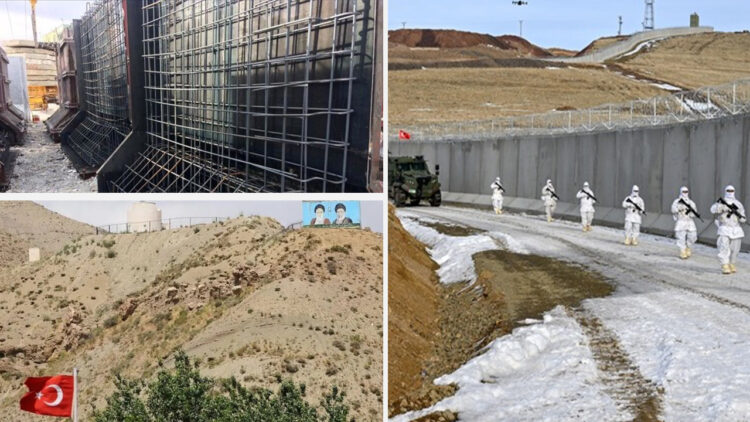
Turkey has completed another section of its security wall along the border with Iran, between Bakur (Eastern Turkey) and Rojhelat (Iranian Kurdistan). The wall, intended to prevent the movement of Kurdish freedom fighters through mountainous regions of Kurdistan, has caused environmental problems and disrupted the daily lives of residents on both sides of Kurdistan.
Since 2021, the Turkish state has focused on building a 560 km long concrete security wall between these regions to combat Kurdish freedom fighters, curb illegal trafficking, and manage immigration. In the most recent phase, 173 km of the concrete wall has been finished, starting at the borders of Chaldoran and due to extend to the town of Gever in Jolamerg province. An additional 163 km has been fortified with barbed wire and trenches.
Since the start of Turkey’s security project, Iranian authorities, as stated by Iran’s Ministry of Foreign Affairs, have welcomed Turkey’s plan to build a border security wall between the two countries.
The Turkish security forces are employing cameras, drones, armoured vehicles, and specialised security units to prevent any movement between the borders. Special teams from the Search and Mine Clearance Battalion, under the Ankara Gendarmerie Engineering Command, are clearing mines along the border to facilitate the construction of the security wall and the excavation of trenches.
This security border wall is equipped with advanced monitoring tools such as electro-optical devices, thermal cameras, and seismic sensors, ensuring continuous surveillance around the clock. Aselsan, the largest defence electronics company in Turkey, is responsible for implementing this project. The company is affiliated to the Turkish Armed Forces Foundation (TAFF).
Local sources report that the construction of the security wall in the Maku region has led to several issues for residents. The project has resulted in the destruction of roads and the environment, the loss of livestock due to flooding, and the separation of families living on either side of the border. Additionally, the construction of the wall has had a detrimental impact on local businesses in the region. However, despite strict monitoring of traffic between the two sides of the security wall, local sources report that residents on both sides have often managed to cross the wall to continue their business transactions.
In addition to Turkey’s construction of the security wall, other countries and parties in the region have also undertaken measures to expand the security space in the region. The Islamic Republic of Iran has erected walls along sections of its border with Pakistan, and the Iraqi government has begun constructing a border wall with Syria. Furthermore, over the past four years, the Kurdistan Democratic Party (KDP) has been digging a trench to encircle the northeastern regions of Syria (Rojava).


