

Amed Dicle
UCAVs (Unmanned Combat Aerial Vehicles) play an important role in the Turkish state’s conflict with the Kurds. Since 2015-2016, these vehicles have been used intensively in the Kurdistan region, killing many Kurds in the process. UCAVs have been used effectively against PKK guerrillas, but attacks have also been carried out against civilians. Hundreds of civilians, especially in Rojava and South Kurdistan regions, lost their lives in the attacks of these drones.
New Developments: PKK shoots down UCAVs
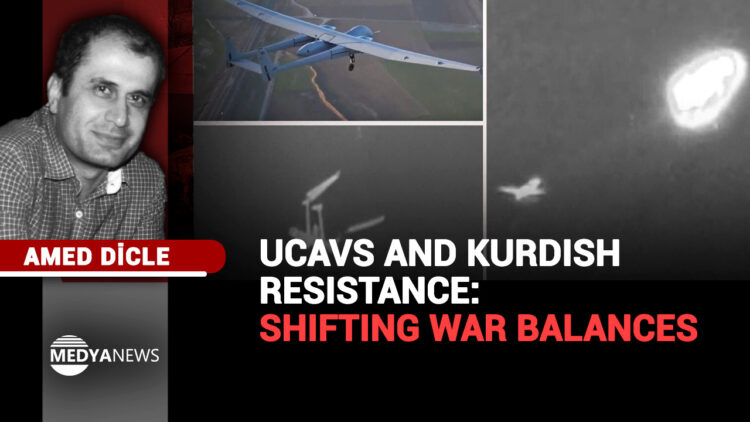
As of 2024, there have been some new developments. Murat Karayılan, a member of the PKK central committee, announced in a statement before Newroz that they would give important good news. On 20 March, the People’s Defence Central Headquarters Command announced that they had shot down the UCAVs. According to this statement, between February 2023 and February 2024, 15 Turkish UCAVs were shot down by PKK guerrillas in the Kandil, Gare and Zap regions. Images of these downed UCAVs were also published. This development caused great excitement and joy among the Kurds at Newroz.
Silence of the Turkish State
But what did the Turkish side do against this situation? As it has often done, they were silent. The Turkish side did not give an official response to this situation, did not make a denial, could not. Therefore, this silence means that they indirectly accept the situation. Just last week, another Anka-type UCAV was shot down in Kandil and its images were published. These developments show that UCAVs are no longer able to fly as easily as they used to and that they have been shot down.
Media Speculation
The Turkish state has not made an official statement in response to this situation, but has started to speculate through its own media. The regime’s Yeni Şafak and Hürriyet newspapers claim that the PKK has been given kamikaze drones by Iran. Such baseless reports have been proliferating in recent days. However, there is no concrete information or document to support these allegations. With these news reports, the Turkish side is trying to cover up its failures against the Kurds by accusing Iran. In these reports, it is written that Iran has given hundreds of kamikaze drones to the PKK. In fact, the implication here is that the PKK may have such technology at its disposal. These reports have a diplomatic objective, but at the same time they are simple intelligence work. It is an ordinary envelope-pushing situation. In other words, in order to understand the capabilities of the PKK, they are trying to find out what the real situation is by putting forward a claim.
Shifting Balances
In light of these developments, the period of Turkey’s effective use of these UCAVs appears to be at its end. Although the details of how the PKK shot down these UCAVs are unknown, it is understood that the PKK has improved its military capabilities and taken effective measures against these vehicles. Turkey’s diminishing ability to use these tools, especially in Syria and Iraq, may change the strategic balances in the region once again.
Regional and International Dynamics
Turkey uses various strategies against Iran and Russia, both in diplomacy and propaganda. Turkey blames Iran in order to demand more help against the Kurds both in Southern Kurdistan and in Syria. At the same time, it is pursuing a similar strategy with the United States. Turkey is constantly asking for help from America, Iran, Russia and Iraq, as if admitting that it has not succeeded against the Kurdish struggle. This is a confession of defeat and failure.
Although Iran is disturbed by Turkey’s expansionist policies in the region, Iran does not want the Kurds and especially the PKK to be powerful. Turkey plans to use such news to pressure Iran at the Astana meeting to be held in the coming days. Iran’s alleged support for the PKK can also be interpreted as an admission of a potential risk to Turkey’s strategic interests in the region. The statement by Erdoğan and Hakan Fidan, “If it weren’t for us, nothing would happen in the region”, suggests that they have not only failed to shape the region but have also hit rock bottom politically and militarily in their struggle against the Kurdish movement, attempting to explain this through Iran or other powers.
The following question can also be asked here. Why is Iran being blamed?
Iran is in a key position in Syria and Iraq and Turkey has a great need for Iran. And since there is a Kurdish problem also in Iran, the Iranian regime does not want the Kurds to be powerful. To some extent, Iran supports Turkey. They have security and strategic co-operation agreements with Turkey.
While Iran fulfils the requirements of these agreements on the one hand, on the other hand, it is of course disturbed by Turkey’s expansionist policy in the region. In other words, Iran and Turkey have friendship and co-operation, but they also have rivalry. But it is almost impossible for Iran to give drones, technology, weapons to the PKK, to the Kurds. This is because Iran does not want the Kurds and especially the PKK to be strong. This is against Iran’s policy both in Iraq, within Iran’s own borders and in Syria. Iran would not provide such assistance to the PKK as a requirement of its own policy. But doesn’t Turkey know this? Of course it does. Turkey is serving this news in order to put pressure on Iran during the meeting on Syria to be held in Astana on 3-4 July.
The government officials do not say it directly, but they dictate it to the Turkish media. They will tell the Iranians that our media said so. They are making these speculations in order to bring the issue to the agenda, to test Iran’s pulse and to obtain help from Iran in a possible situation. Turkey is also using ISIS Khorasan against Iran and Russia. There was also an attack on Iran. Last year, dozens of people were massacred in the mausoleum of Qassem Sulaymaniyah. It turned out that these people came from Turkey. It turned out that the centre of ISIS Khorasan is Turkey. Again, in February, there was a brutal attack on a theatre hall in Moscow. It was revealed that the perpetrators of this attack also travelled from Turkey. In fact, the Co-Presidency of the KCK Executive Council had announced in a statement that Turkey was using ISIS Khorasan against these two countries.
On 18 June, a news report was published in the AKP newspaper Hürriyet. According to the news, ISIS Khorasan was planning an attack on Russia and Turkish intelligence informed Moscow to prevent it. The Turkish administration has planned this mise-en-scène. They had done it against France before. They both transport ISIS terrorists to these countries to carry out attacks, but at the same time they prevent the attack they themselves planned by informing these countries! By doing this, they make these states indebted to them. In return, they want them to take steps against the Kurds. Hakan Fidan’s displaying this mise-en-scène before going to Putin last Tuesday is also an admission of the jam they are in. Because they also have an operation plan for northern Syria. For this, they need Russia’s support one way or another. In the news mentioned above, it is said that there is kamikaze drone technology in northern Syria. If UCAVs are shot down in northern Syria, they cannot be hidden. The myth created by the Turkish regime will collapse. For this, they are trying to influence Russia and Iran both through manipulations and diplomatic means and to get help from them.
Conclusion
The Turkish state has realised that they cannot use their UCAVs as effectively as before, and this has worried state officials. These developments are expected to be further elaborated and revealed in the coming period. These changes may have a significant impact on the military strategies of the Turkish state and the balance of power in the region. Since it is known that the truth will come out one day, silence is considered as an indirect confession of this situation. We will continue to follow these developments and share them with you.
Amed Dicle was born and raised in Diyarbakır, Turkey. He has worked for Kurdish-language media outlets in Europe, including Roj TV, Sterk TV, and ANF. His career has taken him to Rojava, Syria, Iraq, and many other countries across Europe. Follow him on Twitter.


