The Kurdish language has witnessed its own revolution, thanks to the Rojava Revolution, despite attempts to exterminate Kurdish language and identity, a Kurdish lecturer at the University of Kobane has said.
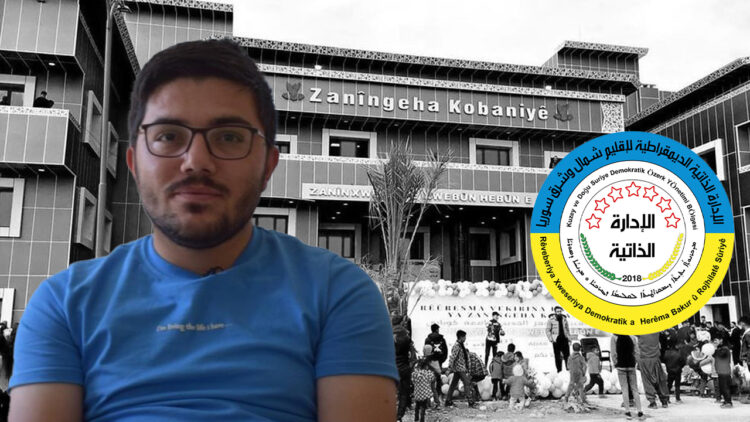
Aras Hesso, lecturer in the Department of Kurdish Language and Literature, spoke to Hawar News Agency (ANHA) to mark Kurdish Language Day on 15 May.
“The Rojava Revolution can be considered a revolution for women and youth, and a revolution for the language,” the lecturer said, adding, “Our universities, institutes, and schools all teach in the Kurdish language, and this in itself is a historical step, no matter how much we talk about the Kurdish language.”
The Rojava Revolution was a social and political transformation that led to the establishment of a de facto autonomous administration in northeast Syria, an area primarily inhabited by Kurds and other ethnic and religious groups. Originating amidst the backdrop of the Syrian civil war that commenced in 2011, the Rojava Revolution gained momentum in 2012, aiming to build a decentralised, multi-ethnic, and democratic system in northeast Syria based on principles of direct democracy, gender equality, and environmental sustainability.
The Democratic Autonomous Administration of North and East Syria (DAANES), the self-governing system that came out of the Rojava Revolution, marked Kurdish Language Day with a statement, saying “Kurdish Language Day is the day of awareness against policies of cultural genocide.”
“We, in the Democratic Autonomous Administration of NE Syria region, confirm that our diligent work will continue so that the Kurdish language is not only official in the NE Syria, but also in everywhere there are Kurds in Syria,” the administration affirmed.
In another article for ANHA on Kurdish Language Day, Mohamed Abdo looks at the reality and challenges of the Kurdish language in Syria, along with the milestones achieved. The first Kurdish language school was launched in Daraqali village, Afrin, on 6 October 2011, and the University of Afrin was inaugurated in August 2015. Prior to the Turkish occupation, Afrin boasted 318 schools overseen by the Education Body, catering to approximately fifty thousand students across different levels.
However, the Turkish invasion disrupted these educational endeavours. Schools ceased operations due to bombings, and educational institutions were looted and repurposed by Turkish forces. Numerous Kurdish language teachers were abducted, while the Turkish occupation imposed the Turkish language in schools, marginalising Kurdish education to a few classes per week before ultimately discontinuing it, citing a lack of teaching staff.