Professor Michael M. Gunter
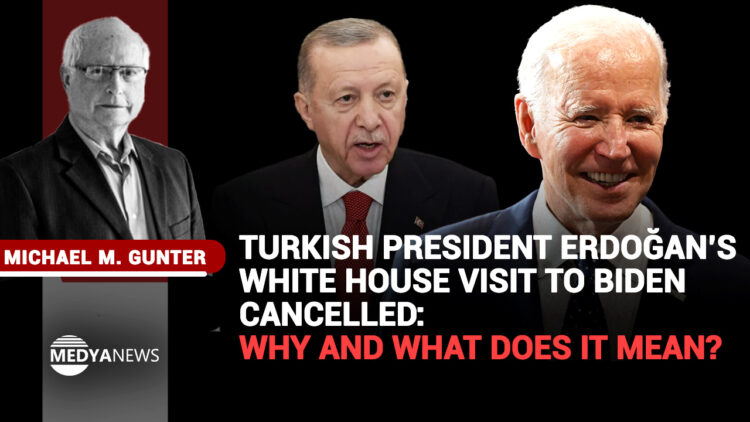
Turkish President Recep Tayyip Erdoğan—one of the more prominent world leaders and an important but in practice only occasional US NATO ally—was scheduled to visit US President Joe Biden in the White House on 9 May. The meeting promised to be of great importance for US foreign policy. However, it was suddenly cancelled due to “scheduling conflicts”. What was the actual reason? To answer this, let us first briefly review the events leading up to the cancellation.
The high-level visit was to be Erdoğan’s first bilateral tete-a-tete with the US President since Biden entered office in January 2021. However, they had met a few times in multilateral settings and known each other for many years. The last time Erdoğan visited in 2019, Donald Trump was still president. During an earlier visit in May 2017, the Turkish president’s bodyguards got into unseemly brawls with protesters in front of the Turkish Embassy just off Dupont Circle in downtown Washington DC. Outstanding warrants for some of these Turkish security personnel to appear in US courts are still valid. Not so diplomatically, one jokester opined that maybe Erdoğan could join Trump in the docket when the Turkish President arrived this time.
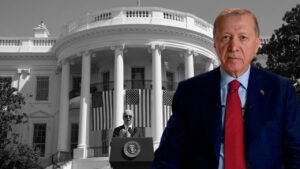
Why has US President Biden put off a proposed meeting with Turkey’s autocratic President Erdoğan?
Seriously, many differences between these two NATO allies still exist, but for various reasons, the timing appeared appropriate to seek a more accommodating path. For the US, immediate Turkey-bashing—in part because of anti-Turkish lobbies like the Greek, Armenian, and Kurdish—eventually tapers off and more thoughtful consideration of Turkey’s long-term importance as an invaluable military ally resurfaces. Erdoğan’s Turkey maintains NATO’s second largest army, is NATO’s only majority Muslim member in a world where Islam is so important, terrorism must be controlled, and Turkey can play an indispensable role in helping mediate the deadly conflicts still raging in Gaza and Ukraine, while occupying a most significant geostrategic position straddling the Dardanelles between the Mediterranean and Black Seas, among others.
For Erdoğan, the White House invitation would add to his prestige at home, much needed after his AK Party took such a thrashing in the recent local elections held on 31 March. More specifically, the talks would have allowed Erdoğan to pressure Biden on trying to persuade Israel to relent in its murderous Gaza campaign. Most Americans have little appreciation for how much Erdoğan is admired in the Muslim world for his defence of perceived Islamic values. Even in India, the author heard this first-hand while visiting with the country’s enormous Muslim minority during a trip there just this past January. An improvement in US ties might also have led to Turkey appearing as a more appealing location for foreign investors to help ease Turkey’s disastrous continuing inflation rate of nearly 70 per cent. The US remains Turkey’s fourth-largest overall trading partner and its second-largest foreign investor.
Turkey’s attempt to use US-Russia tensions to secure its own interests at the expense of the NATO security alliance is unlikely to have won it many friends in Washington
Fast forward to more recent years when the two allies have fallen so far apart that some in the US only half-jokingly began to claim that Turkey has acted more like a member of the former Soviet-led Warsaw Pact than a NATO ally. Erdoğan’s frequent US bashing—in part for domestic Turkish consumption where US favourability ratings are sometimes in single digits—is a major general reason for this decline. US support for the Syrian Kurds and Israel in Gaza represents two specific reasons why US prestige is so low in Turkey.
Erdoğan’s acquisition of the Russian S-400 missile defence system against strong US disapproval led to the US eliminating Turkey from its much-needed update of the US F-35 fighter jets. The US justifiably argued that the Russian S-400 defence system was incompatible with NATO defences and that it might allow Russia to garner secrets about the next-generation stealth F-35 jets the US has so heavily invested in for the future. In addition, Erdoğan’s reluctance to approve Sweden’s NATO membership for almost two long years following Russia’s invasion of Ukraine deeply challenged his reputation as a trusted US NATO ally. For all these reasons, Erdoğan’s meeting with Biden promised to be very important. So, what happened?
The author can only speculate that the cancellation was a big deal for Turkey, since Erdoğan had been trying hard to get invited to the White House for some three years. Maybe too hard, because it seems that while Turkey announced the visit in March, the US had never officially scheduled it. Then the US called it off, but let Erdoğan save some face by claiming he had a scheduling issue. Despite what other observers have written, the author doubts if Erdoğan called his visit off.
The continuing war in Gaza and Erdoğan’s blatant support for Hamas was probably the main cause for Erdoğan being disinvited. As the modern Islamic leader who earlier had finally tamed the secular Turkish military as the ultimate authority in Turkey, Erdoğan has also sought to promote a legal, moderate Islamic agenda in general and the Palestinian position specifically. Thus, Erdoğan’s desire to assume a leading role in the Middle East and his strong Islamic identity, led him to begin taking increasingly anti-Israeli positions.
For example, when Israel assassinated Sheikh Ahmed Yassin, the founder and spiritual leader of Hamas in 2004, Erdoğan accused Israel of terrorism. Soon afterwards in 2005, Erdoğan visited Israel and toured the occupied territories. According to one of his main biographers, the Palestinian dispossession he saw helped convert him to a strong anti-Israeli mindset. He began to see himself as a champion of the Palestinian cause and provide political support to Hamas, which ruled Gaza and was openly calling for the destruction of Israel. Some of the leaders of Hamas were even based in Turkey.
The three-week long Israeli Cast Lead operation against Gaza in December 2008 and January 2009 resulted in the deaths of more than 1,400 Gazans/Palestinians and a further precipitous decline in Turkish-Israeli relations. In most major Turkish cities there were demonstrations against the Israeli attacks, while the West remained quiet. Erdoğan was not only furious but felt disrespected because when he had just met with then-Israeli Prime Minister Ehud Olmert, the Israeli leader had mentioned nothing about it. Then at the prestigious World Economic Forum in Davos, Switzerland in January 2009, the Turkish leader sharply proclaimed to Israeli President Shimon Peres that the fighting in Gaza was “very wrong,” and that “many people have been killed” before ostentatiously storming off stage. Erdoğan’s prestige in Turkey and the Islamic world rose to new heights as he seemed to be the main proponent of the down trodden Palestinian and Islamic cause.
This antagonism reached its nadir on 31 May 2010 when Israeli troops boarded the Mavi Marmara—a ship carrying Islamic activists from Turkey who were trying to break the Israeli blockade of Gaza to deliver aid—and in the ensuing melee killed nine. Not until 22 March 2013 did Israeli Prime Minister Benyamin Netanyahu finally apologise to Turkey for the deaths, and the two agreed to restore normal diplomatic relations. However, they did not exchange new ambassadors until the end of 2016.
New fighting in Gaza, however, over the US decision to move its embassy to Jerusalem in 2018, led to further Turkish-Israeli diplomatic difficulties. On May 14, 2018, Erdoğan accused Israel of carrying out a “genocide” against the Palestinians and being a “terrorist and apartheid State”. The now popularly elected Turkish President, then seeking imminent re-election again, proclaimed, in an Istanbul summit with Islamic leaders including Jordanian king Abdullah II, Palestinian Authority Prime Minister Rami Hamdallah, Kuwaiti Emir Sheikh Sabah al-Sabah, Qatari Emir Sheikh Tamim bin Hamas Al-Thani and even the foreign ministers of long alienated Egypt and Saudi Arabia, among others: “There is no difference between the atrocity faced by the Jewish people in Europe 75 years ago and the brutality that our Gaza brothers are subjected to.”
Throughout the day, Erdoğan had basked in the light of large, adoring crowds thronging the massive Yenikap meeting area on the shores of the Sea of Marmara in Istanbul. Subsequently, Erdoğan and Israeli Prime Minister Benyamin Netanyahu exchanged further insults, with Netanyahu concluding that “a man who sends thousands of Turkish soldiers to hold the occupation of northern Cyprus and invades Syria . . . [and] whose hands are stained with the blood of countless Kurdish citizens in Turkey and Syria is the last one who can preach to us about combat ethics.”
Fast forward again to the present situation in Gaza. Just a few days before his scheduled visit to Washington, Erdoğan stepped up his verbal attacks against Israel, comparing Israeli Prime Minister Netanyahu to Adolf Hitler and accusing the US of sponsoring the “genocide” of the Palestinians. In another address a day before the cancellation, Erdoğan called Netanyahu “the butcher of Gaza”. The Turkish president also lambasted the US for its “unconditional military and diplomatic support” to Israel and excoriated the US Senate for passing an aid package that earmarked $13 billion for Israel.
Already, Erdoğan had met with Hamas leader Ismail Haniyeh in Istanbul and announced that he considered Hamas “brothers who defend their homeland against occupiers”. To make himself even clearer, the Turkish leader announced, “We cannot be among those who label Hamas as a terror organisation just because Israel and its Western [read US] supporters want it that way.” Given such rhetoric, Biden thought it better not to pore any more gasoline on the Gazan infernal by giving Erdoğan a platform in the White House. The visit was understandably cancelled.
However, given Erdoğan’s potential role as fixer or enabler, Biden’s decision to disinvite Erdoğan might have been mistaken. Clearly, Erdoğan wanted the prestige of being consulted at the White House. His pro-Hamas rhetoric was at least partially only for domestic show. It is just possible the US could have convinced Erdoğan to help facilitate a cease-fire in Gaza that would have benefited both sides. If so, the cancellation proved to be a lost opportunity.
Michael M. Gunter is a professor of political science at Tennessee Technological University in the US and the author of ‘Erdoğan’s Path to Authoritarianism: The Continuing Journey’, recently published by Lexington Books. Reviewing Gunter, Dr. Michael Rubin of the American Enterprise Institute, a think tank in Washington, DC, said, “What makes Gunter’s work a masterpiece is not just the flowing narrative, but the fact that Gunter has what so many Turkish experts do not: a balanced approach coloured by decades of experience not only among Turks, but also with the Kurds, Syrians, and others too often ignored.”