

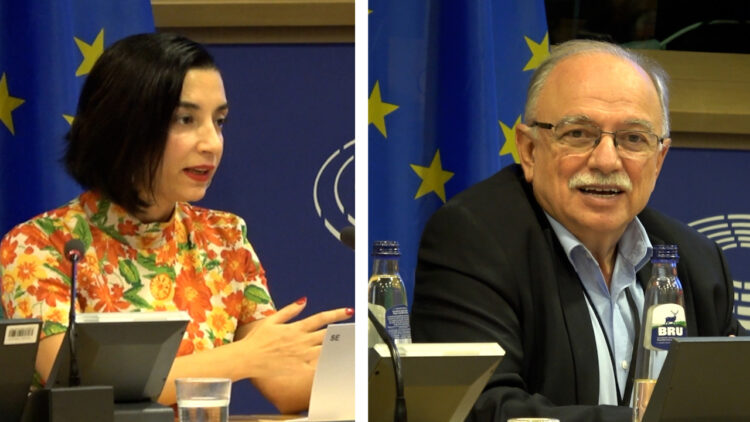
The 18th International Kurdish Conference, focusing on relations between the European Union, Turkey, the Middle East, and the Kurdish people, continued into its second day on Thursday. The conference saw significant discussions on pertinent geopolitical and cultural issues impacting the Kurdish community.
🔴 The overarching message of the 18th International Kurdish Conference (@EUTCC1) is clear: the Kurdish issue transcends regional borders and is a global human rights matter requiring dialogue and political engagement.#KurdConfEP | #EUTCC | @papadimoulis | @eremkansoy |… pic.twitter.com/Z9Y8JLdgdA
— MedyaNews (@1MedyaNews) December 7, 2023
First day highlights: Dialogue, human rights, and the Kurdish issue
The conference concluded its first day with significant discussions focusing on the Kurdish issue within the scope of international relations and human rights. Evin İncir, member of the European Parliament, and Dimitrios Papadimoulis, vice-president of the European Parliament, shared their views with MedyaHaber TV.
“The violence, the isolation is not the right way to deal with the Kurdish issue,” stated Papadimoulis. He emphasised, “When we have to support human rights and democracy as a core value of the European Union, it is important not to have double standards.”
Papadimoulis also stressed the need for dialogue with Abdullah Öcalan, the leader of the Kurdistan Workers’ Party (PKK), for resolving the Kurdish problem, highlighting the importance of opening political dialogue channels. “For the lack of democracy, lack of respect of human rights, freedom of speech, media freedom, the European Union and mainly the European Parliament must put pressure on the Turkish authorities to improve Turkish democracy,” he added.
İncir underscored the conference’s significance: “It is a very important conference to ensure that the light is on the Kurdish cause because the Kurdish cause is an issue of human rights, an issue of international law and it needs to remain like that. I think that the Kurdish issue at large and the issue of human rights is an issue of everybody, the issue needs to be raised of course.”
The conference also featured prominent academics and experts, including Hans-Lukas Kieser from the University of Zurich and Jan Yasin Sunca from Bielefeld University. There were also contributions from journalists, notably Amed Dicle from Belgium.
Continuing discussions: Geopolitical and cultural dynamics
The conference serves as a crucial platform for dialogue among Kurdish representatives, European officials, and international scholars.
Eda Bektaş from KURD-AKAD, Germany, and Şermin Güven from the Free University of Berlin provided insights into the Kurdish situation in the broader European context.
The event is expected to delve deeper into the evolving role and recognition of the Kurdish community in international relations, especially within the European and Middle Eastern spheres.
Overarching message: A global human rights issue
The overarching message of the conference is clear: the Kurdish issue transcends regional borders and is a global human rights matter requiring dialogue and political engagement.
As the conference progresses, it remains a significant gathering for those interested in the political, cultural, and social dynamics of the Kurdish population within the European and Middle Eastern spheres.
07.12 | 09:00-13:00 & 15:00-18:00


