

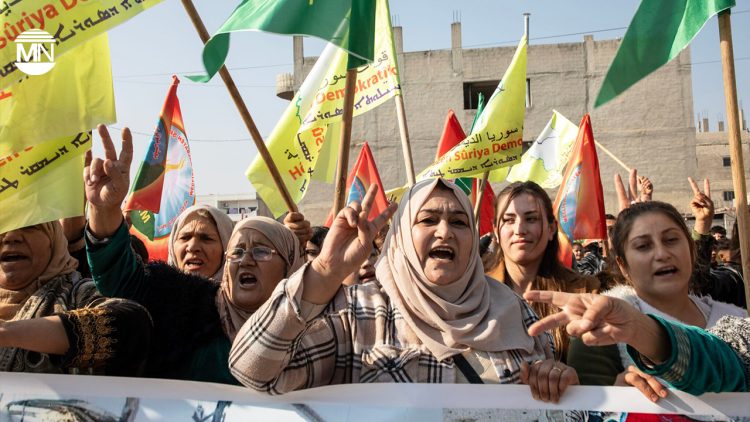
As uncertainty looms over the fate of Syrian women under the rule of the newly established Hay’at Tahrir al-Sham (HTS) government, Kongra Star activist Ronahi Hassan has chronicled the history and resilience of the feminist struggle in North and East Syria (Rojava). Writing for Turning Point Magazine, she reflects on 13 years of grassroots democracy and women’s liberation in North and East Syria, which emerged as a powerful force following the fall of the Assad regime in December 2024.
Hassan situates the struggle within a broader geopolitical framework, underscoring how the revolution in North and East Syria was built on decades of Kurdish resistance and a deep-seated commitment to women’s emancipation. “We needed a revolution with women’s liberation at its centre, and this is how the revolution began in Rojava,” she writes, highlighting the establishment of democratic self-governance and autonomous women’s structures as key milestones.
The feminist movement in North and East Syria took shape long before the Syrian civil war, operating under severe repression during the Assad era. The Kongra Star Women’s Association, founded in 2005, was forced underground, with many of its members facing harassment, arrests, and abductions. Hassan notes that the women’s revolution flourished after the 19 July 2012 military defeat of the Syrian Arab Army (SAA) by the Women’s Protection Units (YPJ) and People’s Protection Units (YPG) in Kobani (Kobanê), when women actively participated in both the armed struggle and political organisation.
“The revolution made possible the public operation of groups that had long been suppressed,” Hassan writes, recalling how Assyrian, Arab, Armenian, and Kurdish women fought alongside one another against the Assad regime and later against ISIS. “Thousands gave their lives to defend this revolution.”
One of the most transformative institutions of the women’s movement in North and East Syria has been the Mala Jin—or Women’s Houses—where deeply entrenched patriarchal structures were confronted through mediation and community-based justice. Hassan points out that these spaces played a pivotal role in reshaping gender dynamics within families and local governance. “Men had to learn to see their wives, daughters, and mothers as equals. This was one of our biggest achievements,” she explains.
Related Article:
“Mala Jin”: The unique women’s houses transforming Middle Eastern society
The feminist revolution in North and East Syria also extended into the legal and political spheres. The Social Contract of the Autonomous Administration of North and East Syria (AANES), originally adopted in 2014 and amended in 2023, enshrines a 50 percent gender quota across all institutions. Hassan stresses the importance of such systemic changes but warns against complacency: “Many laws have been won in defence of women’s rights, but laws can be reversed, as we see in Western countries. What cannot be easily taken away is a transformed society’s consciousness.”
With the fall of the Assad regime and the growing influence of HTS, the model of gender equality in North and East Syria faces new threats. Turkey’s continued attacks on the region, coupled with its support for factions such as the Syrian National Army (SNA) and the resurgence of ISIS-linked groups, pose significant challenges. Hassan warns that these forces seek to dismantle North and East Syria’s democratic structures and impose patriarchal rule. “Turkey has enabled extremist groups that specifically target women. Their attacks are not just military—they are ideological,” she asserts.
Despite these mounting pressures, Hassan remains resolute in her call to action. “The cost of this revolution has been immense. We must defend it at all costs,” she writes, underlining the need for continued mobilisation and international solidarity. The struggle for women’s liberation in North and East Syria, she argues, is far from over.


