

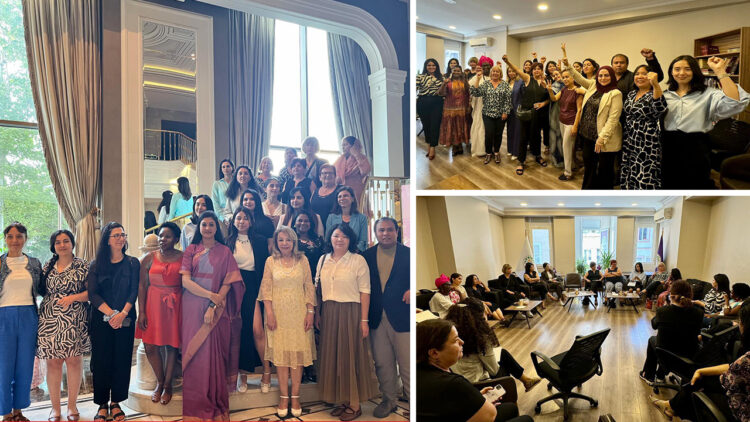
The Progressive Alliance’s Gender Equality Working Group, comprising women from 27 countries across Europe, the Middle East and Africa, has demonstrated solidarity with Turkey’s pro-Kurdish opposition Peoples’ Equality and Democracy (DEM) Party during a visit to Istanbul.
The group met with DEM Party officials on Saturday, ahead of a two-day closed workshop on gender equality issues. DEM Party Istanbul Branch Co-chair Gonca Yangöz highlighted the impact of war policies on women and the challenges faced by women in politics.
‘War policies create deadlocks and poverty that women in this country struggle against. Femicides are increasing daily, and impunity for men persists,’ Yangöz stated. She added, ‘The first target of the trustees appointed to municipalities is women’s gains.’
The Turkish government’s appointment of trustees to replace elected officials in Kurdish-majority municipalities has faced ongoing criticism, at least in part for its impact on women’s rights and services. Critics have noted a pattern whereby these trustees promptly shut down women’s centres and roll back policies aimed at gender equality. This systematic dismantling of women’s support structures has been linked to a subsequent rise in violence against women in these areas.
Ebru Günay, the DEM Party’s Deputy Co-chair responsible for Foreign Relations, placed an emphasis on the party’s commitment to women’s representation. ‘We are a party under constant attack from the male mindset. We are trying to conduct politics in an environment in which our friends are being prosecuted and arrested,’ she explained.
The women of the Progressive Alliance stressed the importance of joint struggle against male-dominated mindsets and expressed solidarity with the DEM Party, particularly with regard to the imprisoned politicians.
The Turkish government’s targeting of women’s institutions in Kurdish-run municipalities is seen as an extension of its policies against Kurdish autonomy, given the emphasis of the Kurdish movement on gender equality. In 2022, Kurdish politician Ayşe Acar Başaran noted that government-appointed trustees typically began by closing women’s institutions, reflecting a patriarchal agenda to reverse progress in local governance, including the co-mayor system. Başaran argued that this left female victims of violence with limited support options, as government-run centres were often perceived as unhelpful or antagonistic.
Despite political pressures in Turkey, the visit went ahead and highlighted shared concerns about women’s rights and the need for international cooperation in addressing gender equality issues.


