

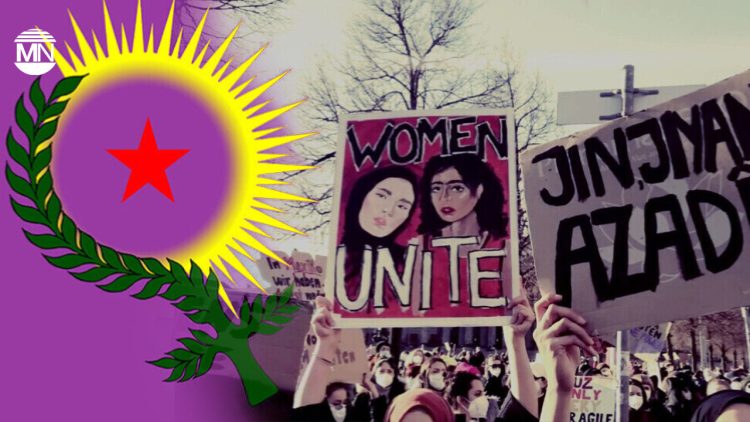
Ahead of 8 March International Women’s Day, the Kurdistan Women’s Communities (KJK) has released a comprehensive statement endorsing imprisoned Kurdish leader Abdullah Öcalan’s Call for Peace and Democratic Society. The statement underscores the central role of women in peacebuilding and societal transformation across the Middle East.
KJK praised women who have taken to the streets “with rebellion, love, and enthusiasm” for freedom, celebrating their ongoing resistance. It described Öcalan’s appeal as “the manifesto of a new era” and called for widespread mobilisation to support his vision for peace and democracy.
The statement highlighted the significance of Öcalan’s paradigm for the Kurdish women’s struggle, rooted in women’s liberation, grassroots democracy, and ecology, and its influence on women’s movements worldwide. Quoting Öcalan, the KJK likened women’s liberation to “snowbells piercing through ice and snow”, symbolising resistance against domination, oppression, and the falsehoods imposed on women throughout history.
The KJK described the women-led Rojava Revolution in North and East Syria as a model for a free society, proving that women’s democratic modernity is a viable alternative and a source of hope worldwide. The organisation also highlighted the ‘Jin, Jiyan, Azadî’ (Women, Life, Freedom) revolution in Iran, emphasising the vanguard role of Kurdish women in leading protests against the Iranian regime.
“The resistance of Zeynep Calali, Pakhshan Azizi, Warisheh Moradi and Sharife Mohammadi, who represent the culture of struggle of the Kurdish and Iranian women’s movement, will open the way for a democratic republic in Iran,” the KJK stressed, referring to prominent women political prisoners in Iran, some of whom remain under imminent risk of execution.
In its statement, the KJK emphasised the need to end Öcalan’s isolation in the high-security İmralı prison and ensure he is free to engage in face-to-face negotiations for a peaceful and democratic resolution to the Kurdish issue in Turkey. “The PKK’s ceasefire has created an opportunity for the peace process,” the statement said.
The KJK stressed that women are disproportionately affected by wars and conflicts in the Middle East, which it described as being rooted in male dominance. At the same time, women “hold the key to democracy”, making social peace and democratisation impossible without a women-centred approach and a shift away from male-dominated attitudes, the organisation added.
“The women’s movements in Kurdistan and Turkey have been at the forefront of the resistance against sexist policies. Their organised participation in the […] democratisation of the republic will only be achieved through the active participation of women, who bring their unique perspectives and solutions,” the KJK stresses, calling on women in Turkey to fulfil their essential role in shaping a peaceful, democratic future.


