

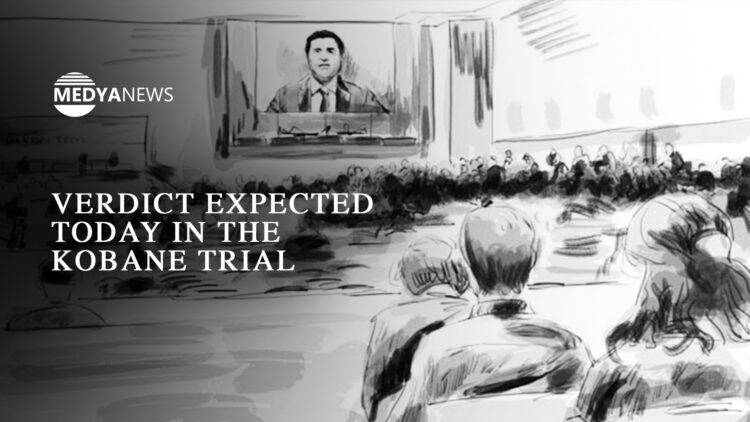
Tensions are high today, as the Sincan Prison Campus in Ankara awaits the long delayed verdict in the Kobane Conspiracy Trial.
The Peoples’ Equality and Democracy (DEM) Party co-chair Tülay Hatimoğulları told a press conference prior to the hearing: “The decision that will come from here; It will either drag Turkey into darkness, or it will be the beginning of paving the way for democracy.”
The prosecution relates to the events of 6-8 October 2014, when the northern Syrian city of Kobanî (Kobanê) was besieged by Islamic State (ISIS) forces. The Turkish government prevented aid from reaching the city, sparking mass demonstrations in southeast Turkey in solidarity.
Anger spilled onto the streets after the then prime minister Recep Tayyip Erdoğan stated that “Kobane is about to fall” in a speech. A total of 48 people were killed in the violence that ensued. The majority of those who died were supporters of the now obsolete pro-Kurdish Peoples’ Democratic Party (HDP), predecessor to the DEM Party. HDP and its supporters have faced almost a decade of prosecution and repression as a result of the events.
In 2016, an anti-democratic constitutional amendment revoked the parliamentary immunity of MPs. This paved the way for the arrest and prosecution of the-then HDP leaders Selahattin Demirtaş, Figen Yüksekdağ and their co-defendants. Several separate proceedings were combined, to create a wide ranging conspiracy prosecution.
The defendants face aggravated sentences of life imprisonment. Charges include “murder” “looting”, “injuring a public official with a gun”, “burning flags” and “disruption of the national unity and the integrity of the country”.
A total of 108 Kurdish politicians have been charged, and 18 remain in prison. Along with Yüksekdağ and Demirtaş, Ali Ürküt, Günay Kubilay, Nazmi Gür, İsmail Şengül, Bülent Parmaksız, Alp Altınörs, Sebahat Tuncel, Zeynep Karaman, Zeynep Ölbeci, Aynur Aşan, Ayşe Yağcı, Ayla Akat Ata, Dilek Yağlı, Pervin Oduncu, Meryem Adıbelli and Gültan Kışanak remain in prison. The imprisoned defendants have refused to attend today’s hearing.
The trial has been widely criticised as an attempt to stifle democracy in Turkey, and a key part of the Turkish state’s strategy to close down the HDP. In 2021 the European Parliament urged Turkey to release Demirtaş, calling his continued imprisonment “cruel and politically motivated punishment”.
DEM party co-chair Tuncer Bakırhan told the press conference in Sincan: “Today we have come to the end of Turkey’s biggest political conspiracy case. When you look at the content of the file, you will see that it has nothing to do with law. It is a conspiracy case in which secret witnesses and forced interpretations prepared by the ruling political power.”
The verdict in the Kobane Trial had been scheduled to take place last month, but it was delayed without proper explanation. Commentators surmised that the Turkish state had engineered the postponement, in order to avoid criticism of Turkey’s human rights record, ahead of President Erdoğan’s scheduled visit to Washington. The visit has since been cancelled, likely over Turkey’s policy clashes with the US on Ukraine and Palestine.


