

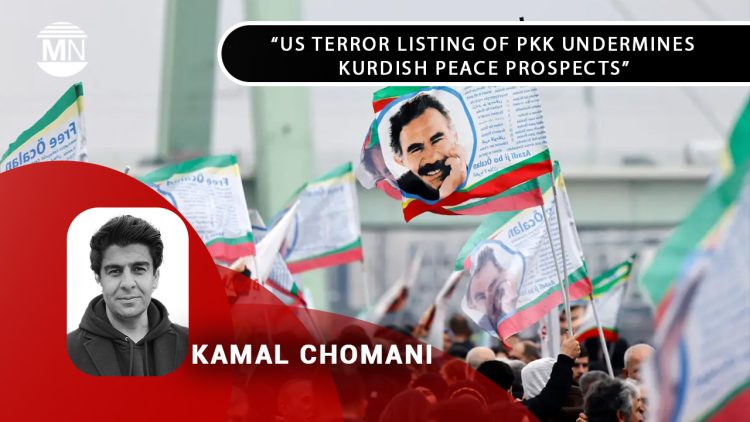
The United States’ approach to terrorism designations has come under scrutiny for perceived contradictions, as it maintains the Kurdistan Workers’ Party (PKK) on its Foreign Terrorist Organisation list since 1997 while easing restrictions on groups with violent histories, such as Hay’at Tahrir al-Sham (HTS). Kurdish scholar Kamal Chomani has urged Washington to reconsider its stance, calling for fairness and consistency to advance peace efforts.
In December 2024, the US removed a $10 million bounty on Ahmed al-Sharaa, the leader of HTS, citing his alleged reformist role and potential as a partner in Syria’s governance. Meanwhile, PKK leaders Murat Karayılan, Cemil Bayık, and Duran Kalkan remain targets of US bounties set at $5 million, $4 million, and $3 million, respectively. Critics argue that this double standard perpetuates injustice and undermines peace prospects in the region.
Since its founding, the PKK has demonstrated a willingness to negotiate politically rather than relying solely on armed resistance. The organisation has declared multiple ceasefires, beginning in 1993, and engaged in high-profile talks, including the Oslo negotiations in 2008 and the 2013-2015 peace process. Despite these efforts, Turkey has used the PKK’s terrorist designation to delegitimise Kurdish political aspirations and justify what human rights groups describe as systematic repression.
Kamal Chomani, a frequent contributor to Medya News, highlights the disparity in Washington’s approach.
“While groups like HTS, with undeniable links to violent extremism, are entertained as political counterparts, the PKK, which has never targeted civilians or conducted operations outside Turkey’s military and security infrastructure, remains vilified. This policy is not only hypocritical but perpetuates the victimisation of Kurds globally,” Chomani said.
Chomani further emphasises the parallels between the PKK and other revolutionary movements, such as Nelson Mandela’s African National Congress, which transitioned from militancy to political engagement.
“Delisting the PKK or at least lifting the bounties on its leaders would have immediate benefits,” Chomani argues. “It would strengthen the US partnership with Kurdish groups, particularly in Syria and Iraq, while addressing a longstanding grievance that has undermined trust. Furthermore, it would weaken Turkey’s ability to manipulate international politics against Kurdish autonomy in North Syria.”
The PKK’s continued inclusion on the terror list has wide-ranging implications. Turkey has utilised the designation to justify military campaigns, including drone strikes in the Qandil Mountains, and to suppress Kurdish activists. Chomani questions whether Washington should persist in aligning with Turkey’s nationalist agenda at the expense of Kurdish rights.
“When the United States continues to label the PKK as a terrorist organisation, it signals alignment with Turkey’s nationalist agenda, which hampers peace efforts,” Chomani adds. “For Washington to be more Turkish nationalist than Turkish nationalists themselves is counterproductive and unjust.”
The scholar pointed to recent statements by Turkish nationalist leaders, including Devlet Bahçeli, who hinted at the possibility of dialogue with Abdullah Öcalan, the PKK’s imprisoned leader, as evidence that even Ankara might be open to a new approach.
Former senior State Department adviser urges political approach, PKK removal from Western terror listsOpen Letter to US Secretary of State Blinken in relation to PKK leaders
Experts argue that removing the PKK from the terror list could bolster Washington’s credibility as a mediator in the Kurdish-Turkish conflict, lay the groundwork for renewed peace talks, and signal to Kurdish communities that their political aspirations are acknowledged.
“There is no peace without justice,” says a Kurdish proverb, and justice, advocates argue, begins with correcting outdated policies.
As the Biden administration re-evaluates its foreign policy strategies, it faces a critical question: if pragmatism justified revising the stance on HTS, why can’t the same logic apply to the PKK? Observers stress that fostering dialogue and recognising the PKK’s evolution is key to regional stability and fairness.


