

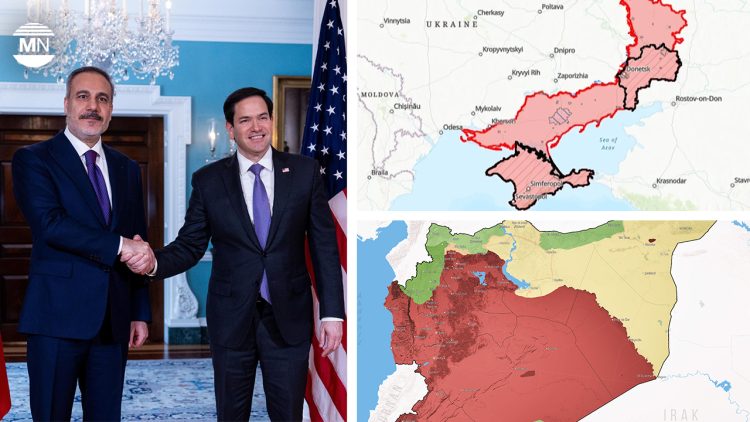
“We seek Türkiye’s support for peace in Ukraine and the South Caucasus,” US Secretary of State Marco Rubio told Turkish Foreign Minister Hakan Fidan on Tuesday, as both sides met in Washington amid deepening tensions over democracy, Syria and sanctions.
The 25 March meeting marked the first high-level Ankara visit since Donald Trump’s return to the White House and came at a delicate moment for Turkish-US relations. While the two officials discussed enhanced trade and regional security cooperation, Rubio voiced pointed concern over “recent arrests and protests” in Turkey — widely seen as a reference to the controversial detention of İstanbul Mayor Ekrem İmamoğlu.
Met with Turkish Foreign Minister @HakanFidan today to discuss collaboration on trade and security benefiting both our countries. The U.S. is building on recent trade advancements made with Türkiye. We’re also partnering together on key issues, from peace in Ukraine and the South… pic.twitter.com/0JkCxQRdKw
— Secretary Marco Rubio (@SecRubio) March 25, 2025
According to a State Department briefing, Rubio “appreciated Türkiye’s leadership in the Global Coalition to Defeat ISIS” but urged Fidan to work with Washington toward “a stable, unified, peaceful Syria” that is neither a base for international terrorism nor a channel for “destabilising Iranian activities”.
Fidan, for his part, is seeking to re-anchor Turkey’s place in US defence frameworks. Turkish officials confirmed the minister pressed for Ankara’s re-entry into the F-35 fighter jet programme and the removal of sanctions imposed under CAATSA — the US law targeting Turkey’s 2019 purchase of Russian S-400 missiles.
However, significant policy rifts remain. A Reuters investigation revealed that just a week earlier, US officials delivered a list of strict demands to Syria’s new leadership in exchange for partial sanctions relief. Among them: eliminating foreign fighters from senior posts, dismantling chemical weapons stockpiles, and cooperating on the case of missing US journalist Austin Tice.
The list, handed over on 18 March by Deputy Assistant Secretary Natasha Franceschi during a Brussels donor conference, marks Washington’s first direct contact with Damascus since Trump retook office. Sources confirmed that the Trump administration remains internally divided on whether to expand engagement with Syria’s interim rulers, who came to power after Bashar al-Assad’s sudden ousting in December.
While the White House reportedly favours a tougher approach, the State Department has advocated more conditional dialogue. Rubio’s language in recent weeks reflects this tightrope. In a statement earlier this month, he condemned “radical Islamist terrorists, including foreign jihadis” for attacks on Alawite civilians in western Syria and demanded accountability from Syria’s new authorities — a stance that reportedly clashed with Trump aides pushing for harsher framing.
Meanwhile, Trump himself struck a far different tone on Turkey. Speaking during an ambassadorial nomination event on 24 March, he praised Erdoğan, calling him a “good leader”, despite mounting international concern over Ankara’s political direction. His comment came just hours after Senator Chris Van Hollen denounced Erdoğan for “locking up his main political rival” and warned of Turkey’s “slide into full-blown autocracy”.
Fidan’s visit is also aimed at coordinating next steps for a planned Erdoğan-Trump summit. Turkish diplomatic sources told Hürriyet Daily News that Fidan hopes to deepen bilateral cooperation and press the US to end military support for the Kurdish-led Syrian Democratic Forces (SDF), which Ankara considers a terrorist affiliate. Washington, however, continues to rely on the SDF in counter-ISIS operations.
Economic stability added further urgency to the talks. The Turkish lira has stabilised under 38 per dollar after plunging past 40 following İmamoğlu’s arrest. Treasury and Finance Minister Mehmet Şimşek told more than 4,500 investors last week he would do “whatever it takes” to restore confidence — data shows 60% of the recent selloff came from foreign investors.
Despite the sharp rhetoric and diverging agendas, both sides signalled an interest in resetting the relationship. Rubio welcomed “advancements in bilateral trade” and encouraged “even greater economic partnership moving forward”.
Yet the message from Washington was clear. While Trump may view Erdoğan as a reliable partner, Rubio and others are drawing red lines around Syria, democracy and defence cooperation.
“This is not just about strategy,” one US official familiar with the talks said, “It’s about values and credibility in the region.”


