Zegrus Enderyari is a Kurdish activist and member of the ‘No to Executions, Yes to a Free Life’ campaign. In his latest piece for Medya News he reveals who the victims of Iran’s executions are, and highlights an alarming surge in the Islamic regime’s use of the death penalty.
By Zegrus Enderyari
2024 annual report on the death penalty in Iran
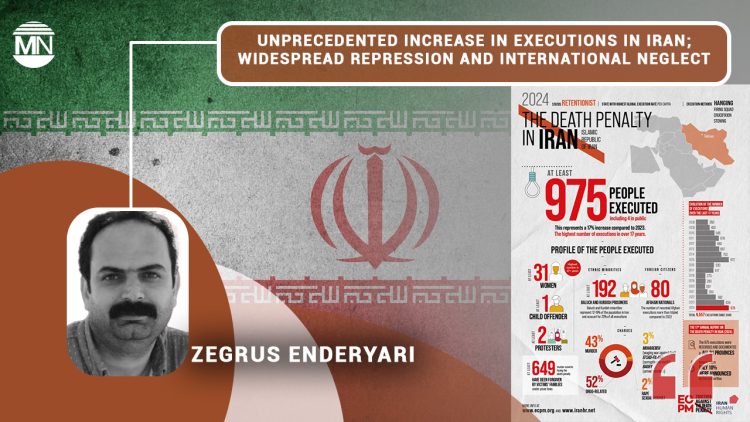
The Iran Human Rights Organisation and Together Against the Death Penalty (ECPM) have published their 2024 annual report on the death penalty in Iran. This report examines the trends in executions, legal frameworks, charges, execution methods, and their geographical distribution.
According to this report, the Islamic Republic of Iran uses the death penalty as a tool for political repression and social control. During the presidency of Masoud Pezeshkian, executions have increased significantly, and the report urges the international community to exert more pressure to halt this trend.
Alarming increase in executions in 2024
According to statistics, at least 975 people were executed in Iran in 2024, marking a 17% increase from 834 cases in 2023. This figure represents the highest recorded in the past two decades. Despite the reformist promises of the new government, executions have continued to rise. These death sentences are part of the Islamic Republic’s war against its own people to maintain power.
Executions as a tool of repression
In 2024, executions went beyond a judicial punishment and became a means of instilling fear in society. 90% of the executions were carried out without official government announcements, highlighting the lack of transparency in Iran’s judicial system. Drug-related executions saw the highest increase, with 503 people executed on drug charges in 2024, compared to just 126 in 2021.
Targeting minorities and political opponents
Ethnic and religious minorities have been the main victims of this wave of executions. 90% of those executed for alleged connections to opposition groups were Kurds. Additionally, the number of Afghan citizens executed rose from 25 in 2023 to 80 in 2024, indicating the discriminatory policies of the regime. Baluch prisoners have also been increasingly targeted for execution under the pretext of drug-related offenses.
Execution of women and children; A clear violation of human rights
In 2024, at least 31 women were executed, marking the highest number in 17 years. Furthermore, at least one juvenile offender was executed, violating Iran’s international commitments, including the Convention on the Rights of the Child. Iran remains one of the few countries still executing individuals under 18 years old.
Among the women executed, many belonged to marginalised communities and faced systematic discrimination throughout their legal proceedings. Cases such as those of Pakhshan Azizi and Warisheh Moradi [currently in prison and sentenced to death] highlight the intersection of gender and ethnic discrimination in Iran’s judiciary. These women were often denied fair trials, subjected to coerced confessions, and face execution without due legal representation. Their executions underscore the disproportionate targeting of women, especially those from minority backgrounds, by the state’s judicial system.
Weak international response
Despite the sharp increase in executions, international institutions have shown a weak response. The United Nations Office on Drugs and Crime (UNODC) has continued its cooperation with Iran, even as 84 human rights organizations called for the suspension of these collaborations. This inaction has effectively emboldened the Islamic Republic to persist with its repressive policies.
The majority of those executed for drug offenses were from marginalized groups, particularly the Baluch people, who have been disproportionately represented among those executed. Revolutionary Courts, which issued 534 death sentences in 2024, handled all drug-related and security-related charges.
Domestic resistance: ‘No to execution Tuesdays’
In response to the rising number of executions, protests and resistance movements within Iran have grown. One of the most significant initiatives has been the ‘No to Execution Tuesdays’ campaign, launched by political prisoners and quickly embraced by broader society. These weekly protests have become a symbol of opposition to the regime’s execution policies.
The urgent need for global action
The widespread executions in Iran are not just a judicial measure but a political weapon against dissidents, minorities, and vulnerable groups. The increasing trend of executions under Pezeshkian’s presidency indicates the regime’s continued reliance on repression to maintain power. In these circumstances, the role of the international community in exerting pressure on the Iranian government is more critical than ever. If global silence persists, the Islamic Republic’s execution machine will continue its deadly work at an accelerated pace.
The Iran Human Rights Organisation and ECPM report calls for increased diplomatic pressure and targeted sanctions against officials involved in implementing death sentences. The future of Iran depends on stopping this deadly trend, and only through decisive international action can there be hope for change.
Zegrus Enderyari is a Kurdish activist from Eastern Kurdistan and a member of the ‘No to Execution, Yes to Free Life’ campaign.