

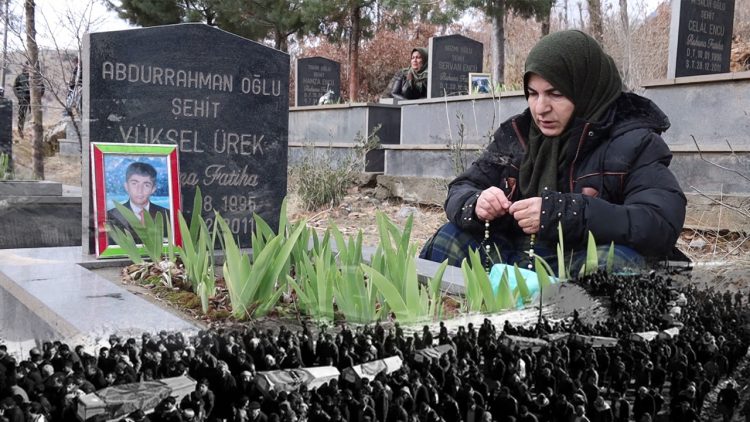
Today marks the 13th anniversary of the Roboskî massacre, which claimed the lives of 34 Kurdish civilians, including 19 children, when Turkish fighter jets bombed them on the Iraqi border in Uludere (Qileban) district in Kurdish-majority Şırnak (Şirnex) on 28 December 2011.
The 13th anniversary commemoration of the Roboskî massacre started with a visit to the cemetery in the early morning hours. The families, dressed in black, held photographs of their murdered family members, read prayers and distributed sweet pastries to visitors attending the commemoration.
Representatives of a number of political parties, among them Democratic Regions Party (DBP) Co-Chair Keskin Bayındır, Peoples’ Equality and Democracy (DEM) Party Co-Chair Tuncer Bakırhan, and those of civil society organisations and bar associations, as well as many ordinary citizens attended the commemoration. It started with a press statement, while two banners reading “Roboskî Massacre awaits justice in its 13th year” and “Roboskî is the bleeding wound of Kurdistan” were held up.
After a minute of silence, Halime Encü, who lost her son Serhat in the massacre, spoke on behalf of the Roboskî families. She recalled that 13 years have passed since the massacre, which “tore the bodies of our children to pieces”. Demanding justice for them, she said “Enough is enough! We want justice! Enough of these massacres. […] Let no more mothers cry!”
DBP Co-Chair Keskin Bayındır noted that the case of Roboskî is “the case of the people not only of Roboskî, but of all Kurdistan” and criticised the Turkish justice system. He said that by giving impunity to the perpetrators of the Roboski massacre and other massacres against the Kurdish people, the Turkish state is telling these perpetrators “whatever you do against the Kurdish people, whatever crimes you commit, our laws will protect you”.
Supporting Bayındır’s statement, DEM Party co-chair Tuncer Bakırhan said that “Roboskî is the Kurdish question” and that the Kurdish question “cannot be solved until Roboskî is solved and its perpetrators are tried”. He also spoke about the Turkish miltary attacks against Kurdish people in northern Syria, saying that “every bomb you drop there shatters the hearts of the mothers of Roboskî and creates the same pain in the hearts of their children”.
Labour Party (EMEP) Chairman Seyit Aslan also drew attention to the ongoing Turkish military attacks against Kurdish people in Syria: “It is not possible to talk about peace and justice if there are still cross-border operations and threats against the democratic rights of the Kurdish people in Syria.”
Şırnak Bar Association President Abdullah Fındık said: “Today our hearts are bitter, our consciences are wounded. As long as justice does not come to Roboskî, no one should talk about the rule of law”. He also explained that the case is now at the European Court of Human Rights (ECHR) and said that he is “hopeful that the perpetrators will not get away with it.”
Years after the incident, neither the Turkish Intelligence Agency (MİT) nor any other state officials have acknowledged their role in the massacre. After the coup attempt of 15 July 2016, the government – obscuring state responsibility – shifted the blame to Fethullah Gülen, a Pennsylvania-based Turkish imam whose movement allegedly had influence within the Turkish army and who was accused by Turkey of orchestrating the coup attempt.
The investigation after the massacre led to the Diyarbakır State Prosecutor’s Office declaring lack of jurisdiction in June 2013 and transferring the case to the Military Prosecutor’s Office. In January 2013, the Military Prosecutor’s Office concluded that the personnel involved had acted within the bounds of their duties and that inevitable mistakes were made, finding no reason to initiate prosecution.
Efforts by victims’ families for justice faced setbacks, with the Constitutional Court rejecting their application in 2014 due to incomplete documentation, and the European Court of Human Rights deeming the application inadmissible in 2018 as it had not exhausted domestic remedies.
This incident remains without justice or resolution despite many legal struggles by families of the victims and human rights organisations, and it highlights the persistent concerns about impunity and perceived state-sanctioned crimes against Kurds, and more broadly, against minorities in the country.


