

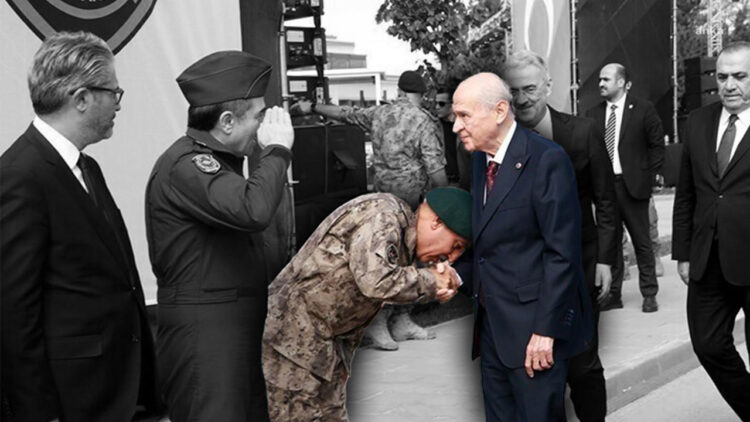
Opposition parties have criticised Turkish police officers for kissing the hand of far-right leader Devlet Bahçeli during his visit to the police’s Special Operations Department on 15 July, the 8th anniversary of Turkey’s 2016 attempted coup, saying that the gesture was a threat to the integrity of the state, and called for Department Head Süleyman Karadeniz to step down.
Devlet Bahçeli, leader of Turkey’s far-right Nationalist Movement Party (MHP) and a staunch ally of Turkish President Recep Tayyip Erdoğan, visited the police’s Special Operations Department in Gölbaşı, Ankara, where the head of the department kissed his hand (a gesture that is reserved in Turkish society for one’s elders and betters), and police officers followed suit. The whole episode sparked controversy.
Bahçeli was welcomed by General Director of Security Erol Ayyıldız, the Head of the Special Operations Department Süleyman Karadeniz and other officials. During the reception, Karadeniz kissed Bahçeli’s hand. Other officers took their cue from this and queued up to kiss his hand later as he departed the site.
The hand-kissing episode drew adverse reactions from several opposition parties. The deputy leader of the main opposition Republican People’s Party (CHP) Murat Bakan said, “If police and soldiers start kissing hands, this country is bound to experience [attempted coups like that of]15 July again and again.” He stressed that the uniform worn by Karadeniz represents the Turkish state, not a political party, and called for Karadeniz to step down immediately.
Development and Progress (DEVA) Party MP Mustafa Yeneroğlu echoed these sentiments, arguing that the police should not align themselves with any political party, calling the episode a significant threat to the state. Salih Uzun, Democrat Party (DP) MP for İzmir, further added, “As long as this individual remains in office, no citizen who is not an MHP member will feel safe.”
Notably, the images of officers kissing Bahçeli’s hand were not shared by the MHP, the General Directorate of Security, or the Special Operations Department, possibly in response to the backlash.
The Special Operations Department (Özel Harekat Dairesi) of the Turkish National Police has come under intense scrutiny for alleged human rights abuses. This unit, originally established for high-risk counter-terrorism operations, has been implicated in numerous incidents of brutality, particularly during the 2015-2016 urban conflicts in Kurdish-majority regions of Turkey.
During this period, the Turkish authorities imposed curfews and launched extensive military operations in several Kurdish-majority cities, including Cizre (Cizîr), Silopi (Silopya) and Diyarbakır (Amed). These actions led to significant civilian casualties and widespread destruction. Security forces were accused of various forms of misconduct, including writing racist slogans on the walls of private houses, vandalising property and leaving excrement in civilian dwellings.
Specific incidents attributed to the special operations forces include:
Silopi, 7 August 2015: Raids in various neighbourhoods resulted in three civilian deaths due to indiscriminate gunfire. Hamdin Ulaş, who was taken to hospital with injuries, was subsequently executed by Special Operations forces near the facility.
Şırnak (Şirnex), Cizre district, 7 August 2015: Indiscriminate firing outside the emergency department of a state hospital caused patients to flee under police blockade.
Yüksekova (Gever), 5 August 2015: Workers were handcuffed, tortured and forced to lie face down on the ground during a raid on a construction site. An officer recorded the abuse, threatening consequences for perceived traitors.
Nusaybin (Nisêbîn), 12 August 2015: Journalists attempting to document casualties following an attack on a government building were assaulted. They endured kicks, punches and being beaten with rifle butts, while police fired into the air.
These events highlight a pattern of misconduct and human rights violations by Turkish Special Operations forces, particularly targeting Kurdish populations.


