

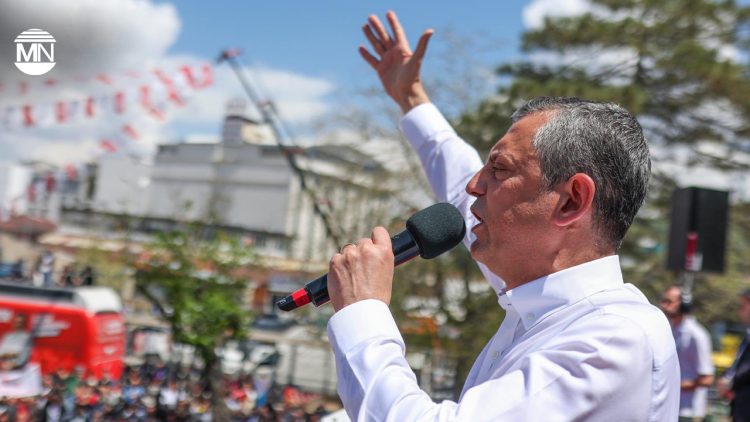
The leader of Turkey’s main opposition party has called for urgent reforms in parliament to end the practice of appointing government trustees in place of elected officials in Kurdish-majority cities.
Speaking at a rally in the Kurdish-majority eastern city of Van (Wan) on Saturday, Özgür Özel, leader of the Republican People’s Party (CHP), condemned the Turkish government’s dismissal of elected mayors and the continued use of state-appointed trustees to administer municipalities.
“This people have elected their mayors,” Özel told a large crowd in Van’s city square. “The same will that dismisses them again and again does not know the people. It is hostile to Kurds and hostile to democracy.”
The rally was the fifth in a nationwide campaign titled “Protecting the National Will”, launched following the imprisonment of İstanbul Mayor Ekrem İmamoğlu, who is also the CHP’s presidential candidate in the upcoming election. Imprisoned in Silivri Prison, İmamoğlu’s message was read aloud at the event.
Özel strongly criticised the state-appointed governor in Van, accusing him of intimidating people into avoiding the rally. He said authorities had initially refused to recognise the legitimacy of Abdullah Zeydan and Neslihan Şedal, who were elected from the pro-Kurdish Peoples’ Equality and Democracy (DEM) Party as Van’s co-mayors in 2024 with 56 percent of the vote, but were briefly denied their mandates.
The CHP leader framed the removal of Kurdish mayors as evidence of a deeper political issue. “In Manisa, a mayor is elected and governs. In Rize, it is the same [both Turkish cities]. But in Van, Diyarbakır (Amed), Batman (Elih) and Mardin (Merdin) [all Kurdish-majority cities], when people vote, they are told: ‘You can vote, but we will not let you govern.’ That is the Kurdish issue,” he said.
The trustee system was first introduced following the breakdown of peace talks between the Turkish government and the Kurdistan Workers’ Party (PKK) in 2015. It has been widely criticised for undermining local democracy, particularly in Kurdish-majority areas, where pro-Kurdish parties have historically performed well.
Özel rejected the government’s approach, stating that the Kurdish issue could only be resolved democratically through parliament. He said the CHP would support steps to recognise Kurdish rights, end unequal policies, and release political prisoners.
“We say yes to a Turkey without terrorism,” he said. “But we also expect action in parliament to end the trustee system and free those imprisoned for their political beliefs. Anyone who says no to this is outside the democratic process.”
Özel said the CHP’s new alliance — which he described as the “Turkey Alliance” — aims to bring together democrats from across the political spectrum, from conservatives to socialists, and from Turkish to Kurdish voters.
Van, he added, was one of the most neglected provinces in Turkey in terms of public investment. “In education and health, it ranks among the worst. In income per capita, it is in the bottom five. The people here have not only been denied their political will, they have also been left in poverty,” he said.
Özel’s visit to Van marked a shift in tone for the CHP, a party traditionally associated with Turkey’s nationalist establishment. He acknowledged the party’s past electoral failures in the city and pledged to build a broader democratic front that embraces Kurdish voters.
Özel ended his speech by vowing to uphold the promise made to recently deceased DEM Party MP Sırrı Süreyya Önder, a key figure in past and ongoing peace talks between the Turkish state and the PKK. “Even if others abandon this path, we will carry on,” he said. “One day, we will achieve Turkish-Kurdish brotherhood.”


