

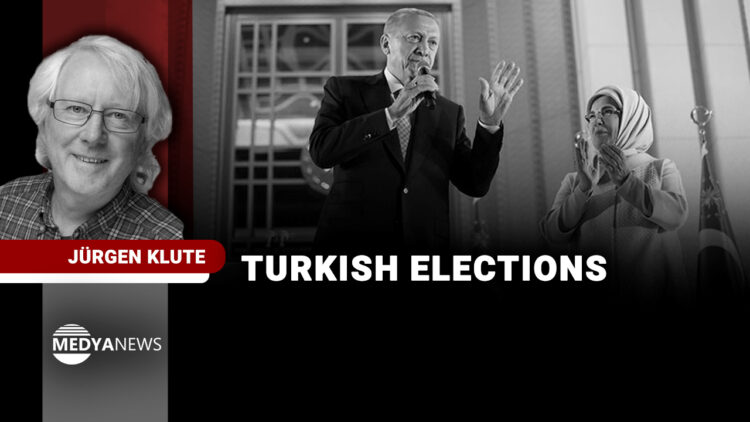
Jürgen Klute
While I am writing this text, not all votes in the run-off of the Turkish presidential election have been counted yet. According to the figures I have, about 97 per cent have been counted. According to these figures, the outgoing president Recep Tayyip Erdoğan is narrowly ahead of his challenger Kemal Kılıçdaroğlu. Even though the result is close, the outcome of the presidential election is clear.
After weeks and months of hope, this is a disappointment for all those who had counted on political change in Turkey. For a long time, things did not look good for the acting president.
In any case, it is clear that this result is bad for both Turkey and the European Union.
For Turkey, it is bad that Erdoğan will now continue his authoritarian, undemocratic political course against opposition members, critical journalists, human rights activists and minorities for probably another five years. Above all, he will continue his war, which is against international law, against Turkey’s Kurdish population and against the Kurds living in northern Syria (Rojava). The tensions within Turkish society will thus be further exacerbated.
But the election results do not promise anything good for the Turkish economy either. The desolate situation of the Turkish economy and the high inflation are mainly the result of Erdoğan’s economic policy. The war against the Kurds living in Rojava undoubtedly also contributes to the desolate situation of the Turkish economy.
Finally, it can be assumed that the part of Turkey affected by the severe earthquake at the beginning of this year, which is predominantly populated by Kurds, will not receive the support under Erdoğan that the people living there urgently need.
So all this points to an increase in social tensions and conflicts and to a further shift to the right in Turkey.
These developments are also bad for the European Union. The EU is facing the enormous challenge of an energy transition, i.e. phasing out the use of fossil fuels. This does not only mean a fundamental restructuring of the economy within the EU, but it also has geopolitical consequences. A considerable part of its fossil energy sources – i.e. oil and gas – come from the Middle East. The EU’s energy transition will also have an extreme economic impact on the Middle Eastern oil and gas exporting countries if their main exports can no longer be exported to the EU due to the energy transition.
A second point is the already noticeable consequences of global warming.
Both developments can lead to considerable internal social distortions and to regional conflicts in the Middle East as well as climate-induced migration from the Middle East if these developments are not mitigated politically. These developments are likely to accelerate markedly over the next five years. A stable, peaceful, democratic and reliable Turkey would be of central importance for the EU in the expected situation of upheaval, in order to be able to steer these processes of economic and climatic change in a peaceful direction. Erdoğan is likely to have little interest in this and hardly any understanding of the emerging processes.
After all, the EU should also have an interest in a reliable and democratic Turkey in view of the Russian war against Ukraine.
But obviously, the EU has still not developed a sufficient sense of the explosive developments in the Middle East and continues to underestimate the economic impact of the energy transition and global warming. The Kurdish HDP [Peoples’ Democratic Party] in particular would have been an important partner for political cooperation on these points. After all, these issues are present in the HDP’s programme.
Some political groups in the EU, however, might find the election result convenient: Those who think that Erdoğan, after more than 20 years at the political top, is likely to be more predictable than the candidate of a broad and not entirely consistent opposition alliance.
In the coming weeks, the opposition alliance will now have to reflect on the political mistakes made and draw the consequences. The agreement on a common candidate in the opposition alliance was not easy and it was a success. But it also came too late. And perhaps the decision in favour of Kemal Kılıçdaroğlu was an unfortunate one.
A general problem is undoubtedly to win voters for left-of-centre politics in a society with a conservative basic attitude. This actually requires very long-term strategies. Jumping on conservative issues in the short term, as the CHP [Republican People’s Party] candidate did before the run-off election, is risky. On the one hand, it reinforces and confirms conservative positions. On the other hand, one must then also make a corresponding policy in the event of an election victory. This is a way of being pulled to the right. Or you “forget” the conservative voters. But then you lose them again at the next election. And as the election results show, this tactic was not successful.
Another critical point is the presence of Turkish citizens in European countries, especially in Germany, Austria, Belgium and the Netherlands, who are entitled to vote in Turkey. Turkish citizens living as migrants in these countries in particular voted – as in previous years – by a majority for Erdoğan (in Germany two thirds!). By comparison, the approval rate of Turkish voters living in the USA and Canada is well below 20 per cent. At least for Germany, there are now some studies on the reasons why Turkish voters living in Germany vote for Erdoğan and the AKP [Justice and Development Party]. Perhaps the Turkish societal left should take a closer look at these studies. Because if these Turkish voters had voted differently, the close result could have been the other way around.
Looking at Germany, however, it can also be said that the failed German integration policy towards Turkish migrants has a considerable influence on voting behaviour. At least, that is what the studies mentioned above show.
Another question is what the EU could have done differently. In principle, of course, it is problematic to interfere in an election from the outside. After all, the voters of a country are supposed to express their political decisions freely and without outside influence. Within the EU, however, it would have been possible to approach Turkish voters and enter into a political dialogue with them. This would have been a task for the parties in the EU countries.
In the course of Turkey’s accession process to the EU, which is still officially ongoing, there are of course contacts with Turkish civil society. Stronger support from the EU would have been a possible way to strengthen democratic forces in Turkey. The EU would be well advised to think about how it can promote democratic forces in Turkish society over the next five years.
Finally, the election result confronts all democratic forces with a fundamental problem about elections. Elections, as Turkey has shown once again, are highly susceptible to manipulation of various kinds. Once autocrats like Erdoğan have come to power through elections, it is difficult to get rid of them. They use the – usually manipulated – elections as legitimisation for their policies. And at the same time, through access to legislation and to the state’s monopoly on the use of force, they have the opportunity to cement their own power and marginalise the opposition. Elections only work if there is a high level of education in a society and a very active and critical civil society. From my point of view, this shows – not only in the example of the elections in Turkey – that democratic election procedures urgently need to be further developed and reformed.
- Jürgen Klute was a Die Linke (The Left) MEP and spokesman for the Kurdish Friendship Group in the European Parliament from 2009 to 2014. Since December 2016, he has been editing the Europa.blog.


