

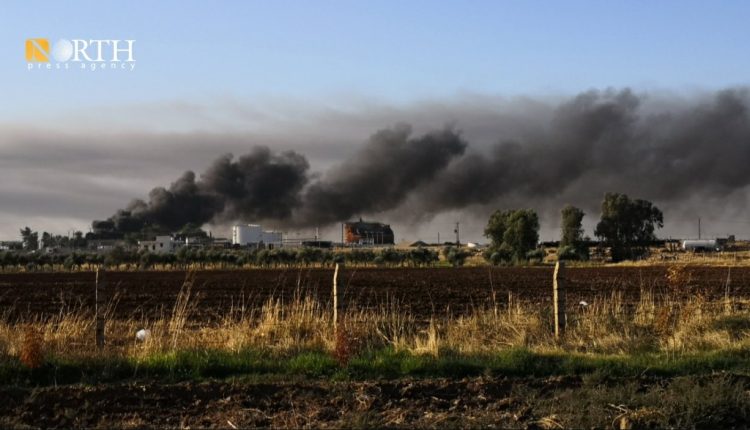
For the third day, Turkish forces have carried out extensive airstrikes in North and East Syria and the Kurdistan Region of Iraq (KRI), focusing on areas governed by the Autonomous Administration of North and East Syria (AANES). Numerous casualties have been reported, including at least 27 civilians killed, among them an 11-year-old girl in Manbij (Minbic). The number of injured has also risen, with 40 wounded as a result of airstrikes on densely populated areas and critical infrastructure.
The Turkish occupation continues to bomb the center of #Kobani city with drones in an attempt to commit new massacres. pic.twitter.com/usjx51cx9Z
— Syrian Democratic Forces (@SDF_Syria) October 25, 2024
On Thursday evening, a Turkish strike on grain silos in Kobanê (Ayn al-Arab) killed one worker and injured eight others. Drones and heavy artillery also struck civilian sites, including hospitals, a stadium, and checkpoints in Kobanê, a Kurdish-majority town in northern Syria near the Turkish border which became symbolically significant in 2014 when Kurdish forces, led by the People’s Defence Forces (YPG), defended it against the Islamic State (ISIS).
Local sources report extensive damage to homes, health centres, and energy facilities. In Kobanê, strikes also impacted a power station, and oil and gas facilities on Qamishli’s (Qamişlo) outskirts sustained severe damage.
Mazloum Abdi, General Commander of the Syrian Democratic Forces (SDF), condemned the strikes as ‘indiscriminate’ and a ‘war crime’, and reaffirmed the SDF’s commitment to dialogue in the conflict.
Hikmat Habib, co-chair of the People’s Council in Hasakah’s governorate, emphasised that Turkey is currently facing internal economic and democratic crises and is trying to export these problems beyond its borders by escalating military action in Syria. Habib called for international intervention, noting that Turkey’s attacks are harming civilians and further destabilising the region.
These airstrikes coincide with increased discussions within Turkey regarding the Kurdish question, including potential dialogue on the role of Kurdish leader Abdullah Öcalan.


