

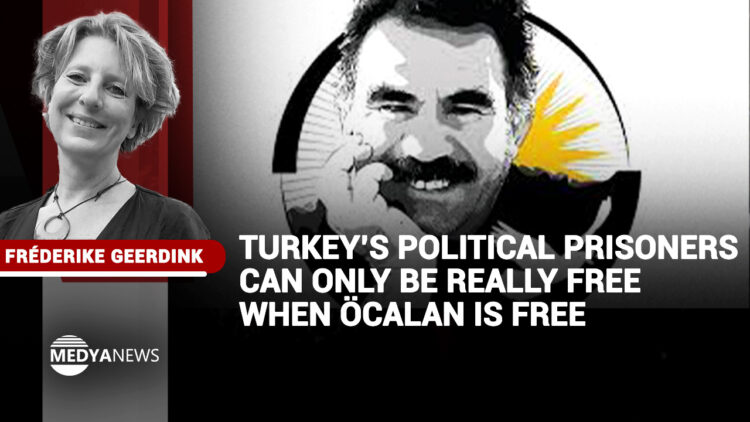
Fréderike Geerdink
It’s a joyous occasion when political prisoners are being released. But the joy about recent releases of Kurdish political prisoners in Turkey doesn’t extend far beyond personal freedom and reunification with loved ones. Why? Because at the same time, new political prisoners are taking the place of the ones who are set free. And the one political prisoner who could solve the problem and work towards a release and rehabilitation of all political prisoners, is held incommunicado.
Since some two years, stories emerge of Kurds who are being reunited with their families and communities after having spent years in jail. This week for example, it was the turn of Halis Tekin (50) and Yılmaz Suncak (51), who were sentenced to life imprisonment respectively in 1994 and 1993, both for ‘disrupting the unity and integrity of the state’. Suncak was severely tortured for 50 days after his arrest 30 years ago. Both men are sick, with Suncak having been diagnosed with cancer 10 years ago and suffering from severe COPD (Chronic obstructive pulmonary disease), caused by prison conditions.
Resist suppression
These men, like practically all of the political prisoners, were peaceful activists. They were deprived of the chance to build a family of their own, to contribute to the Kurdish struggle for freedom in the way they would have wanted to, and to study, work and develop themselves freely. The injustice of this is further deepened by the refusal of the state to acknowledge the mistake of locking these people up. The released prisoners remain known as terrorists, while all they did was resist suppression.
By the way, most of those released are peaceful activists, but now and then also people who were captured as PKK members are set free after long prison sentences. I consider them political prisoners too. They took up arms for legitimate reasons. That young Kurds still take up arms for the same cause as the generations before them, is telling enough about the total lack of progress Turkey has made when it comes to solving the Kurdish issue.
Fabricate cases
What confirms the lack of progress Turkey has made since the largest Kurdish uprising ever started in the late 1970s, is that still every day new political prisoners are made. This week, dozens of Kurds who are active for the DEM Party were detained in early morning house raids all over the country, part of whom will remain behind bars.
What’s cynical is also that this week, the former co-mayor of Dersim, Nurhayat Altun, was released after serving a seven-year prison sentence, after she was replaced by an AKP ‘trustee’ in 2016. Meanwhile, after the most recent local elections on 31 March, the government and judiciary are cooperating already to fabricate cases against the DEM Party’s elected mayors to replace them by trustees again. I am afraid that’s a matter of time.
This must be seen in the light of the so-called Kobani trial as well. It is verdict day today, 16 May.
The Kobani trial is a court case that has been dragging on since 2016, when politicians of the Kurdish movement were arrested and later accused of having called on violent protest in October 2014, during the battle for Kobani between Kurdish fighters and ISIS. During those protests, several dozens of people died, and the state blames HDP (now DEM Party) politicians for it. They had indeed called on people to take to the streets to support the Kurdish fighters, but of course in a peaceful manner.
Tiniest shred
Governing parties AKP and MHP have never accepted a HDP proposal to thoroughly investigate what happened during the Kobani protests and how and why it turned violent, indirectly implicating themselves. More than 100 people are prosecuted (18 of whom have been jailed since 2016) for assorted terrorism-related crimes, without even the tiniest shred of evidence. Multiple life sentences are demanded against the defendants.
There is not much doubt that lengthy prison sentences will indeed be given. So, there you go: another group of people will spend many, many years behind bars for political activism. When will they be released? Starting in 2046? It’s just mind-blowing to even think about it.
While it could all be over on very short notice. The Kurdish issue is not extremely difficult to solve. It’s basically a matter of securing people with rights they have according to every single international human rights and political rights treaty. A right to education in their mother tongue. Right to express your culture. The right to political representation. In short: the right to self-determination. What makes it complicated, is that this breaks the foundations of the Turkish state, which denies the right to self-determination of Kurds. In short: Kurds must be Turks, and as Turks, they can exercise their right to self-determination already within the Turkish state.
Incommunicado
Solving the Kurdish issue takes political will. If there is political will, it can be solved swiftly. And there is a man who is ready at any given time to work with the state to do just that. And that is PKK founder and Kurdish leader Abdullah Öcalan, the most important political prisoner in Turkey since 1999, when he was captured in an international plot. But he has been held incommunicado for 38 months now, with no access to his family nor to his lawyers.
The day this most important political prisoner walks out of prison, the real, unconditional and lasting freedom of all political prisoners will be a fact. They will all get rehabilitated. And their empty prison cells won’t be filled again.
Fréderike Geerdink is an independent journalist. Follow her on Twitter https://twitter.com/fgeerdink or subscribe to her acclaimed weekly newsletter Expert Kurdistan https://frederikegeerdink.com/expert-kurdistan/.


