

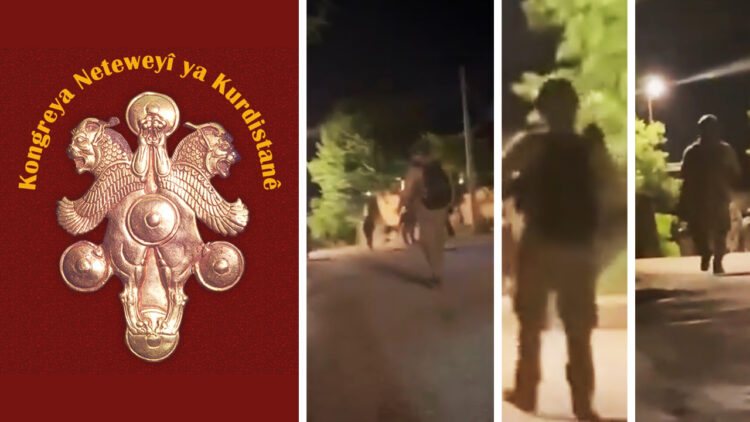
Kurdistan National Congress (KNK) has issued an open letter and a press statement calling for urgent international action to halt Turkey’s aggressive military strategy in the Kurdistan Region of Iraq (KRI). The KNK highlights Turkey’s increasing military actions and human rights violations in the Kurdistan Region of Iraq (KRI), which have escalated dramatically since 15 June with the deployment of hundreds of armoured vehicles, tanks, and troops. Turkish forces have established checkpoints, conducted identity checks on Kurdish citizens, and attempted to evacuate villages, leading to widespread fires from continuous bombings.
“It is worrying that global media and institutions are not responding to Turkey’s military actions and human rights violations,” says the KNK. “Immediate intervention is crucial by the Iraqi government, the US, the EU, the UN, and the Council of Europe to halt escalating violence.”
The KNK pointed out that this invasion follows President Recep Tayyip Erdoğan’s April 2024 visit to Baghdad and Erbil (Hewlêr), where he secured support for the military campaign in exchange for concessions in oil, infrastructure, and water to the Iraqi Federal Government and the Kurdistan Regional Government (KRG).
In recent days, the increased military presence in Duhok and Erbil, supported by the Kurdistan Democratic Party (KDP), has raised fears of a creeping permanent occupation, “which could result in long-term regional conflict with global repercussions,” said the KNK.
Community Peacemaker Teams (CPT), a US-based monitoring group, has reported significant civilian displacement and destruction of agricultural lands due to the military operations. Civilians have also seen damage to infrastructure, including a school and a Christian monastery. “According to CPT, Turkey has conducted 1076 attacks in Iraqi Kurdistan between January and July 2024, with 238 bombardments since the new campaign began,” the KNK added.
“Intense clashes between the Kurdistan Workers’ Party (PKK) and Turkish Armed Forces erupted in Amedi (Amediyê) district of Duhok on Friday,” the KNK said. Airstrikes in the village of Guherzê caused significant damage to houses and vehicles.
Vedant Patel, a US State Department spokesperson, signalled indirect approval of Turkey’s occupation of parts of Iraqi Kurdistan, the KNK highlighted. Political observer Mucaşeh Tamimi noted Iraq’s vulnerability, Turkey’s influence on Iraq’s water supply, and the economic impact of Turkish products undermining border control.
The KNK also noted that statements from the Kurdistan Communities Union (KCK) and the Patriotic Union of Kurdistan (PUK) claim Turkey has enlisted fighters from Al Nusra and other jihadist groups to support its operations. Recent military shipments to Amediye have continued, causing distress among villagers and criticism over the lack of political response.
The KNK’s open letter, addressed to figures such as UN Secretary-General António Guterres and US President Joe Biden, underscores Turkey’s efforts to expand its borders into Kurdish territories, citing historical claims outlined in the Misak-ı Milli*.
“In 2011, the Arab Spring protests and uprisings spread to Iraq and Syria,” the KNK stated, adding, “the Turkish state, which wanted to take advantage of this situation, took action to attempt to expand Turkey’s borders to those of Misak-ı Milli, claiming all of Kurdistan, including northern Iraq and northern Syria, to be within the borders of a Turkish state.”
The KNK further accused Turkish leaders of pursuing expansionist goals through military campaigns and alliances with jihadist groups. “Turkish President and AKP leader Recep Tayyip Erdoğan has often stated that he intends to occupy all of these areas,” the letter continues, “which include the area from Aleppo to Mosul, Sulaymaniyah, Kirkuk, Sinjar, and Behdinan, within the borders of Misak-ı Milli.”
Regarding Turkey’s military activities in Iraqi Kurdistan, the KNK highlights concerns over violations of international law. “In Southern Kurdistan [the KRI],” the KNK asserted, “Turkish troops are now boldly entering 30 kilometres into the region with thousands of soldiers and 300 tanks, carrying out identity checks on Iraqi citizens in and around Duhok.”
The KNK’s call to action was supported by a coalition of Kurdish political parties and civil society organisations, who emphasised the urgency of international intervention to prevent further destabilisation in the region. They urged bodies such as the Arab League, the European Commission, NATO, and the UN to intervene decisively to protect Kurdish communities and uphold international legal norms.
* “Misak-ı Milli” translates to “National Pact” or “National Oath”. It refers to a set of resolutions adopted by the Ottoman Parliament in 1920, outlining territorial claims for the Ottoman Empire following World War I. The resolutions included regions considered historically significant or strategically important to the Ottoman Empire, including parts of what is now modern-day Turkey, Iraq, Syria and other areas, mostly coinciding with Kurdistan. In contemporary contexts, especially within Turkish political discourse, “Misak-ı Milli” is sometimes invoked to emphasise historical or territorial claims.


