

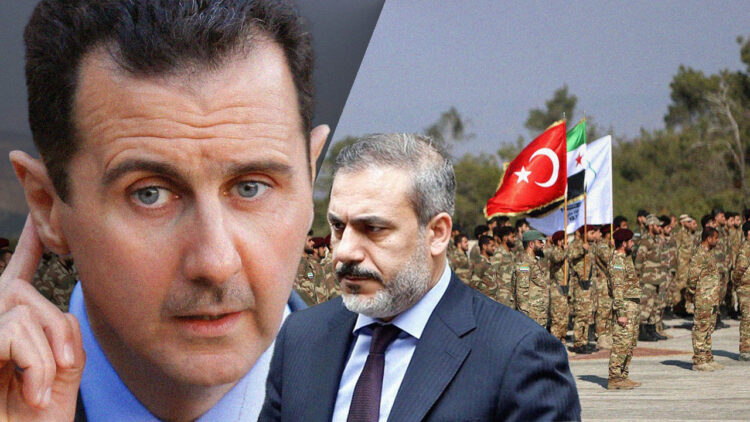
Turkey’s foreign minister, Hakan Fidan, assured Syrian opposition leaders on 8 August that Turkey’s engagement with the Assad regime was motivated by national security concerns and the repatriation of refugees, not by an intent to normalise relations. The clarification was made during a meeting in Ankara, as reported by the UK-based Asharq al-Arabi on Monday.
Fidan explained that Turkey’s recent dialogue with Damascus was largely a response to pressure from Russia, which insists on progress within the Astana process. He emphasised that Turkey’s primary focus was to ensure national security and address the refugee crisis, dismissing any suggestion that Turkey seeks to restore full diplomatic relations with Assad. “This engagement is about national security and the safe return of refugees,” Fidan told the opposition leaders.
The meeting, held on Thursday, included prominent figures such as Hadi al-Bahra, President of the Syrian National Coalition, and Abdul Rahman Mustafa, Prime Minister of the so-called Syrian Interim Government. Mustafa Yurdakul, the Turkish Foreign Ministry’s official responsible for the Syrian file, also attended.
The agenda included the situation of Syrian refugees in Turkey. Fidan informed the opposition that the government plans to replace the current temporary protection cards with new plastic cards resembling residency or work permits, following complaints about the existing documentation. Additionally, Fidan promised to ease the renewal of tourist residencies for Syrians and implement new work permit laws.
Tensions in the Syrian city of Al-Bab, controlled by opposition forces, were also discussed. According to the Asharq al-Arabi report, a recent conflict in Al-Bab between local residents and internally displaced persons from Deir ez-Zor has escalated, with civic groups accusing armed factions of exacerbating the violence. Fidan did not directly address this issue during the meeting but noted the broader implications of ongoing border negotiations with the Assad regime, particularly the planned opening of the Abu al-Zendin crossing.
In recent months, both Syrian President Bashar al-Assad and Turkish President Recep Tayyip Erdoğan have shown openness to the possibility of a meeting to restore relations. “There is no reason not to establish relations with Syria,” Erdoğan stated on 28 June, signalling a shift from previous confrontational rhetoric. He emphasised Turkey’s willingness to re-engage with Syria diplomatically, insisting that there was “no intention or goal of meddling in Syria’s internal affairs”.
However, reassurances given by Foreign Minister Hakan Fidan to the Syrian opposition suggest a more complex agenda. According to insights from political and religious scientist Hüseyin Çiçek, Turkey may be using the return of Syrian refugees as leverage to weaken the Kurdish influence in northeast Syria, while also alleviating domestic pressure from anti-refugee sentiment.
Çiçek argued, in an article titled ‘The Fairytale of the Umma: Erdoğan’s Foreign Policy Fiasco’ published by Austrian newspaper Der Standard on 8 August, that Erdoğan was hoping the refugees would return to Syria to “rebuild their country, and remember Turkey’s role in the conflict, thus contributing to a new alliance policy”.


