

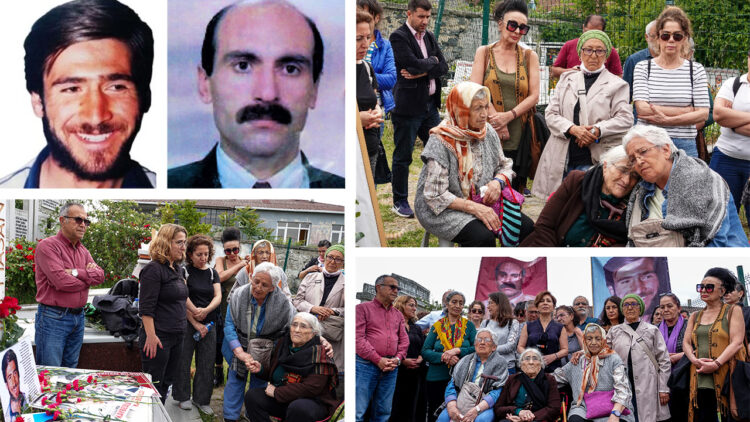
Hasan Ocak and Rıdvan Karakoç, emblematic figures among the many disappeared in Turkish custody, were commemorated on Sunday at their graves in Istanbul as part of International Week of the Disappeared.
The International Week of the Disappeared is globally commemorated from 26 to 31 May. It was first initiated by the Latin American Federation of Associations of Relatives of Disappeared-Detainees (FEDEFAM) in 1981 and later adopted by many organisations of families of the disappeared and civil society organisations worldwide.
The ceremony, attended by the Saturday Mothers, Human Rights Association (İHD) Co-chair Eren Keskin, pro-Kurdish Peoples’ Equality and Democracy (DEM) Party executives and representatives from various other political and democratic organisations, began at the grave of Rıdvan Karakoç. His brother, Hasan Karakoç, paid tribute, stating, “They endured the harshest tortures for our brighter future. We will not abandon their struggle.”
Eren Keskin recounted her last encounter with Rıdvan Karakoç. “I met Rıdvan at Apê Musa’s house. He later came to my office, saying, ‘They’re following me; they’re going to harm me.’ He asked me to call him daily, but one day, we never heard from him again,” she said.
At Hasan Ocak’s grave, his mother, Emine Ocak attended despite her advanced age, and lamented in the Kırmançki dialect of Kurdish. Hasan’s brother, Ali Ocak, expressed their quest for justice: “We are lucky to have a grave, but who killed Hasan? Who gave the orders? We must ask these questions.” Another brother, Hüseyin Ocak, added, “Istanbul police headquarters concealed the whereabouts of those who disappeared in custody deliberately.”
Maside Ocak, Hasan’s sister, criticised the restrictions on gatherings in Galatasaray Square. “We have a grave, but our mourning continues because justice has not been served,” she stated. “I want to say, ‘Look, Hasan, those who disappeared you have been punished,’ but I can’t say that.”
Hasan Ocak and Rıdvan Karakoç were prominent figures in Turkey who became symbols of the fight against enforced disappearances and human rights abuses.
Ocak was a teacher and human rights activist who was disappeared and murdered in 1995. He was detained by the Turkish police, and his body was later found showing signs of torture. His disappearance and death sparked significant public outrage and became a rallying point for the Saturday Mothers (Cumartesi Anneleri), a group of activists who gather weekly in Istanbul to demand justice for their disappeared relatives and to raise awareness about enforced disappearances.
Karakoç was also a victim of enforced disappearance. Like Ocak, Karakoç was detained by the police, and he was last heard from on 15 February 1995. His body was later discovered bearing signs of torture. He, too, became a symbol of the struggle against state violence and impunity in Turkey. His case highlighted the broader issue of political repression and human rights violations during a period of intense conflict between the Turkish state and Kurdish insurgents.
Both men are remembered annually, especially during the International Week of the Disappeared, for their contributions to the human rights movement and their tragic fates, which exemplify the struggles faced by many in Turkey during that era.


