

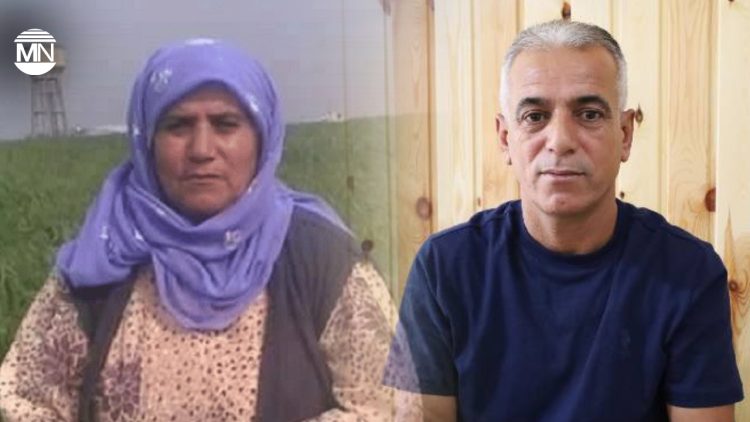
Families of Kurdish civilians killed during past military operations and enforced disappearances in Turkey have spoken out in support of Abdullah Öcalan’s latest call for peace, urging the state to respond with concrete actions and justice measures.
Speaking after the Kurdistan Workers’ Party (PKK) announced on 12 May that it had formally ended its armed struggle, Mehmet İnan and Eren Baskın – both relatives of victims of state violence – endorsed the peace initiative and called on the Turkish government to match Kurdish steps with legal reforms and public accountability.
Mehmet İnan, whose mother Taybet İnan was shot dead by security forces in Silopi (Silopiya), Şırnak province, during a military curfew in December 2015, said his family continued to believe in peace despite the trauma. “My mother’s body was left in the street for seven days, but we still say ‘peace’,” he said. “Those who haven’t paid a price have no right to say they are against peace.”
He expressed full support for Öcalan’s “Call for Peace and a Democratic Society” and urged the state to reciprocate. “The state has no other option but to reach out to the Kurdish people,” İnan said. “It must take steps towards a democratic solution.”
Eren Baskın, who has campaigned for justice for over three decades after his father Abdülmecit Baskın was killed in custody in 1993, also welcomed the recent developments. “If there is truly to be an honourable peace, I am ready to forgive my father’s killers,” he said.
Baskın criticised decades of impunity for state-linked killings, referencing the failed prosecution of figures such as former Interior Minister Mehmet Ağar. Despite confessions and evidence, all suspects were acquitted in what became known as the Ankara JİTEM (Gendarmerie Intelligence and Counter-Terrorism) trial, with courts citing the statute of limitations.
He argued that real peace requires legal reform and recognition of past abuses. “If Öcalan and the PKK are willing to end the armed struggle and take risks, then the state must meet legitimate democratic demands,” he said, listing Kurdish-language education, the release of sick prisoners, and implementation of the ‘right to hope’ among necessary steps.
Both İnan and Baskın called for improved conditions and eventual freedom for Abdullah Öcalan, describing him as the key actor in the process. “This process cannot continue unless Öcalan is allowed to speak, share his views, and lead,” said İnan. “If the state is serious about peace, it must show it by changing his conditions.”
For families like the İnan and Baskıns, the renewed call for peace offers hope — but only if met with justice. “We want to live together,” İnan said. “Kurdish people have done their part. Now it’s the state’s turn.”


