

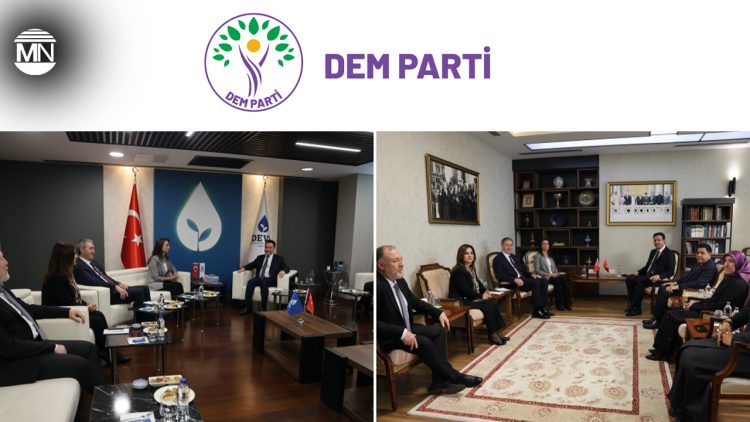
The pro-Kurdish Peoples’ Equality and Democracy (DEM) Party has proposed the creation of a fully authorised commission within Turkey’s parliament to guide political reform and democratic negotiations, including matters related to the Kurdish issue and recent developments surrounding the Kurdistan Workers’ Party (PKK).
The proposal was conveyed during a series of closed-door meetings on 19 May between DEM Party co-chairs Tülay Hatimoğulları and Tuncer Bakırhan, and the leaders of the Democracy and Progress Party (DEVA) and the conservative Felicity Party (SAADET). DEM Party officials said the commission would include representatives from all political factions and help facilitate democratic consensus under the Grand National Assembly (TBMM).
“These visits addressed key topics concerning Turkey’s democratic future,” the DEM Party said in a written statement. “Recent contact with [PKK leader] Abdullah Öcalan and decisions from the Kurdistan Workers’ Party’s 12th Congress on 12 May were discussed in detail. In this context, our delegation proposed the establishment of a fully authorised commission under the TBMM to ensure a healthy and inclusive political process.”
The party’s dialogue with political counterparts is part of a broader initiative following the PKK’s announcement of its official dissolution earlier this month—a move seen as a significant step toward renewing stalled peace efforts in Turkey. DEM Party leaders are seeking parliamentary engagement to institutionalise the process.
Further talks are scheduled with the main opposition Republican People’s Party (CHP) and the Islamist New Welfare Party (YRP) on 20 May, followed by a meeting with the Future Party (GP) on 23 May. The DEM Party has stated it aims to meet with all political parties, including the ruling Justice and Development Party (AKP) and its nationalist ally, the Nationalist Movement Party (MHP).
The party’s initiative underscores its push to centre parliamentary institutions in any resolution process, as opposed to extra-institutional negotiations. Analysts view the proposed commission as an attempt to ensure democratic legitimacy and broader political buy-in, especially as tensions persist over the government’s long-standing trustee policy in Kurdish municipalities and the continued isolation of imprisoned PKK leader Abdullah Öcalan.
The meetings have so far taken place behind closed doors, and no joint statements have been issued. However, the DEM Party’s insistence on a structured and representative forum in parliament suggests a renewed strategic approach to advancing both Kurdish rights and democratic reform within Turkey’s existing political framework.


