

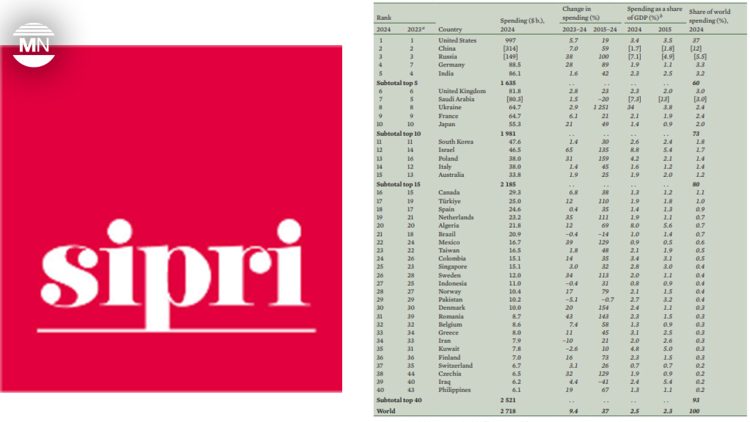
Turkey increased its military spending by 12% in 2024, bringing its defence budget to $25 billion, according to data published in April 2025 by the Stockholm International Peace Research Institute (SIPRI). The country now ranks 17th globally, amid a decade-long global surge in military expenditure driven by geopolitical tensions and large-scale rearmament policies.
SIPRI’s annual report shows that world military spending rose by 9.4% in real terms to reach $2.718 trillion in 2024—the highest level recorded since data collection began in 1988. The rise marks the tenth consecutive year of increases and the sharpest year-on-year growth since the end of the Cold War.
Turkey’s decade-long growth in defence spending—110% since 2015—underscores the country’s deepening focus on security strategy and procurement, particularly amid its regional entanglements in Syria, Iraq, and ongoing geopolitical rivalries in the Eastern Mediterranean and South Caucasus. Defence expenditure made up 1.9% of Turkey’s GDP in 2024, a slight increase from 1.8% in 2015.
The SIPRI report found that more than 100 countries raised their military budgets in 2024. Globally, military spending accounted for 2.5% of world GDP, up from 2.3% in 2023. The 15 largest military spenders, including Turkey, were responsible for 80% of the global total.
The five biggest spenders—the United States, China, Russia, Germany and India—collectively accounted for 60% of global military expenditure. The United States led by far, allocating $997 billion, followed by China at an estimated $314 billion. Russia’s spending increased by 38% to reach $149 billion, reflecting the ongoing war in Ukraine and a dramatic redirection of national resources toward its armed forces.
Meanwhile, Ukraine’s military budget stood at $64.7 billion—representing 34% of its GDP, the highest military burden in the world in 2024. All of Ukraine’s tax revenue was absorbed by its military budget, while social services were primarily funded by international aid.
Europe as a whole was the largest contributor to the global spending surge. Regional expenditure rose by 17% to $693 billion, with all countries increasing their defence budgets except Malta. In Central and Western Europe, countries like Germany and Poland posted sharp increases—28% and 31% respectively—as governments accelerated arms procurement and reoriented policies towards long-term militarisation.
Germany became the largest military spender in Western Europe for the first time since reunification, allocating $88.5 billion to defence. Poland’s military burden reached 4.2% of GDP, the highest in its region.
The Middle East also witnessed a significant rise, with overall military spending estimated at $243 billion—15% higher than in 2023. Israel’s budget soared by 65% to $46.5 billion, driven by the ongoing war in Gaza and renewed hostilities along its northern border. Lebanon, which had seen years of constrained military budgets due to economic collapse, also increased its spending by 58%.
In contrast, Iran’s military expenditure fell by 10%, down to $7.9 billion, amid continuing sanctions and economic instability.
In Asia and Oceania, defence budgets grew by 6.3% overall. China, Japan and India continued to modernise their forces, with Japan recording a 21% rise—its largest annual increase since 1952. Myanmar, gripped by internal conflict and military rule, posted the region’s sharpest increase at 66%, raising its military burden to 6.8% of GDP.
Among NATO members, total military spending reached $1.5 trillion in 2024, equivalent to 55% of global expenditure. For the first time, 18 out of 32 member states met or exceeded the alliance’s 2% GDP guideline. European NATO members spent $454 billion collectively, with spending increases driven by renewed concerns over Russia and debates about US commitment to European security.
Although Turkey did not cross the 2% NATO benchmark, its 2024 spending placed it ahead of numerous allies in both volume and growth rate. The country’s increase is part of a broader pattern of sustained investment in its domestic arms industry and growing regional military footprint.
SIPRI’s analysis also highlights the economic trade-offs involved. As governments prioritise defence, many are reallocating funds from development, welfare and international aid. Some, such as the United Kingdom and France, are adopting extra-budgetary mechanisms to support military build-up, while others are loosening fiscal rules or turning to bond markets.
While military modernisation and preparedness are presented as strategic necessities, SIPRI’s findings raise long-term questions about the sustainability and societal cost of this global arms race.


