

Sarah Glynn
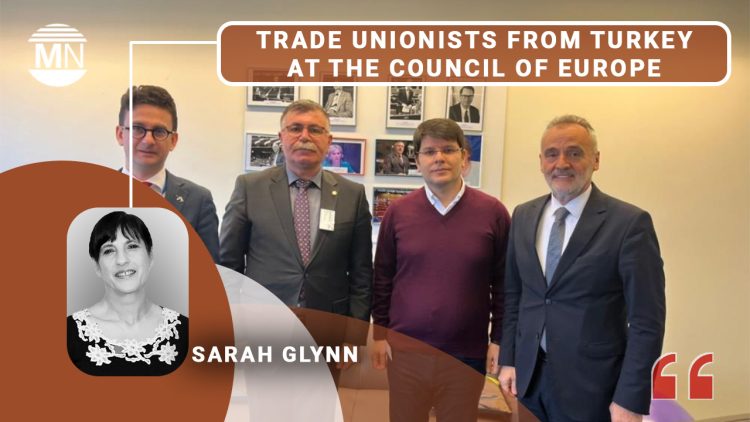
Turkey’s appalling human rights record ensures that there is a steady stream of people from Turkey lobbying the Council of Europe. Last week, as well as members of Abdullah Öcalan’s legal team who come to all quarterly sessions of the Parliamentary Assembly, it was the turn of two representatives from the Confederation of Public Employees Trade Unions, KESK: Ahmet Karagöz, KESK co-president, and Osman Işçi, their International Relations Officer.
Throughout the world, workers’ rights are under attack as part of the growing authoritarianism, and this is particularly true in Turkey, which the International Trade Union Confederation has classed as one of the 10 worst countries for workers every year since 2016. 2016 was the year of the attempted coup that President Erdoğan described as a “gift from God” and used as a pretext to clamp down on all opposition, not just the followers of Fethullah Gülen who the government blamed for the coup. Under Emergency Decrees, which bypassed Parliament, 140,000 public sector employees were dismissed from their jobs, many of whom, including last week’s visitors, are still unable to work.
Although almost 2/3 of public sector workers are in trade unions, most are in unions that rely on government support. For public sector workers who are not prepared to accept the official line, there is KESK, for white collar public employees, including teachers and academics, and DISK (the Confederation of Progressive Trade Unions) for other public sector workers, as well as for everyone employed in the private sector. The division reflects distinctions in Turkish labour law. Although KESK membership is relatively small, a disproportionate number of their members – 4,259 – were among those dismissed in 2016.
Osman Işçi lost his job as an academic – like Sevilay Çelenk, who is now one of the Peoples’ Equality and Democracy (DEM) Party Deputies at the Parliamentary Assembly. Işçi explained that KESK members were targeted “because of our position on labour rights, because we were saying ‘no’ to corruption in the public sector, because we defended peace, because of our position on the Kurdish issue, because of our position on democracy, the rule of law, and because we say ‘no’ to violence against women…” Ahmet Karagöz, who had been a teacher before being dismissed, estimated that around 80% of the dismissed KESK members were Kurds.
Trade Union legislation in Turkey is very restrictive. With the exception of academics, who can even be actively involved as advisors, people working in the public sector are not permitted to be members of a political party; and public sector workers are not allowed to strike. Karagöz explained that this didn’t stop them organising actions. They have always pushed at the boundaries. KESK was founded in 1995, but it was not until six years later that public sector unions were made legal. This sort of struggle puts them under constant pressure, and one of their officers is currently in prison, as well as other union members.
KESK has challenged the dismissals through the courts, and ultimately through the court of last resort, the European Court of Human Rights. The European Court instructed Turkey to establish an enquiry commission, but Turkey then used this as a delaying mechanism. Six out of seven commission members were government appointees, and the commission only agreed reinstatement for 14% of applications; however, cases could not be taken to the European court without exhausting this internal process first. Of the dismissed KESK members, 2,512 have still been denied their rights.
The two union representatives were here in Strasbourg, with their latest report on the situation, to meet with Council of Europe officials, and to explain their case to deputies attending the Parliamentary Assembly, who they asked to keep the issue on the Council’s agenda. I listened to their short speech to the Left Group and met up with them afterwards.
Karagöz explained that the real coup was the government declaration of a State of Emergency. Işçi observed that although it is officially ended, the mentality of the Emergency is still going on. He described how the dismissals were carried out without due process and with no opportunity to question the decision: “we just saw our names on the list”. They were told the dismissal was permanent, their social security was stopped for them and their families, and their passports were taken away for a long period. The public services where they worked also suffered from their loss.
The government showed no sympathy. When asked how these people would survive, one politician told them they could eat leaves from the trees. The union launched a solidarity fund, which has been a big job over many years. The comprehensive nature of the attack served to drag out the fightback. The union had to fight for the return of people’s basic rights before they could address their reinstatement. They are active, of course, in international trade union bodies, and have received support in publicising the issue, and also for their solidarity fund, from unions in other countries.
This is not the first case that KESK has taken to the European Court. They have had wins before, and they know it is a long slow struggle.
Sarah Glynn is a writer and activist – check her website and follow her on Twitter or bluesky


