

Ertuğrul Kürkçü
As the ruling “traffic light” coalition in Germany drifts, partly because of its own internal fragilities and partly because of global power shifts, the country has been plunged into the worst traffic congestion in recent history.
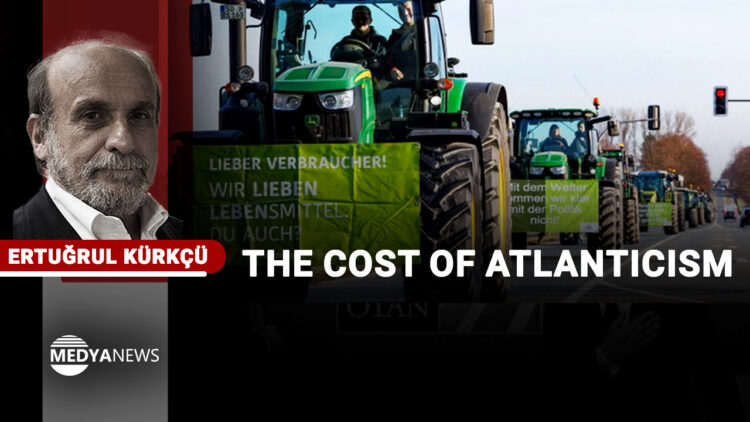
“Congestion” is not just a metaphor: Chancellor Scholz’s government is floundering in the face of protests by farmers who ran their tractors onto the main arteries of the capital Berlin as well as the metropolitan cities of Cologne, Hamburg, and Munich, smothering the streets with manure. After being stranded for hours on a ferry with angry farmers, the Green Minister for the Economy and Climate and Deputy Chancellor Robert Habeck spoke of the “spectre of a coup d’état in Germany” and sought to explain it away as the infiltration of the proto-fascist Alternative for Germany (AfD) party into the farmers’ protests.
Obviously, the minister’s political myopia does not allow him to perceive even what is visible to the naked eye as the labour strikes and farmers’ protests develop like a tsunami.
In Germany, as in all capitalist countries, the ups and downs of social life are determined by the course of the contradictions between labour and capital. Germany’s socio-political order was based on a broad social consensus, which was adopted through a kind of national consensus when the country was rebuilt after the Second World War. Reflecting this social consensus, long-lasting “grand coalitions” of centre-left and centre-right parties could even be formed in an electoral system based on proportional representation and local autonomy that excluded the socialist left from the political spectrum. With the expansion of the European Union in the 90s, the unification of East and West Germany and the advantages harvested by the state and the economy to place the country at the centre of Europe, Germany had gained an adorable position in the “West” with its high growth rate and the finances almost exempt from inflation and budget deficits – the only problem remained was how to tackle the budget surplus.
However, the two major general crises in the last four or five years have reminded Germany all too quickly of the fundamental realities underneath this rosy picture: that political life is based on the tensions between conflicting classes. The massive downcycle in global growth caused by the COVID-19 pandemic had a direct impact also on the German economy, followed by the difficulties imposed by the Atlanticist position adopted by the Scholz government in the Ukraine-Russia war. The budget surpluses and all the gains amassed in the previous decade have been poured into 100s of billions of euros in impair investments and arms purchases imposed by the preparations for a “possible war with Russia”. Energy costs which, thanks to the relatively cheaper supply of Russian natural gas, could have remained low under Merkel, skyrocketed by at least 20 percent when the “enemy” Russian natural gas was cut off as Germany repositioned alongside Washington. Thus, under Scholz’s “traffic light” government, Germany was reacquainted with the problems it had forgotten for several decades: Inflation, the high cost of living, falling wages, impoverishment, widening and sharpening inequalities…
As if all this was not enough, Germany’s constitutional court unexpectedly turned down the government’s decision to redirect the emergency loan authorized for use during the pandemic period to the new climate and green transformation fund. With this decision, which comes at a time when the constitutional “debt brake”, which had been suspended for the last three years, is back in force, the government, not knowing how to plug the “black hole” in public finances, has acted by the classic reflex of lifting agricultural support funds (subsidies), increasing taxes and cutting wages.
Although the first widespread reaction coming from farmers, who traditionally face the conservative parties, may provide a fertile ground for circulating rumours of an “AfD scare” in politics, the situation is more complicated. This week, train drivers pulled trains into sheds, and they are planning a long and bitter strike period in 2024. Physicians are preparing to halt their practices in demand of increased health subsidies, while truckmen, angered by exorbitant toll increases, are planning to cut Germany’s famous motorways like their Peruvian counterparts did last year.
It is in this climate that the AfD stands out, with its propaganda characterised by classic proto-fascist, ultra-nationalist themes: However, the AfD’s catchwords concerning immigration and xenophobia, the Hitlerite “Deutschland über Alles”, is more popular in the former East German states, far from the Middle East refugee routes, but which have suffered the most negative consequences of the unification of the two Germanies – relative poverty, cuts in social benefits, relative income inequality, and neglect. Although the AfD’s propaganda campaign appeals to conservative German voters in general, it is consistent with the party’s proposed core political goal of rebuilding Germany as a self-sufficient, “strong” state: The party’s current political agenda for Germany is to pull out of the war with Russia, to make a separate peace, and to pursue economic co-operation with Moscow by pursuing an economic policy in line with its geostrategic position rather than that of the USA and Western Europe.
The rise of the AfD influence among the impoverished people of East Germany, who have become aware of the close connection between their impoverishment and the war and economic policies of the Scholz government, has more to do with these socio-economic realities than with conspiracy theories.
Indeed, the same socio-economic realities have also resonated within the ranks of the Left Party (Die Linke), which was born from the merger of the Democratic Socialism Party (PDS), which emerged from East Germany, and the left wing of the German Social Democratic Party (PDS) and until a few years ago was pushing the 10 percent threshold. The move by Sahra Wagenknecht, one of the young leaders from East Germany, to leave the Left Party and form a new party to create a “conservative left” policy in an attempt to stem the flow to the AfD and rise on this wave did not go unnoticed. A survey conducted a few months ago showed that 14 percent of voters said they could consider voting for this party.
Of course, Wagenknecht’s “conservative left” has nothing to do with socialism. While the movement she launched envisages increased government intervention in the economy, increased social security, and shifting the source of income transfer to the rich, it also promises that wealth and inheritance rights will be guaranteed and that it will remain committed to “ordoliberalism”, the founding ideology of the Federal Republic of Germany, i.e., “social market economy”, as a “fair market economy”.
These policies may not imply a meaningful future, but they are at no cost to listen to those who yearn for the “good old days” and “even older and more beautiful days”. In the coming days, Germany will be more open to hear alternative policy proposals rather than paying the bill for the Atlanticist foreign policy and “belt-tightening” measures of Olaf Scholz and the “Traffic Light” coalition, and the voices of trade unions will be heard more loudly.
*Ertuğrul Kürkçü is the current Honorary President of the Peoples’ Democratic Party (HDP) and Honorary Associate of the Parliamentary Assembly of the Council of Europe (PACE). He spent 14 years as a prisoner between 1972-1986 for his political activism in Turkey. He is also member of Progressive International Council.


