

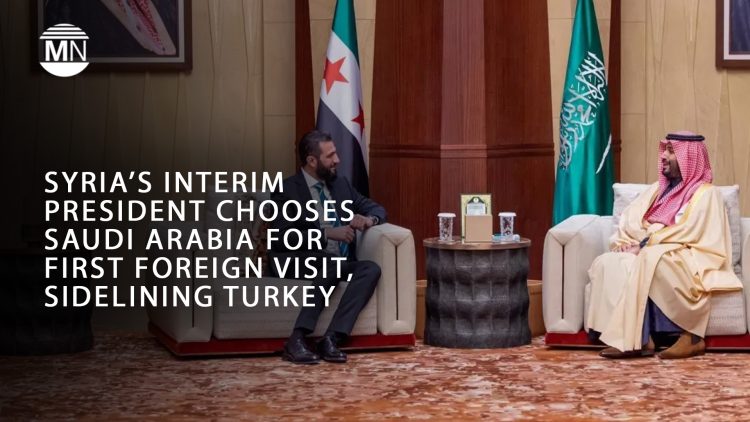
Syria’s interim President Ahmed al-Shara’a arrived in Riyadh on Sunday, making Saudi Arabia rather than Turkey his first official foreign destination since taking office. Accompanied by Foreign Minister Asaad al-Shibani, al-Shara’a was received by Saudi officials and later met with Crown Prince Mohammed bin Salman (MBS).
Saudi Arabia has also gradually reformed its Salafist ideology, positioning itself as a key player in shaping Syria’s political future.
Riyadh hosted a regional foreign ministers’ summit to discuss Syria’s political future on 12 January.
The UAE signed the Abraham Accords with Israel, with Saudi Arabia engaging in indirect diplomatic shifts that pave the way for dialogue.
Saudi authorities have gradually moved to reform their strict Salafist doctrine, distancing themselves from the radical interpretations once dominant in the kingdom.
Related Articles :
Turkey targets Kurdish autonomy, aims to block inclusive Syria in diplomatic push
Ankara’s dual strategy targets Kurdish gains
Given that Salafism is the official sect of Saudi Arabia, and that al-Shara’a has strong Islamic credentials, the visit also hints at Saudi Arabia’s growing influence in shaping Syria’s future governance model.
During his meeting with MBS, al-Shara’a and Saudi officials are expected to discuss Syria’s reconstruction, economic partnerships and diplomatic re-engagement with the Arab world. Saudi Foreign Minister Faisal bin Farhan earlier visited Damascus, advocating for the lifting of sanctions on Syria, a move that could deepen Riyadh’s economic ties with Damascus.
Meanwhile, Ankara remains actively engaged in shaping Syria’s future. Today, Turkish Foreign Minister Hakan Fidan met his Qatari counterpart in Doha, just two days after the Emir of Qatar visited Damascus. Turkey and Qatar, long-time regional allies since the rise of ISIS and the Syrian war, continue to push for greater influence over the new Syrian leadership. However, with Saudi Arabia asserting its role through direct engagement with al-Shara’a, a complex power struggle over Syria’s post-Assad trajectory is now unfolding between these regional players.


