

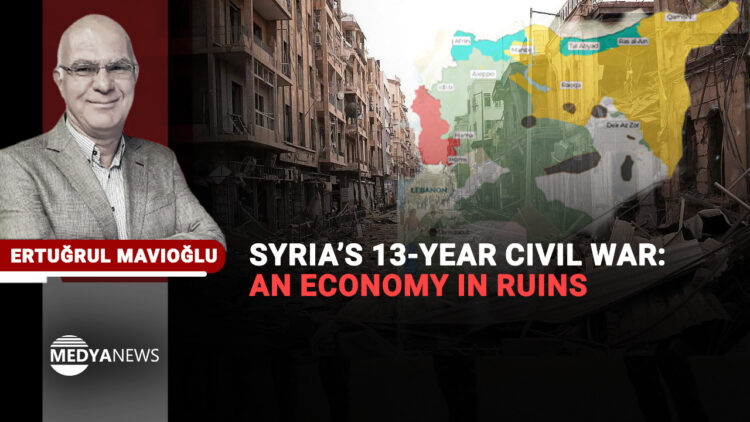
Ertuğrul Mavioğlu
The 13-year civil war in Syria has led to catastrophic economic devastation, leaving the country in a state of unprecedented ruin. Despite the fall of the 61-year Ba’ath Party regime, the prolonged conflict has caused irreparable damage to Syria’s economy.
In 2011, just before the civil war erupted, Syria’s gross domestic product (GDP) stood at $64.7 billion, ranking the country 87th globally. Although considered underdeveloped, Syria had a relatively diversified economy, with foreign investments accounting for 27.4% of industrial output. Agriculture made up 16.9%, while services and tourism constituted 55.7% of the economy.
Economic challenges were not new to Syria. From 1982 to 1989, real per capita income declined by 22%. However, reforms introduced in the 1990s by the Assad regime led to a gradual recovery, with per capita income surpassing $4,000 by 2010.
Before the war, Syria’s main revenue streams were agriculture, oil, and tourism. Yet, as the war escalated, these sectors collapsed under the combined weight of internal strife and international sanctions imposed by the USA, Australia, Canada EU, Arab League, and Turkey. The fragile economy, already vulnerable, was pushed to its breaking point.
Unprecedented economic loss
According to UN observers, the economic damage between 2011 and 2013 amounted to $143 billion, rising to $237 billion by 2015. The World Bank reported in 2018 that nearly a third of Syria’s housing and half of its health and education facilities were destroyed during the war.
Years of sanctions have crippled Syria’s ability to trade, turning it into a near-isolated economy. With almost no production or imports, the population—now reduced to approximately 20 million—struggles to meet basic needs. Widespread hunger has driven people to forage for food in rubbish dumps.
Displacement and unemployment
The war has displaced around 6 million Syrians, with many living in dire conditions in refugee camps in neighbouring countries like Turkey and Lebanon. Meanwhile, domestic unemployment soared from 14.9% in 2011 to 57.7% by 2014. Over 3 million people lost their jobs during this period, and by 2015, Syria Policy Research Centre reported that 70% of Syrian workers were earning less than $100 per month. Five out of every six Syrians now live in poverty, unable to afford even basic necessities.
Impact of foreign occupation
The conflict in Afrin [Efrîn] further exacerbated economic woes. Turkey’s occupation of the region, alongside allied jihadist groups, caused widespread destruction of olive groves—a key resource for local farmers. These groups looted olive oil production facilities, depriving Kurdish communities of a vital income source.
Currency collapse
Syria’s currency has been in freefall. After the Assad regime’s collapse in certain regions, the Syrian pound lost 42% of its value against the US dollar. In Damascus, the exchange rate climbed to 22,000 pounds per dollar, while in Aleppo, it surged to 36,000 pounds—a 64% depreciation.
The plundering of Syria’s Central Bank by jihadist groups only deepened the crisis, worsening poverty and signalling the continuation of a profound economic and political disaster.
Ertuğrul Mavioğlu is a journalist and author. He was imprisoned from 1980 to 1991 for opposing the 1980 military coup in Turkey. Mavioğlu has been active in journalism since 1985 and has published eight books. He faces ongoing legal challenges over his 2013 documentary ‘Bakur’, filmed in Kurdish guerrilla camps. His latest work, ‘Bakur Notes’, was released in 2013.


