

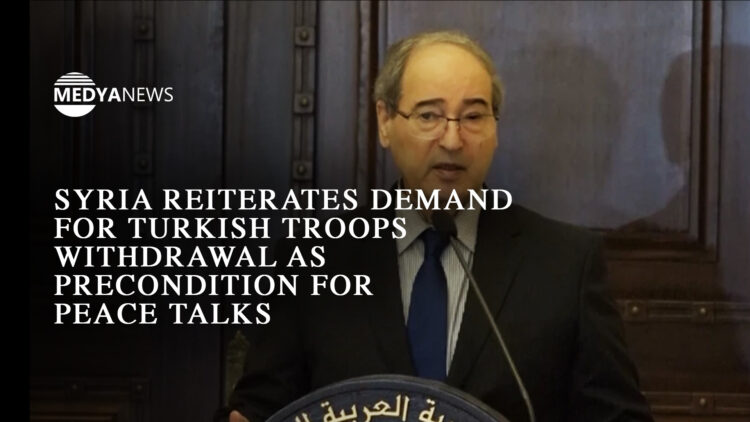
Syria has set a firm precondition for peace talks with Turkey: Ankara must first declare its readiness to withdraw its forces from all occupied Syrian territories. The demand was made by Syrian Foreign Minister Faisal Mekdad during a press conference in Damascus on Tuesday.
Mekdad emphasised that dialogue cannot proceed while Turkish troops occupy Syrian land. “The fundamental condition for any Syrian-Turkish dialogue is Ankara’s declaration of its readiness to withdraw from the territories it occupies. We do not negotiate with those who occupy our land,” Mekdad explained.
He further demanded precise Turkish commitments that reflect “a genuine intent to withdraw and to cease supporting terrorist organisations” in northern Syria, referring to a number of jihadist groups backed by Turkey. “The Turkish occupation of Syrian lands must not continue to support terrorist organisations in northern Syria,” he added.
Meanwhile, the pro-regime Al Watan newspaper reported on Monday that Turkish President Recep Tayyip Erdoğan is seeking to restore rapprochement with Bashar al-Assad ahead of the US presidential elections in November, aiming to settle the Syrian refugee issue and “ward off the danger” of the Syrian Democratic Forces (SDF).
The newspaper quoted sources “monitoring the relationship between Damascus and Ankara” stating that the Turkish president is working to restore talks with the Syrian regime following “leaks revealing the Biden administration’s intention to accelerate the recognition of an SDF-controlled Kurdish canton in northeastern Syria ahead of the American presidential elections in November.”
Al Watan did not provide specific details or direct sources regarding the US leaks about recognising a Kurdish canton, but quoted the sources as saying, “This matter may push Erdoğan to again extend his hand to the Syrian regime to increase coordination in this thorny issue, for fear of such dramatic measures.” Given that Al Watan is a pro-regime newspaper, its report could be interpreted as part of a strategic approach by the Syrian regime to influence Turkish policy, since the idea that the Biden administration might recognise Kurdish cantons in northern Syria could act as a lever to pressurise Turkey into negotiating or realigning its stance more favourably towards Syria.
The Turkish military presence in Syria began in August 2016 with the launch of Operation ‘Euphrates Shield’, which was ostensibly aimed at securing its borders and but widely considered to be a move to prevent the rise of Kurdish autonomy in the region, that might influence its own Kurdish population. This and subsequent operations are widely viewed by some observers and critics as efforts to disrupt advances made by Kurdish forces, particularly the People’s Defence Units (YPG), after their effective resistance against ISIS. Later operations, such as Operation ‘Olive Branch’ in 2018 and Operation ‘Peace Spring’ in 2019, extended Turkish occupation over various Kurdish-majority regions. These campaigns have led to significant forced displacements of people and the resettlement of certain areas by Arab populations, outcomes that have raised concerns about alteration of the demographic balance and dilution of the Kurdish presence in these areas.


