

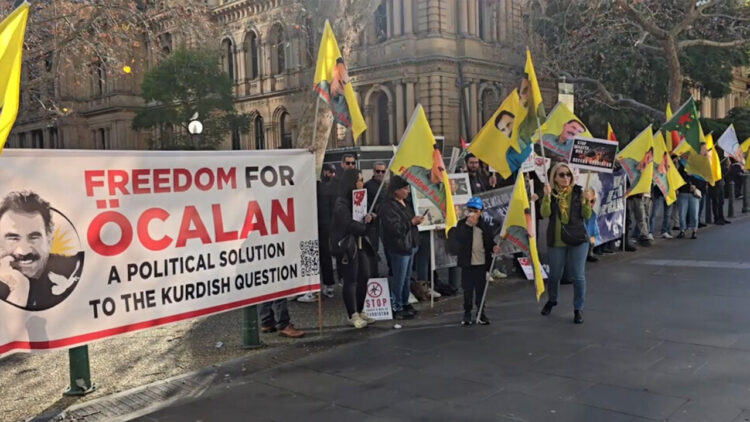
Brusk Aeiveri, co-chair of the Federation of Democratic Kurdish Society – Australia, urged the Australian government to cease arms exports to Turkey and discourage tourism to the country at a rally in the centre of Sydney on 21 July. The rally was part of a global protest against the latest Turkish invasion into Iraqi Kurdistan, known to Kurds as Başûrê (South) Kurdistan.
Aeiveri made a strong appeal to the Australian authorities, saying “the Australian government [must] request a response through the Turkish embassy and request the Turkish government to stop this invasion of Kurdish land in Başûrê and Rojava.” His comments reflect growing concerns within the Kurdish community about Turkey’s military actions and their broader implications.
He outlined the historical context of Turkey’s actions, noting that this is not the first instance of Turkish aggression. “Turkey has occupied many other countries, like in Syria, north and east of Syria, which we called Rojava, and also Cyprus many years ago. And they’re still occupying that land. And now they’re trying to occupy southern [Iraqi] Kurdistan which we called Başûrê Kurdistan,” he explained.
The current Turkish operation in southern Kurdistan is distinguished by the deployment of over 300 tanks, a scale of military presence that Aeiveri sees as indicative of an occupation rather than a temporary incursion. “This is a pure sign of occupation of southern Kurdistan. And Turkey is now starting checking Iraqi citizens’ IDs when they’re crossing the roads. This is a breach of international law and a big worry,” he added.
The impact of the Turkish military actions on the local population has been severe. According to Aeiveri, the operations have led to significant destruction and displacement. “They have destroyed almost the Kurdish forest and are cutting down the trees and emptying the villages. This is what’s happening there. So many civilians have been killed too,” he noted.
The rally also called attention to the role of the Kurdistan Regional Government (KRG) and its cooperation with Turkish forces. Aeiveri criticised the KRG, particularly the Barzani family, for aiding Turkey. “When we talk about the Kurdistan Regional Government, it’s basically run by one party or one family, the Barzani family. And even within the KDP, not everyone agrees with the Barzani family’s cooperation with the Turkish army,” he said. He argued that without the assistance of the Barzanis, Turkey would struggle to navigate the Kurdish mountains, despite their advanced technology.
Local opposition to this collaboration has not been entirely suppressed. Aeiveri recounted instances of protest within the region. “There was a protest by people in Amedi (Amediyê). They blocked the roads with their cars and whatever trucks they had. At that instance, they captured the protesters, moved them, and some of them have been jailed. And actually, a few journalists have also been jailed because they didn’t want the news to leak to Western media,” he reported.
Aeiveri’s comments underscore the broader geopolitical implications of Turkey’s actions and the need for international intervention. He called for a return to dialogue and negotiations, drawing a parallel with global responses to other conflicts. “If we have not allowed Russia to occupy Ukraine, if we have stopped similar things in the world, this would not happen. War is not the answer. There always is a dialogue,” he stated. Aeiveri emphasised that the suffering caused by these conflicts affects civilians on all sides, including Kurds, Turks and Iraqis.
The Federation of Democratic Kurdish Society Australia is calls on the Australian government to urge its diplomatic channels to pressurise Turkey into ceasing its military operations and to facilitate a peace process. Aeiveri highlighted a period of peace in 2015 when both Kurds and Turks lived without conflict, suggesting that renewed dialogue could restore stability. “We’d like the Australians to be mediating this, to be facilitating this kind of discussion as Australia was involved in this East Timor’s peace. It’s quite important that Australia have a bigger role to play,” he said.
He also made a compelling case for the release of the Kurdistan Workers’ Party (PKK) leader Abdullah Öcalan, asserting that Öcalan’s freedom is vital to facilitate peace talks. The call for Öcalan’s release is rooted in the belief that his participation is crucial for any meaningful dialogue between the Kurdish population and the Turkish government. Öcalan, a founding member and leaderof the PKK, has been imprisoned since 1999, and his detention remains a contentious issue in Kurdish-Turkish relations.
As the rally concluded, Aeiveri’s message was clear: the need for international solidarity and action against what he described as unlawful and oppressive measures by the Turkish state. The call for the release of PKK leader Öcalan and a cessation of arms sales to Turkey are seen as pivotal to achieving lasting peace in the region.
The protest, part of a global demonstration, drew significant attention and featured a speech by Peter Boyle, a prominent journalist and a contributor to MedyaNews.
Boyle addressed the crowd with a strong condemnation of the Turkish regime’s ongoing military actions against the Kurds. “The Turkish regime continues this war against the Kurds. We know that this war is not just happening in one place; it’s happening everywhere,” he stated. He stressed that the conflict is ongoing not only in Iraqi Kurdistan but also in northern Syria and within Turkey itself, particularly in the southern regions.
Referring to the recent elections in Turkey, Boyle noted the Kurdish community’s participation and the challenges they face. “The Kurdish people have voted and expressed themselves in fair, open elections. However, even then, those who were democratically elected for local government are being targeted. The authorities are trying to remove the people’s choice for who should run the country,” he said.
Boyle reiterated the Kurdish people’s demands, which he described as very basic rights. “The Kurdish people are asking for very simple things: the right to their own identity, the right to speak their own language, and the right to manage their own affairs at a local level with some degree of political autonomy.”
The rally in Sydney is part of a broader movement calling for international attention and support for the Kurdish cause, amid ongoing conflicts and political struggles in the region.


